
The EU’s clean power moment has arrived
Ember Current – February 2026 Newsletter

This month, I was proud to release Ember’s European Electricity Review 2026, with some exciting energy news – much needed at a time of ongoing geopolitical instability.
2025 marked a major tipping point for the European Union’s transition to clean power: wind and solar generated more power than fossil fuels for the first time. Nearly all EU countries set new clean power records. The importance of this goes beyond the power sector as the danger of fossil fuel dependencies looms large in destabilised geopolitics.
In 2015, when I first embarked on my PhD in renewable energy management, wind and solar made up 13% of EU electricity. By 2025, that figure reached 30% — clear progress that inspires confidence in the EU’s energy transition. With that confidence in mind, let’s dive into the research.
Insights, analyses and commentaries
My top picks
As wind and solar surge across the EU, clean flexibility and electrification are primed to take centre stage in the region’s electricity transition. Grids, batteries, heat pumps and electric vehicles are just a few tools that can be used to fully unleash the benefits of renewable energy and decarbonise beyond the power sector. Read on to learn more about how smart policy and collaboration are key components of Europe’s clean electricity future.
European Electricity Review 2026
The EU’s electricity transition reached a new milestone in 2025 with wind and solar generating more power than fossil fuels.
Money on the line: scaling electricity interconnection for Europe’s energy future
Europe’s current pipeline of cross-border transmission projects falls short of what’s required for an optimised power system in 2040. Timely action is needed to support new interconnectors.
Plugging heat in: smart policy can help electrify household heating in Europe
Heat pumps can slash EU fossil fuel imports, protect consumers from price shocks and boost local industry, but wider use depends on making them cost competitive with fossil heating.
There’s more!
- How cheap is battery storage? | Read the report
- 25 years of British offshore wind | Read the report
- The EV leapfrog – how emerging markets are driving a global EV boom | Read the report
- Collaboration will strengthen North Sea power | Read the report
- Highlights of the global energy transition in 2025 | Read the report
- Solar met 61% of US electricity demand growth in 2025 | Read the report
Ember in the news
- Wind and solar overtook fossil fuels for EU power generation in 2025, report finds | The Guardian
- Trump fact-checked: President claims China uses no windmills. Here is why he’s wrong | Independent
- India is electrifying faster than China using cheap green tech | The Economic Times
What I’m reading
- ‘The biggest transformation in a century’: how California remade itself as a clean energy powerhouse | Read more
- Germany approves record capacity for new onshore wind turbines in 2025 – Clean Energy Wire | Read more
- EU risks new energy dependence as US could supply 80% of its LNG imports by 2030 – Institute for Energy Economics and Financial Analysis | Read more
Visual storytelling corner
Chart of the month
In 2025, wind and solar generated more power than all fossil sources in half of EU member states. I love this chart because it shows the clean power transition progressing country by country – from early movers like Sweden and Denmark, to major economies like Germany, to former coal-dependent nations like Hungary and the Iberian Peninsula. The momentum is unmistakable, with even more formerly coal-heavy countries such as Greece and Bulgaria now closer than ever to crossing the line. Across the region, the rise of wind and solar shows just how quickly the power sector is changing in every corner of the European Union.
Turning data into action
Data highlights

European electricity prices and costs data tool
See how carbon prices and gas commodity prices contribute towards wholesale electricity prices in Europe.
Europe electricity interconnection data tool
Take a look at current and projected cross-border electricity transmission capacities and flows across European and neighbouring countries.
2024 EU NECP tracker
Compare renewable energy targets from the National Energy and Climate Plans published by EU member states.
Region spotlight
Solar generated more EU power than ever before in 2025 (369 TWh), reaching 13% of EU electricity, higher than coal and hydro. Solar grew in every EU country, but it was Hungary leading the way, with solar accounting for 28% of electricity in 2025 – more than any other country in the bloc.
Event highlights
North Sea offshore wind power breaks records
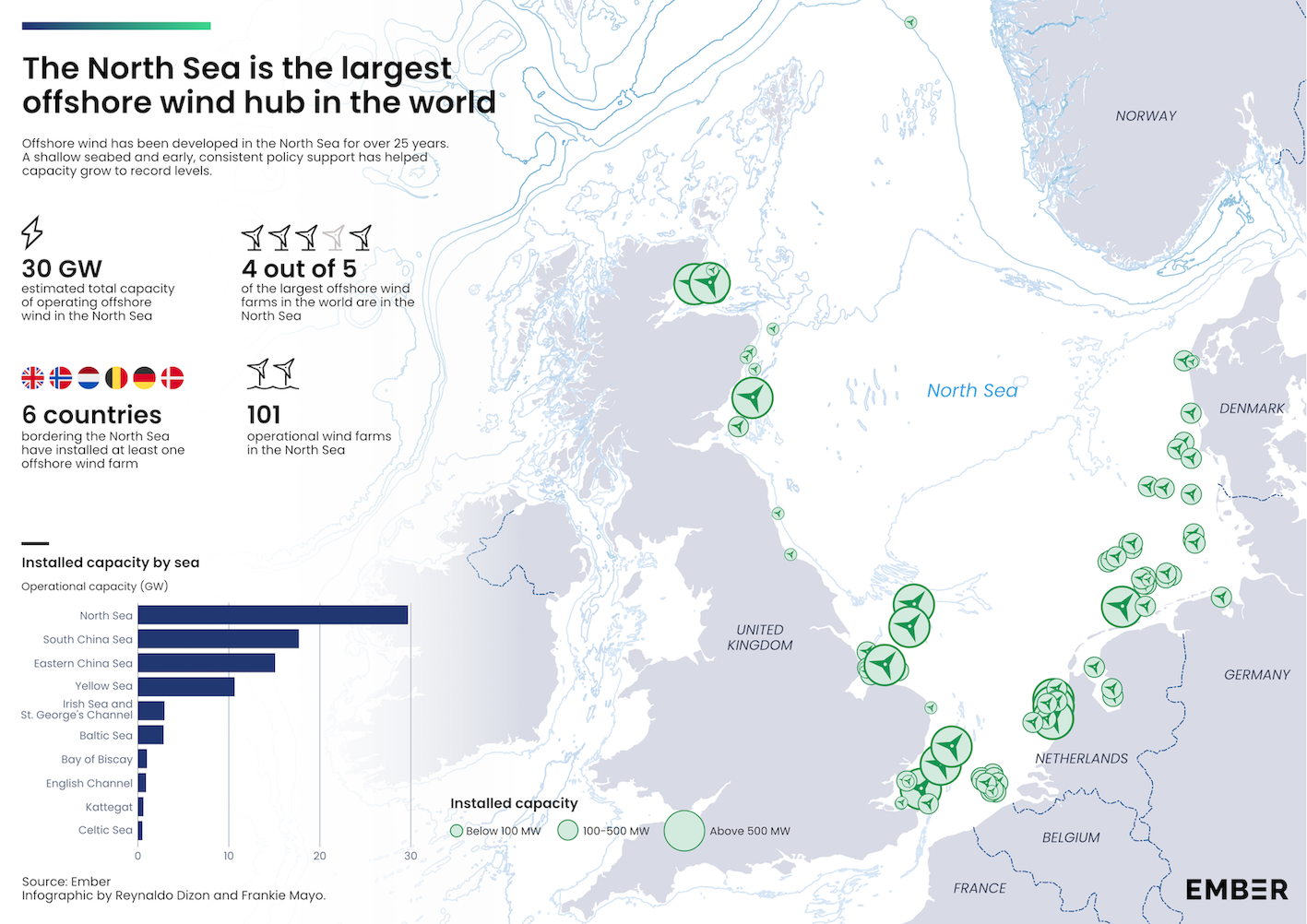
On the 26th of January 2026 a joint UK and European commitment was announced at the North Sea Summit in Hamburg, to build 100 GW of joint offshore wind projects through international collaboration. The North Sea is ideally placed to deliver the secure, competitive energy that Europe desperately needs. Before the summit, Ember analysis highlighted its value as the largest offshore wind hub in the world, with 101 wind farms currently running and many more in development. Explore wind generation data from European countries using Ember’s interactive data explorer here.
Acknowledgements
Eli Terry, Claire Kaelin, Burcu Unal, Chelsea Bruce-Lockhart, Jivan Zhen Thiru, Leo Heberer