Reframing Energy for the Age of Electricity
We need to count energy from the perspective of the consumer in order to understand the changes sweeping the energy sector. There are four battles in the energy system and electrotech is set to win three of them.

Principal
Ember

Director
Ember

Manager
Ember

Energy Analyst
Ember

Chairman and CEO
Liebreich Associates
Summary
Most analysts count energy from the perspective of the supplier, and that approach means we cannot appreciate the dramatic changes sweeping the energy system. We set out a different way to think about the energy system from the perspective of the consumer, and in simple terms. It turns out that there are four key battles for the future of energy; electrotech is clearly winning two of them, and is set to win the third.
This article comes with a companion tool to go into more detail on the data for both 2023 and previous years.
Energy from the consumer perspective
The orthodox way to look at energy
Standard energy models track supply rather than demand. They begin with the annual ‘primary’ energy supply (100 million barrels a day of oil, 6,000 million tonnes of coal equivalent and so on), and work backwards to calculate the ‘final’ energy (91 EJ of oil, 5 EJ of biofuels and so on) sold to energy consumers. Fossil fuels are 80% of primary energy supply, and the easy narrative is that fossil fuels are dominant in the energy system and will remain so in the future as we consume more and more energy.
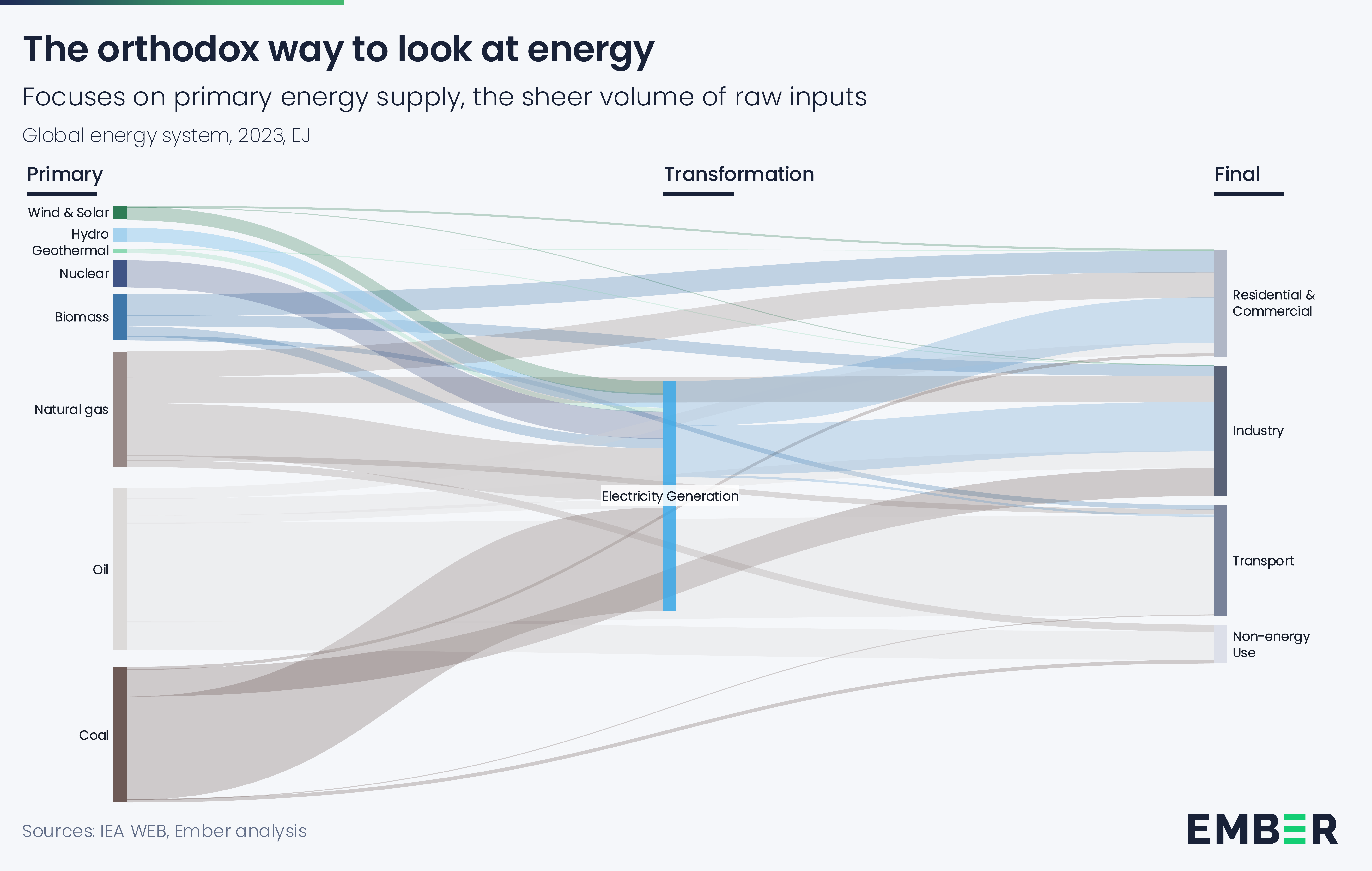
However, there are a number of flaws in the orthodox approach. The focus on energy supply is peculiar if we are trying to understand the future of the energy system. We do not seek to understand bread demand by measuring wheat supply, nor do we count phone adoption by chip production.
The orthodox approach makes no allowance for quality, assigning equal value to one exajoule of primary coal and one exajoule of solar electricity, despite the fact that the solar produces three times as much final electricity as the coal. This ‘primary energy fallacy’ is the subject of a forthcoming paper by Jan Rosenow, Nick Eyre and others. Electricity is a high-quality energy carrier capable of delivering precise work, whereas fossil fuels primarily deliver heat before they can perform useful tasks. For decades this efficiency gap was not very important because most of the growth in energy came from inefficient sources. But the collapse in the cost and the rapid growth of electrotech over the last decade has altered the situation materially. In 2025 for example, solar and wind supplied almost all the growth in electricity generation, and in 2024 electricity was half the growth in final energy demand.
The orthodox approach is extremely complex. Complexity is great when you want to understand how to deal with a refinery outage, but not helpful when you are trying to understand change over decades. High levels of complexity entrench status-quo bias because it is so hard to see the wood for the trees and so easy to confuse with complexity.
Finally, the orthodox approach only looks at the total supply rather than the change in supply, at stocks not flows. Again this is very unusual because stocks look backwards to the past and flows look forward to the future. In most other areas of analysis, analysts (or at least successful analysts) focus on flows in order to understand how the system is changing.
There are six improvements we make below to help us better understand the energy system. We add in useful energy and start the analysis from the consumer perspective; we have three steps to simplify the energy system into the two core horizontals of work and heat; and we focus on change in demand.
Improvement 1: Include useful energy demand
Energy is not an end in itself; what people want is hot showers and cold beer, as Amory Lovins noted. Using data from the International Institute for Applied System Analysis (IIASA), it is possible to calculate the useful energy that provides those energy services, the energy that actually propels a vehicle, heats water, or powers a robotic arm. IIASA identify seven types of useful energy – low temperature heat, high temperature heat, light, stationary power (to run motors or electronics), transport, other energy uses, and non-energy uses. The advantage of this approach is that we are able to identify the very material losses from the conversion of final energy into useful energy, which are especially large in the transport sector for example.
When measured this way, useful energy was only 209 EJ in 2023, about one third of the energy that is counted at the primary level. Meanwhile non-energy use of 42 EJ (mainly for petrochemical feedstock) can be split out from the energy system in the same way as we exclude wood for furniture from the energy system.

This perspective makes apparent the remarkable inefficiency of today’s energy system: in 2023 roughly 380 exajoules, nearly two-thirds of all primary energy inputs, are wasted, and do not convert into useful energy. This has been well framed as the primary energy fallacy, and we examined it in detail at RMI. When petrol powers a car, roughly three-quarters of the energy is wasted as heat rather than motion. A coal-fired power station converts less than 30% of its fuel into final electricity, wasting the rest as heat. These losses stem from fundamental physics. Combustion releases heat in all directions; capturing it for useful work requires additional conversion steps, each governed by thermodynamic limits.
Electrotech sidesteps this problem. An electric motor converts electricity to motion at over 90% efficiency. A heat pump supplies thermal energy at 300-400% efficiency relative to electrical energy input. LED lights powered by solar electricity lose a fraction of what gas-fired incandescent bulbs waste. Meeting future energy demand therefore requires far less new supply than conventional metrics suggest, provided that supply comes from efficient electric technologies. What appears to be a daunting energy challenge becomes considerably more manageable once the efficiency advantage of renewables and electricity comes into focus.
Improvement 2: Start with the consumer
The second improvement is straightforward: we reverse the analytical direction of thinking about energy. Instead of starting with fuels and tracking them downstream, we begin with useful demand and work upstream. This shifts the fundamental question from “how much fuel must we supply?” to “how much useful energy do we need?” Anchoring the system on outcomes exposes how much of today’s upstream energy exists merely to compensate for conversion losses.
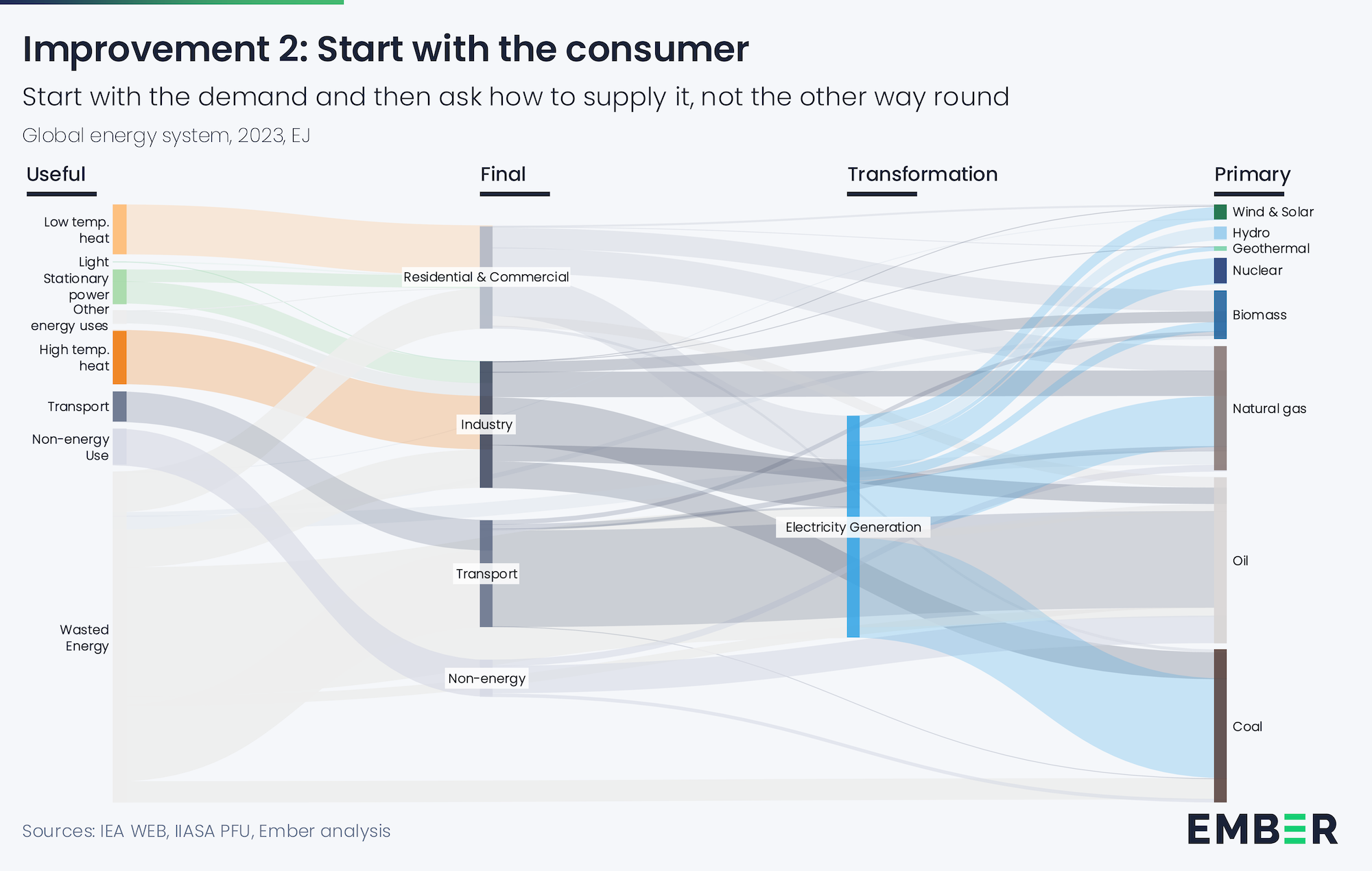
The implications are significant. Today, humanity consumes approximately 75 gigajoules of primary energy per person, but only 26 gigajoules of that is for useful energy—most of the rest is lost in conversion. Organisations such as Shell argue that 100 gigajoules per person of energy is required for high levels of human development. But these projections assume continuity of the inefficiencies of combustion-based systems. With electrotech, 26 gigajoules per person of primary energy can supply the same amount of useful energy, largely because the gains from heat pumps offset losses elsewhere.
The discrepancy reveals the extent to which current metrics conflate genuine human needs with the structural waste of fossil systems. The pathway to universal prosperity requires far less primary energy than conventional projections suggest.
Improvement 3: Simplify useful energy to work and heat
These two improvements make energy accounting more accurate, but also more complex. The next three improvements aim to simplify so that we can see more clearly the structure of the system. We simplify first useful energy, then final, then primary.
At the most fundamental level, all energy performs just one of two functions: it moves things or it changes temperature. Transport is motion. Industrial machinery is motion. Computing, though it may appear different, is electrons moving through circuits. Space heating, water heating, and industrial process heat are all raising temperature. Even cooling is simply moving heat from one place to another. Every energy service, however sophisticated, reduces to work or heat. This insight, formalised in a landmark 2021 paper by Professor Nick Eyre, allows useful energy to be split cleanly into two categories: work and heat.
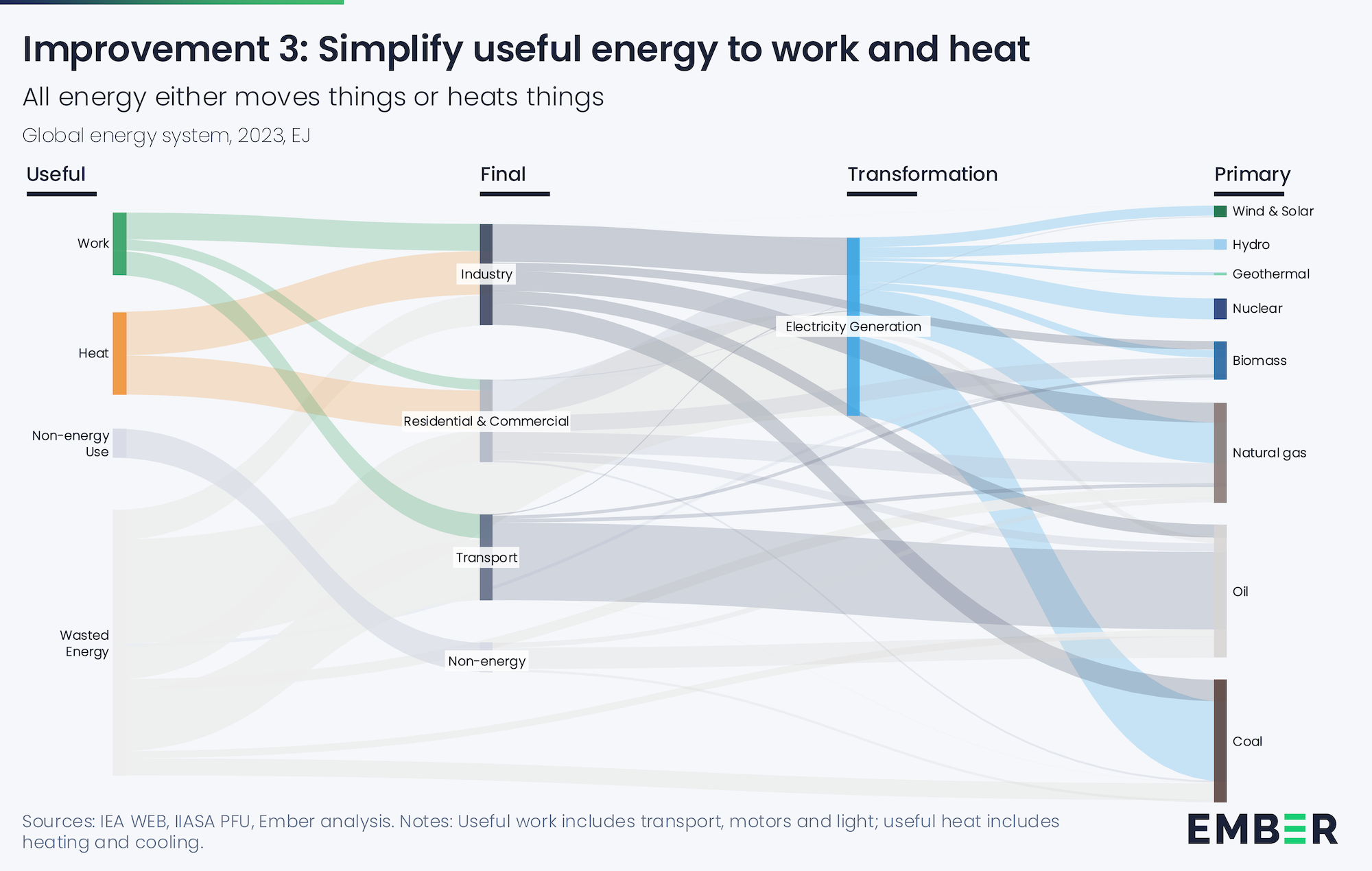
In 2023 useful energy demand was 90 EJ of work (stationary power to run motors or electronics, and mobile power, otherwise known as transport) and 119 EJ of heat (which splits into low and high temperature heat). So the split is 43% useful work and 57% useful heat.
This framework strips away unnecessary complexity whilst preserving the essential physics. The distinction matters because the efficiency of conversion into work and heat is very different.
Improvement 4: Simplify final energy to electrons and molecules
The same simplification applies to final energy, which can be understood as two distinct types: electrons and molecules. This distinction is rooted in physics. Electrons, delivered as electricity, are already organised energy: charges flowing through conductors, capable of powering motors and devices directly. Molecules such as gas, oil, coal, and biomass, store energy in chemical bonds. To release that energy requires combustion, which liberates heat. Molecules can warm buildings efficiently, but converting them into work runs up against thermodynamic limits: most of the energy escapes as waste.
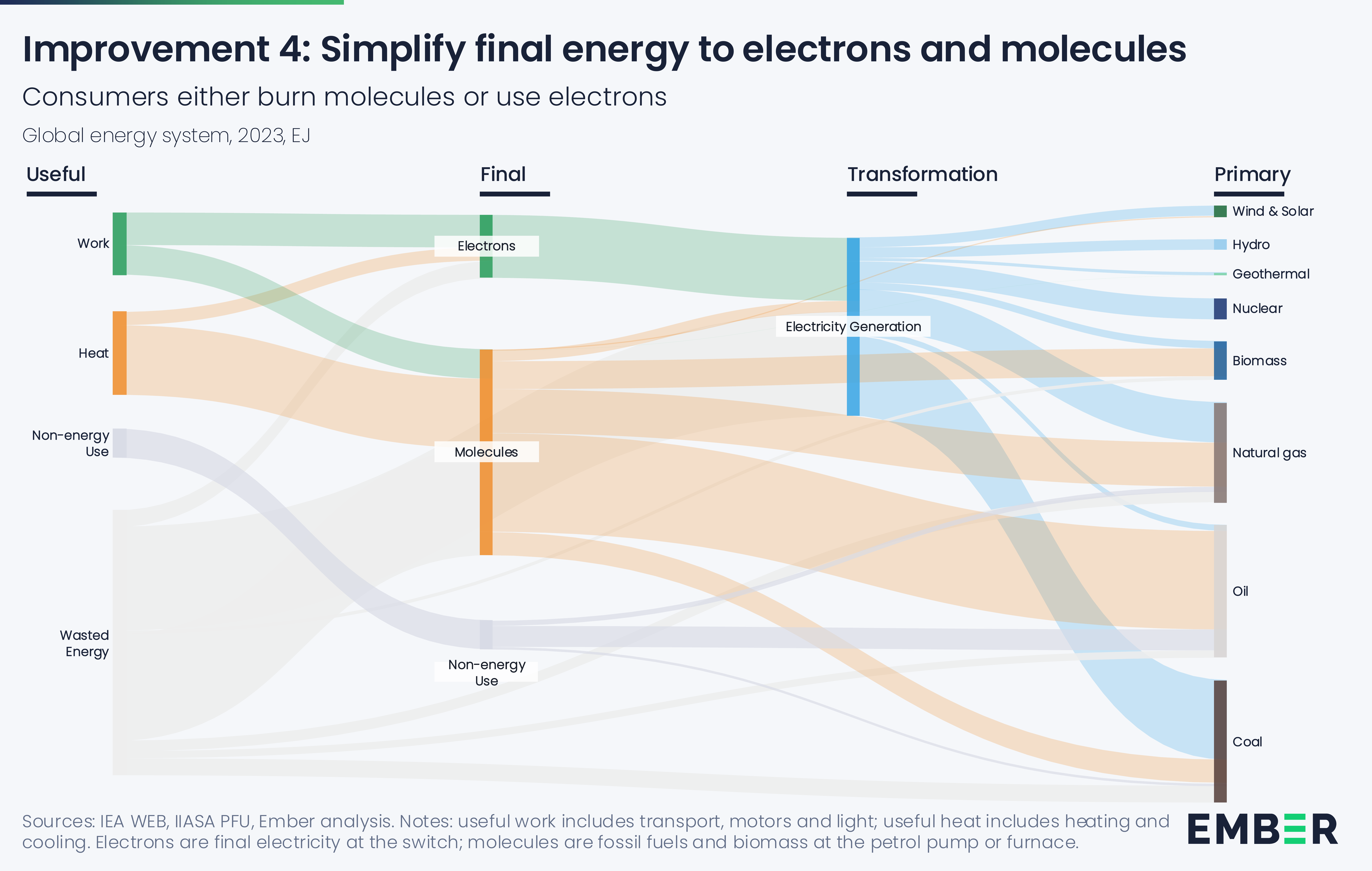
Restated in these terms, the global energy system in 2023 required 91 EJ of electrons and 296 EJ of molecules. So around one quarter electrons and three quarters molecules. Electrons deliver work with minimal loss. Molecules must surrender most of their energy to entropy before performing the same task. This is not a matter of technology maturity or cost, though both increasingly favour electricity. The advantage is rooted in thermodynamics: systems built around electrons will always outperform systems built around molecules when delivering work, and increasingly outperform them for heat as well.
Improvement 5: Simplify primary energy to thermal and electro sources
The work-versus-heat distinction applies also to primary energy sources. Fossil fuels and biomass are thermal sources: chemical energy locked in molecular bonds, released through combustion. Nuclear energy, though it may seem different, is also thermal. It generates heat through fission, then converts that heat into electricity, wasting roughly 70% of the primary energy in the process.
In contrast, sources such as wind, solar and hydro directly produce electricity without combustion, and so we can call them electro sources.
We can also fold the transformation stage into this framing because almost all electricity ends up in electrons. The 2 EJ of electro supply that ends up as molecules (green hydrogen or green ammonia or solar thermal) is deemed to pass directly to molecules.
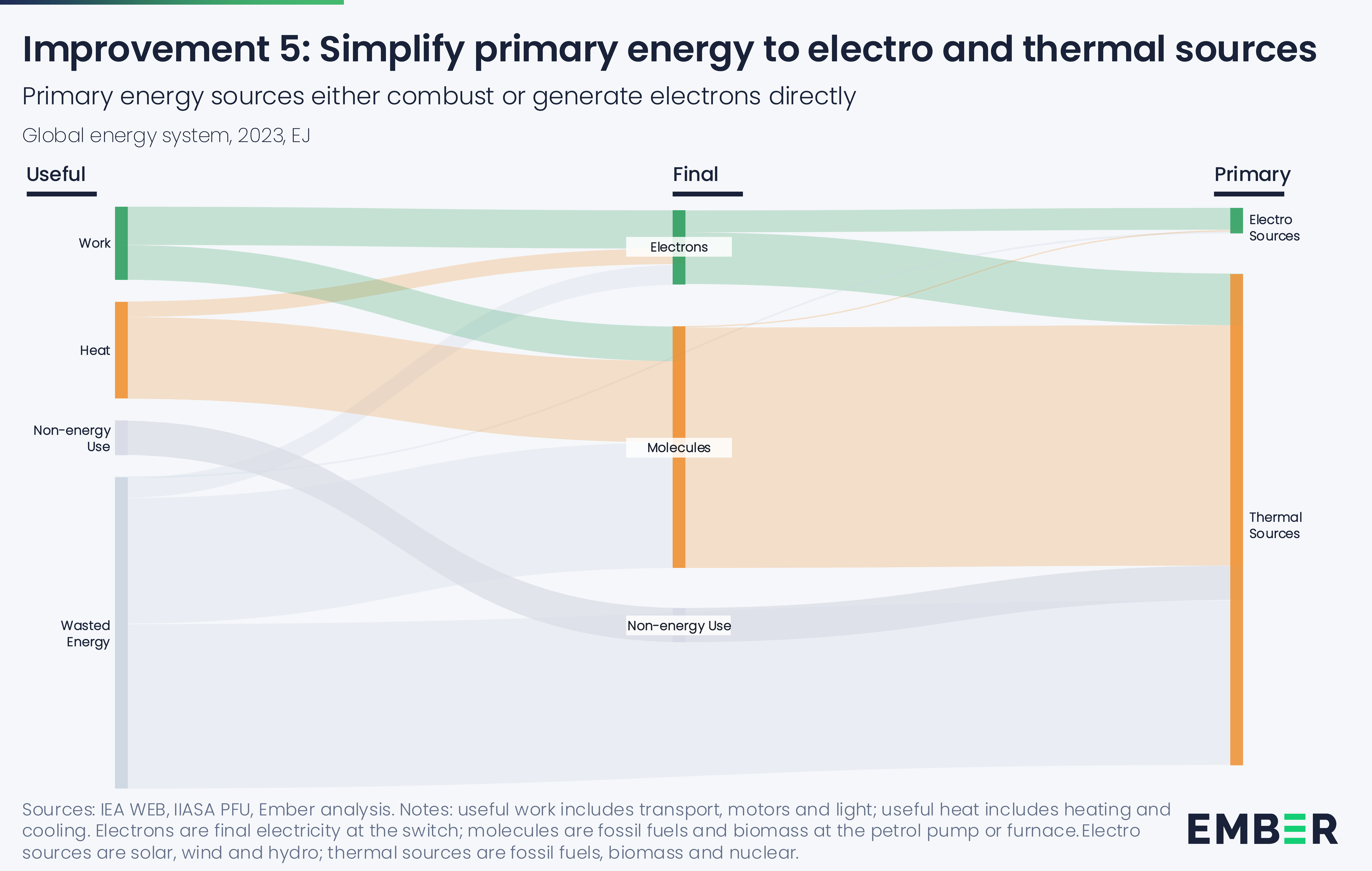
In 2023, primary energy supply consisted of 31 EJ from electro sources and 560 EJ from thermal sources. So at this level electro sources are only 5% of primary energy supply.
Improvement 6: Focus on change
Most energy analysis focuses on total energy demand for oil or gas, which is a stock, rather than the change in demand, which is a flow. But financial markets are driven by flows not stocks, and in most markets analysts will focus on flows to see where the system is headed. For example, we seek to understand the car market not by examining the number of cars on the road (a stock) but the number of cars that are being sold (a flow).
If you focus on the change in energy demand then a very different picture emerges. For example, solar, wind and hydro (the electro sources) were 30% of electricity generation in 2023, but in the first 9 months of 2025 they were 96% of the change in electricity generation. Electrons provided just over half of useful work in 2023, but 80% of the change in useful work in the period 2019 to 2023.
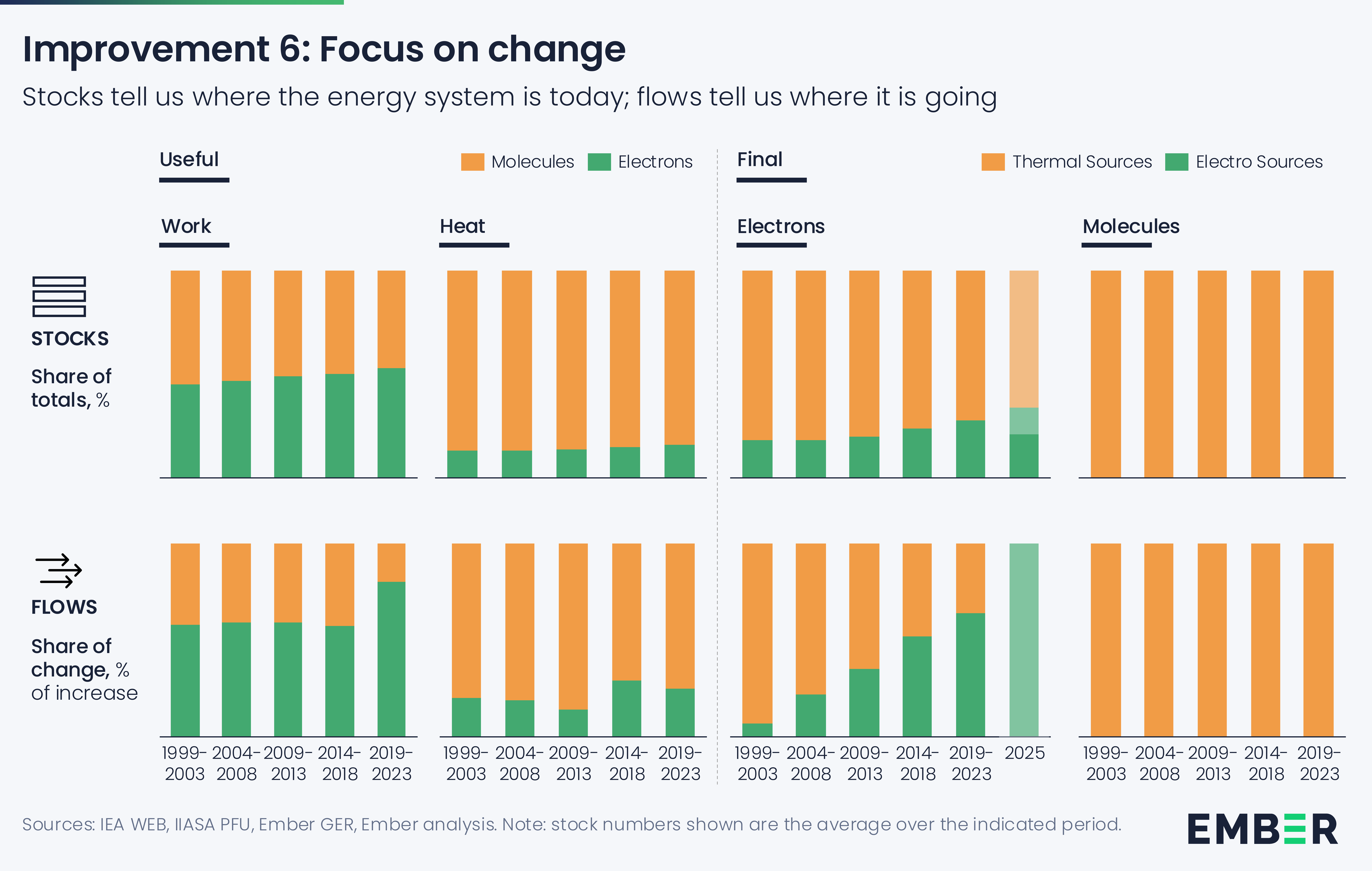
The chart reveals the gap between stocks and flows. The top row shows the share of total energy across four categories: useful work, useful heat, final electrons, and final molecules. The bottom row shows the share of the change—the proportion of new growth each technology captures in five-year increments from 1999 to 2023, with a 2025 projection for electrons.
Looking at the totals suggests slow evolution. Looking at change reveals the rapid transformation underneath. Incumbent technologies dominate the stock, but electrotech increasingly dominates the flow.
The four battles of the energy transition
With this new framework of looking at energy, we are able to get deeper insights into the energy system. The energy transition is not one battle, but four.
Between the primary and final stage, electro sources like solar and wind compete with thermal sources to supply electrons and molecules. Between the final and useful stage, electrons and molecules compete to deliver useful work and heat.

We will elaborate more in a subsequent report, but we summarise the four battles below. Efficiency is of course not the only determinant of success, but it is an important way to distinguish between the competing energy solutions.
Battle 1: Electron Supply – Electro sources v Thermal sources
The first battle is to supply final electrons. Electro energy sources—solar, wind, and hydro—compete with thermal sources to generate electricity. The physics advantage of electro sources is stark; once you factor in distribution losses, they convert primary energy into final electrons at 92% efficiency. Thermal sources must convert heat to electricity in a process governed by the Carnot limit, and on average their conversion of primary energy into final electrons only has 29% efficiency.
This battle is a classic example of the difference between looking at stocks and flows. Electro sources were 30% of electricity generation in 2023, but over time their share of the growth in supply has been rising fast; in the first 9 months of 2025 they were 96% of the change in electricity generation.
Battle 2: Useful Work – Electrons v Molecules
The second battle determines how we deliver motion: transport, machinery, and industrial processes. Here the battle is between electrons and molecules directly. On average today, electricity converts final electrons to useful work at 68% efficiency. Molecules only do so at 29% efficiency.
Electrons already dominate stationary work (washing machines, computers and so on) and light; after the rapid fall in battery prices, the new battle is to provide mobile work (i.e., transport).
In 2023, electrons were already 53% of useful work, but the rapid growth in electric vehicles means that electricity is supplying an increasing share of the growth in useful work demand. In 2019-23 electricity was 80% of the change in useful work. If oil demand starts to fall in transportation (which could be as early as this year according to the IEA), then electricity will supply all of the growth in useful work demand.
Battle 3: Useful Heat – Electrons v Molecules
The third battle is for useful heat—warming buildings, heating water, and industrial processes. Molecules supply useful heat at 64% efficiency for conversion from final energy to useful heat energy. Electrons supply useful heat at 91% efficiency on average, and heat pumps can achieve 300-400% efficiency for low temperature heat.
Electrons supplied 16% of useful heat in 2023, and were 25% of the growth in useful heat supply in 2019-2023. If heat pumps grow more rapidly in the very low growth market of heat, we would expect to see the share of the growth increase.
Battle 4: Molecule Supply – Electro sources v Thermal sources
The fourth battle is different—it is an uphill battle for electro sources. Thermal sources convert to molecules at 85% efficiency. Electro sources attempting the same task, such as green hydrogen or green ammonia, and so on, struggle to reach 70% efficiency. Turning electricity into molecules is thermodynamically expensive. Thermal sources have a market share of over 99% and are still almost all the growth in supply.
However, as useful work and useful heat increasingly shift to electrons, the overall need for molecules will shrink as we electrify our end demand. That means this battle will become less central to the energy system over time. Winning battle 1, 2, and 3 makes winning battle 4 less important.
In simple physics terms, the four battles can be expressed in the diagram below which shows the efficiency of conversion at each stage. For example, electro supply converts into electrons at an efficiency at 92%, whilst thermal supply converts into electrons at an efficiency of only 29%.
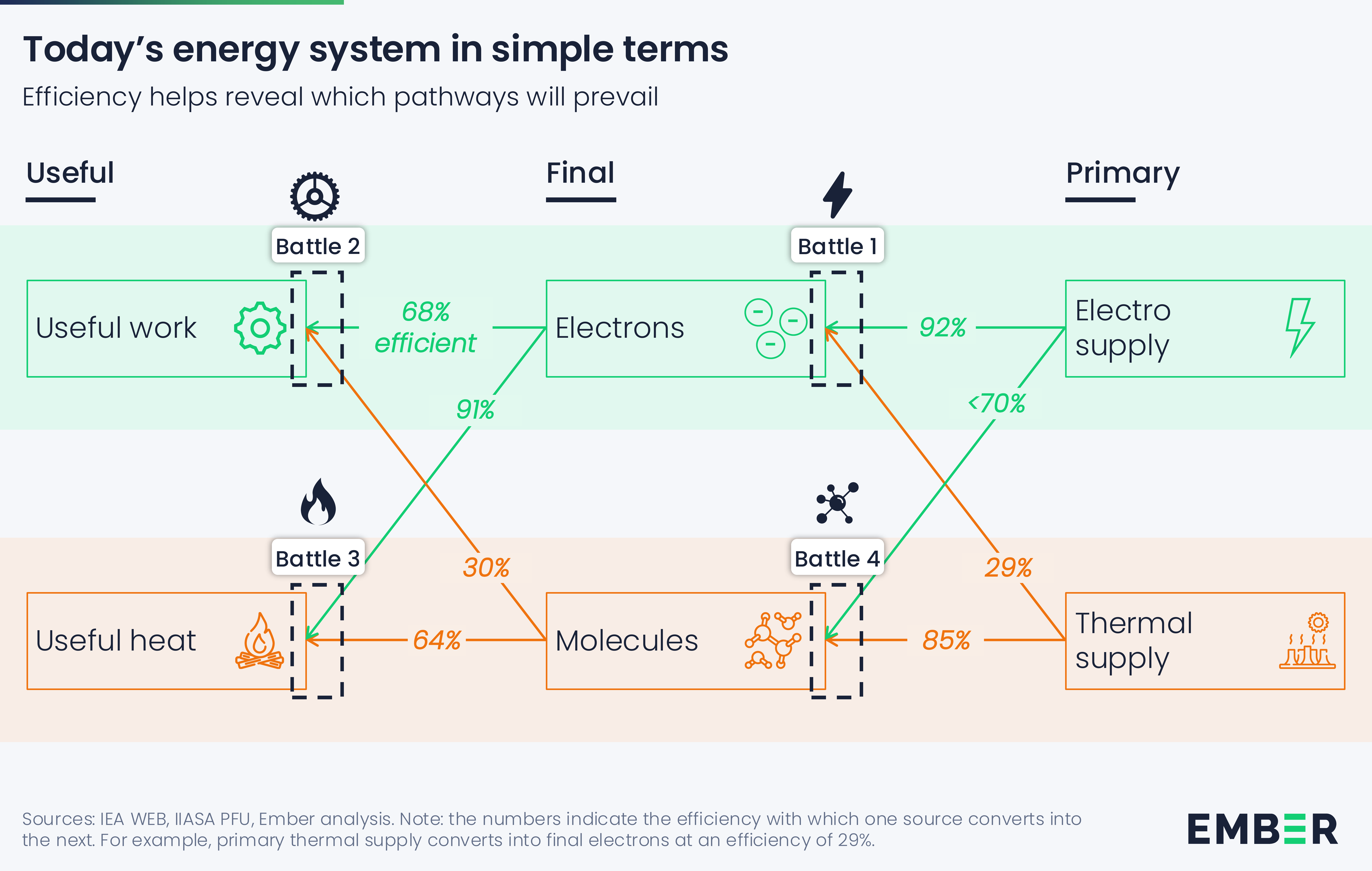
What is perhaps most notable about this chart is the loss of over two thirds of energy whenever heat crosses the divide to work.
Conclusion
“The limits of my language mean the limits of my world,” Wittgenstein wrote. The orthodox approach to energy accounting constrains how we understand the energy transition. It obscures both the scale of current waste, and the efficiency gains available. The framework outlined here provides a clearer language for energy systems. With that new language, we can express new insights about the energy transition’s speed, scale, and implications. This is what we will turn to in our next article.
Supporting materials
Methodology
The data source for primary and final energy is the World Energy Balances by the International Energy Agency. This data is available in detail for 2023.
IIASA provides a methodology to convert final energy into useful energy. There are other ways to do this, most notably from Brockway, Heun et al or DNV, but a key feature common to them all is to account for the huge losses from the conversion of heat sources into work uses.
We took the IIASA methodology for converting final energy to useful energy, and extrapolated it to 2023 based on the links between GDP growth and efficiency. Because final to useful efficiency ratios change only very slowly, the 2023 conversion ratios are very similar to those published by IIASA.
When we simplified the data, we used the approach set out by Nick Eyre to split all energy into heat and work. For useful heat we took the two sectors identified by IIASA as low temperature and high temperature heat. For electrons we took final electricity demand from the IEA. For primary energy, we took the data for the primary supply of solar, wind and hydro from the IEA. To simplify the framing, we included the small sectors of agriculture and ‘other’ inside industry, and heat transformation inside electricity transformation.
Acknowledgements
With thanks to: Amory Lovins, Dave Jones, Hannah Broadbent, Chelsea Bruce-Lockhart, Hannah Ritchie, Jan Rosenow, Martin O’Brien, Matthew Heun, Mike Hemsley, Nick Eyre, Onur Ozgun, Paul Brockway and Vincent Petit.
Cover image credit: VeugerStock
Related Content