

Monthly EV Sales Data
Ember’s monthly data on new electric car sales in 56 countries, the world and the EU, with estimates of each country’s current EV fleet, its electricity demand, oil displacement and avoided fuel costs.
Updated monthly

Anchor point: Summary
Summary
This dataset contains monthly new car registrations by drivetrain for 56 countries, the European Union and the world. It covers battery electric (BEV) and plug-in hybrid (PHEV) cars alongside petrol, diesel, hybrid, flex-fuel and other cars, so EV sales can be read as a share of the whole market.
The data are compiled from national vehicle registration authorities, statistics offices and industry associations, such as Germany’s Federal Motor Transport Authority (KBA), the China Passenger Car Association (CPCA) and the UK’s Society of Motor Manufacturers and Traders (SMMT). The countries covered made up over 80% of global car sales in 2025 and over 90% of global EV sales.
The data are updated monthly as publishers release new figures, typically two to six weeks after the end of the month. The latest month therefore differs between countries. Already published figures can be subject to revisions.
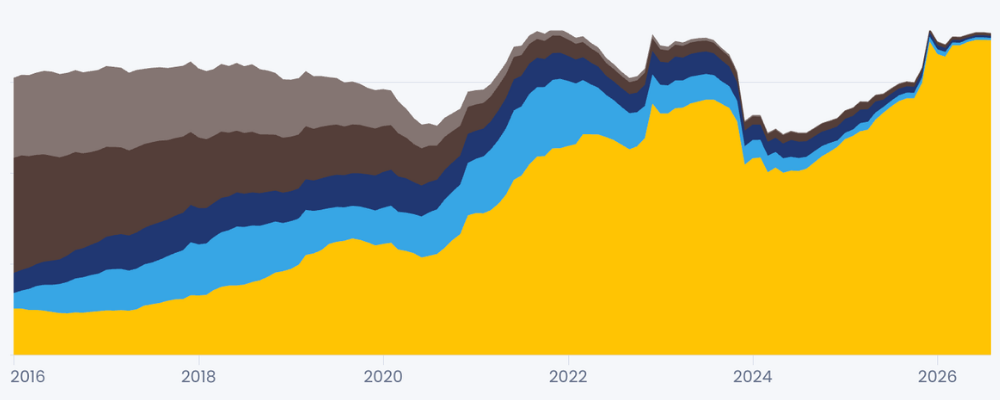
Explore the data and compare countries in our EV Sales Data Tracker.
Data structure
Two CSV files are available. Both use the same area names, ISO 3 codes and groupings, so they can be joined on Area or ISO 3 code.
Monthly EV sales data (CSV)
One row per area, month and drivetrain. Each row covers a country or region (Area, ISO 3 code, and Area type: “Country or economy” or “Region”), a month (Date, the first day of the month) and a Drivetrain. The column Is aggregate drivetrain flags the two aggregates: “Electric vehicle (BEV+PHEV)” and “All drivetrains”.
Drivetrains follow one common set. Battery electric, Plug-in hybrid, Hybrid, Petrol, Diesel, Ethanol/petrol blend (flex-fuel and high-ethanol cars in Brazil and India), Combustion (unspecified) and Other (hydrogen fuel cell, LPG, CNG and unclassified cars). Each publisher’s categories are mapped to this set. Where a publisher does not separate a drivetrain, its cars stay where the publisher reports them: Colombia and Malaysia, for example, include plug-in hybrids in Hybrid. For World, only Battery electric, Plug-in hybrid and Combustion (unspecified) are published.
Metrics are columns, not rows. Registrations; Registrations YoY change and Registrations YoY change (%), against the same month a year earlier; Share of registrations (%), always relative to “All drivetrains”; Year-to-date registrations and Year-to-date share of registrations (%), resetting each January; and Rolling 12-month registrations and Rolling 12-month share of registrations (%), which remove seasonal swings and are blank until 12 months of data are available.
Absent drivetrains are set to zero. A drivetrain that a country reports in some months but not in others is zero in the months it is absent.
Groupings are included as columns. Continent, Ember region, and EU, OECD, G20, G7 and ASEAN membership.
EV fleet and oil displacement data (CSV)
One row per area, for its latest available month. The column Latest available date gives the first day of the latest month with registrations data, which differs between countries.
Metrics are columns. EV fleet (vehicles), Ember’s estimate of the battery electric and plug-in hybrid fleet; EV fleet electricity demand (GWh per year); Oil displaced (thousand barrels of oil equivalent per year), measured in barrels of crude oil equivalent; Value of oil displaced (USD million per year); and Brent price 6-month average (USD/bbl), the price used for the value.
Data coverage
56 countries, the European Union and the world. Series start between 2005 and 2024 depending on the country. The EU series, the sum of all 27 member states, starts in January 2023. The countries covered are Albania, Australia, Austria, Belgium, Brazil, Bulgaria, Chile, China, Colombia, Croatia, Cyprus, Czechia, Denmark, Ecuador, Estonia, Finland, France, Germany, Greece, Hungary, Iceland, India, Indonesia, Ireland, Israel, Italy, Japan, Latvia, Lithuania, Luxembourg, Malaysia, Malta, Mexico, Nepal, Netherlands, New Zealand, Norway, Peru, Poland, Portugal, Romania, Singapore, Slovakia, Slovenia, South Korea, Spain, Sweden, Switzerland, Taiwan (China), Thailand, Türkiye, Ukraine, United Kingdom, United States, Uruguay and Viet Nam.
Anchor point: Methodology
Methodology
The data count new passenger cars registered for the first time in the month. The tracker and the dataset refer to these as sales. Where a publisher only reports a different measure (all car sales, wholesales or customs imports) or a different set of vehicles (light commercial vehicles, pickups, imported used cars), the data are used as published and the country notes (section 9) say so. Figures are collected to a common scope where possible.
The current EV fleet is an Ember estimate. It starts from the latest published year-end fleet, from Eurostat or the IEA, adds the cars registered since and subtracts the cars estimated to have left the fleet. Battery electric and plug-in hybrid fleets are estimated separately for each country and region.
Oil displaced assumes each electric car replaces an average new non-plug-in car driven the same distance. Energy intensity of a non-electric new car in each country is estimated from the Global Fuel Economy Initiative database.
Read our more detailed methodology here:
Anchor point: Explore this data
Anchor point: Contact


Related Content

Datasets
China Electricity Data
Monthly and yearly national and province level electricity data for generation and emissions in China.
Last Updated: 13/10/2026
Datasets
Coal Mine Methane National Dataset
The latest data in coal mine methane emissions, satellite monitoring potential and confidence scoring in reported emissions.
Last Updated: 13/10/2026

Datasets
China Cleantech Export Data
The latest clean technology export data from China, including solar PV, batteries and electric vehicles, by destination
Last Updated: 13/10/2026
Datasets
Europe Electricity Interconnection Data
Data on electricity use (flows) and potential (capacity) of the cross-border transmission grid across Europe and neighbouring countries.
Last Updated: 13/10/2026