
Chapter 3
Africa’s solar panel manufacturing rises – but for export, not domestic demand
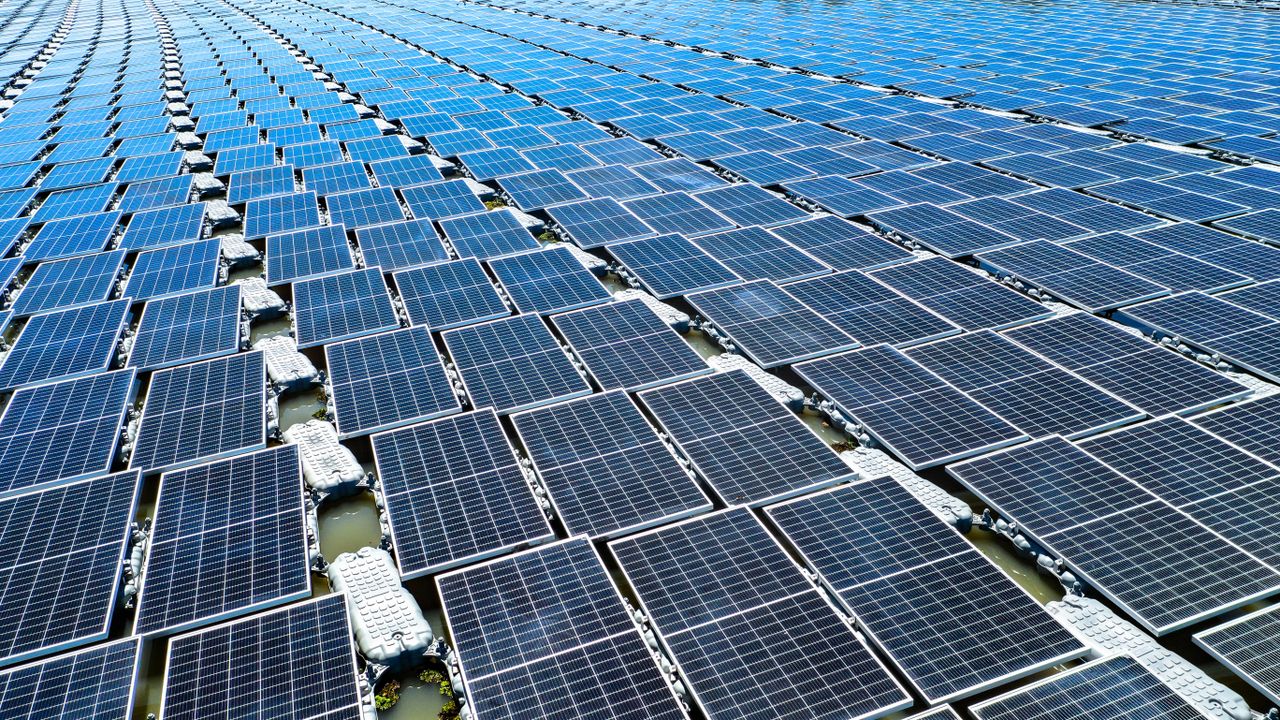
New large solar panel manufacturing plants have come online in Egypt and Tanzania, and other gigawatt-scale plants are planned. This should bring value-add for many countries, even though it has a strong reliance on Chinese inputs. The immense reported exports of Chinese cells and wafers to Africa far exceed the scale of Africa’s solar panel manufacturing needs, and suggest large-scale reshipping.
3.1 Africa’s solar panel manufacturing will likely quadruple in 2026
Africa’s solar panel manufacturing will quadruple this year as new large plants come online in Egypt and Tanzania to around 3,500 MW (Egypt 2,000 MW, Tanzania around 500 MW, six others around 1,000 MW), compared to around 800 MW in 2025.
This is equal to 20% of the 17 GW of solar panels installed during 2026. However, in both markets, the solar panels are predominantly for export to the US, where prices are much higher than for Chinese panels due to US tariffs on Chinese goods. The panels installed in Africa are predominantly Chinese-imported panels.
Ember estimates 2026 manufacturing output will be 2,000 MW in Egypt and around 500 MW in Tanzania – both up from near-zero in 2025. In addition, smaller plants in other countries are estimated to add a further 1,000 MW in 2026, more than doubling from 460 MW in 2024.
However, the data to assess this is extremely limited. There seems to be little documentation of the status of solar plants – either by governments or publicly elsewhere.
A large Ethiopian solar plant came online in 2025, manufacturing wafers into cells for sale to the US, where they are turned into solar panels. We exclude it here, since we are looking at only solar panel manufacturing.
Egypt and Tanzania built for US export
Ember’s 2026 production estimate of 2,000 MW is based on EliTe’s output ramping quickly up to full capacity, and no output yet from the Sunrev plant. Customs data shows this 2026 ramp may be slower: Egyptian customs data shows US solar panel exports ramped up to 48 MW by April 2026, and the US reports zero imports as yet from Egypt. However, Chinese cell and wafer reported exports were much larger, at 2.4 GW of cells and wafers in the first half of 2026 alone, suggesting a large step-up in production is coming.
In Egypt, the rise in solar manufacturing is only just beginning. There are three large solar panel manufacturing plants – one began production at the start of this year, another started shortly after, and another is due to begin in early 2027.
- EliTe Solar began production at Ain Sokhna around the turn of the year, inaugurated by Egypt’s prime minister on 11 January 2026. Its $115mn USD complex pairs 2 GW of cells with 3 GW of modules and employs about 800 people, roughly 700 of them Egyptian.
- Sunrev Solar laid its cornerstone in June 2025 targeting production in the first half of 2026, though no start was confirmed by July, so we assume no output from it this year. Its $200mn USD plan adds 2 GW each of cells and modules; a second phase making wafers would be Africa’s first.
- ATUM Solar – JA Solar with Global South Utilities, Infinity Capital and Egypt’s AH – broke ground in December 2025 for early 2027. Its $210mn USD project adds 2 GW each of cells and modules, and carries the only commitment by an African plant to buy local glass and aluminium.
In Tanzania, there is just one plant: Tanzol’s building at Kwala, in Kibaha, with a reported $300 million USD first phase and operations said to have been relocated from Vietnam and China. A special economic zone official confirmed in May 2026 that it is running, but no start date or capacity has been published. Reports imply it could be as big as 2 GW per year, but there is no confirmation of this.
Ember’s 500 MW Tanzanian estimate is very much a guess. US customs isn’t reporting any imports yet in its data to April 2026 (and Tanzania customs doesn’t report data either way). However, Chinese customs data does report large exports of cells – 945 MW in the first half of 2026 – and also 1,481 MW of wafers (although no known Tanzanian plant could use wafers). Some is feedstock; some may simply be passing through.
Other African countries supporting domestic growth
Meanwhile, six further countries have a smaller amount of solar panel manufacturing, which has been rising as more plants come online or have been expanded. We estimate 2026 output in Nigeria and South Africa will triple compared to 2024, Morocco and Algeria will double, and also Tunisia and Kenya will rise.
Nigeria’s output has risen because a second large line – LPV Technologies’ 200 MW plant in Lagos – started up in January 2025, joining incumbents Auxano, NASENI and Blue Camel. Its rural electrification agency puts national capacity at 300 MW, up from 120 MW two years earlier, though no Nigerian manufacturer publishes output.
Nigeria’s pipeline is large but stalled. Tranos broke ground on an 800 MW plant in June 2025 but has not commissioned its first line; the 1 GW Solarge–InfraCorp hub has neither construction nor a site; Oando’s 1.2 GW is a pre-investment decision.
In Morocco, two 1.2 GW plants have been proposed, but both are at early stages of development.
New US tariffs may hurt exports – but may ultimately support domestic installations
Trump announced new tariffs on solar cells and panels, which will make all imports of cells and panels much more expensive from 1 December 2026. It will reduce the ability for Egypt, Tanzania and Ethiopia to sell panels and cells into the US.
The premium is also closing from the other side: China removed its 9% export VAT rebate on 1 April 2026, lifting Chinese panel prices 4-8% and improving the economics of an African-made panel sold in Africa.
This could mean solar panels end up being used domestically. This would replace Chinese imports and ultimately mean Africa becomes more directly self-sufficient.
3.2 Africa’s solar manufacturing has a large Chinese reliance, though there is some local value-add
Both the Egyptian and Tanzanian plants are value-adding to the national economies, despite a strong Chinese reliance. But of the two large plants that have come online in 2026, the value-add is very different.
The Egyptian plant includes cell manufacturing and is using new production lines. The Tanzanian plant is for panel assembly only and seems to use older, relocated production lines, running on Chinese cells.
Egypt is manufacturing cells, and has plans for wafer, glass and frames manufacturing, but overall progress is slow to go beyond importing components. No solar glass is made anywhere in Africa (including even in South Africa); a proposed $700mn USD Suez plant would be first. All EVA, backsheet, ribbon and junction boxes are thought to be imported.
India provides a good example of building industrial strategy for solar and batteries, and is one of the few countries to properly scale supply chains that can compete on price with China.
3.3 Imports of cells and wafers are not a good proxy for African panel manufacturing
China exported ten times as many cells and wafers to Africa as Africa has manufactured solar panels, according to import data from Ember’s China’s Solar PV Export Explorer. 28 GW of solar imports – 19 GW of cells and 9 GW of wafers – compared to just 2.7 GW estimated to have been manufactured in the 2.5 years to June 2026. In fact, 19% of Chinese solar cell exports and 13% of wafer exports in H1-2026 were destined for African countries.
We think that, in a small part, this reflects the step-up in African solar manufacturing that will continue into late 2026 and beyond.
But we think the majority would not actually be imported into the country, but rather re-shipped most likely to the US. Customs in most African countries do not report imports of cells and wafers, so there is no data there that helps to clarify.
Ethiopia imports cells, yet there is no manufacturing capacity to convert and build them into panels. Tanzania and Kenya reportedly received large exports of solar wafers from China, despite having no manufacturing plants to convert them into cells. Nigeria imported 3.1 GW of solar cells in the 12 months to June 2026, which far exceeds its small manufacturing capability.
Therefore, these Chinese exports give few insights into African solar panel manufacturing.
Related Content