

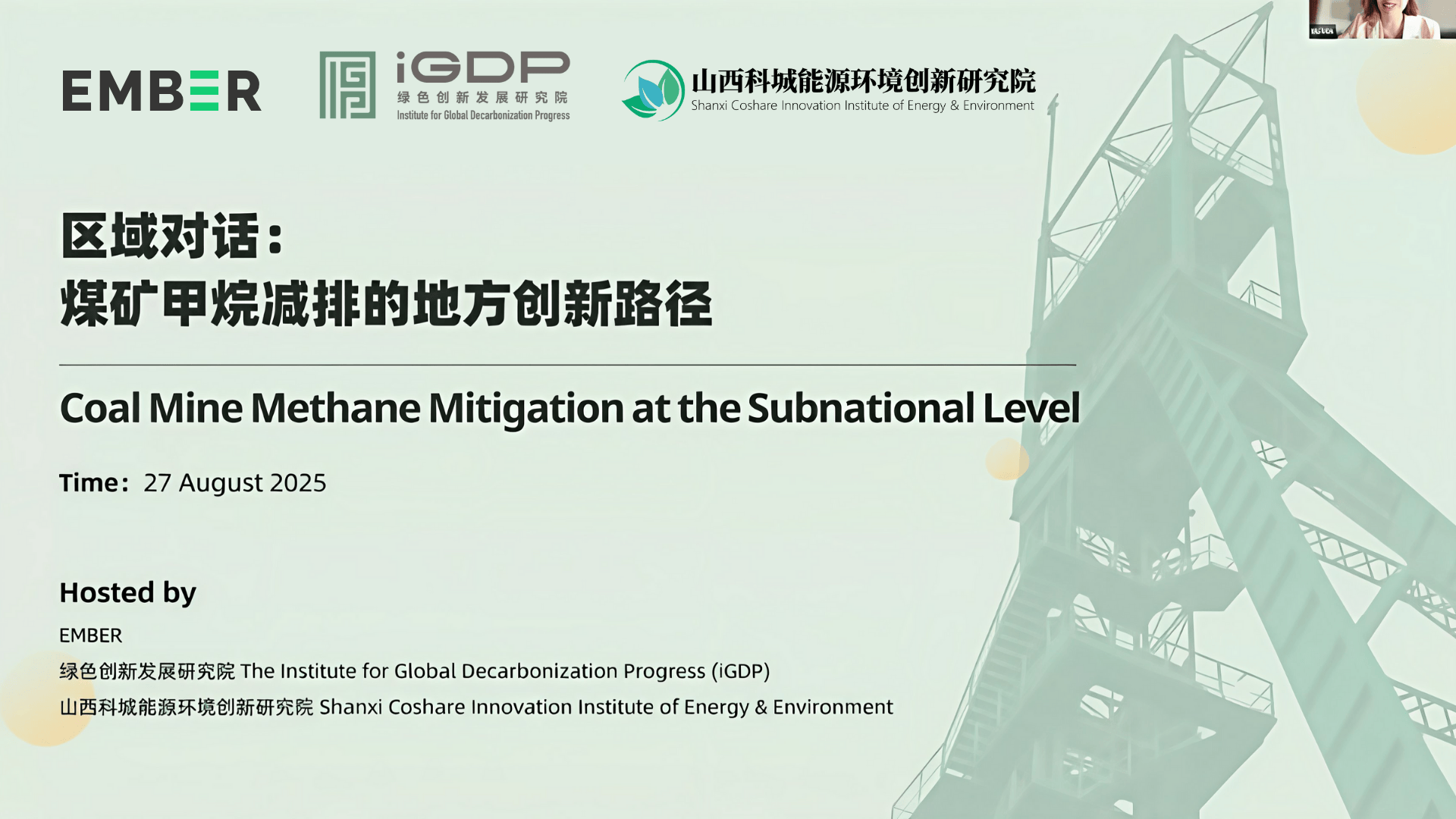
Subnational coal mine methane mitigation
Key insights and recommendations from experts on advancing subnational coal mine methane (CMM) mitigation in China, India, Indonesia and Australia.
Date and Time: August 27, 2025 12:00 am
Online
Methane emissions and control policies in four countries’ coal mines
China
China is the world’s largest coal producer and methane emitter. According to the latest greenhouse gas inventory, China’s methane emissions reached 60.645 million tons in 2021, with 25.03 million tons (41%) originating from coal mining fugitive emissions. Approximately 80% of coal mine methane originates from underground mining, with ventilation methane contributing over 80% of this total. In 2023, China released the Action Plan for Methane Emission Control, promoting key initiatives including regular reporting of coal mine methane emissions, establishing gas emission standards, updating coal mine safety regulations, and inclusion of methane utilisation projects in the China Certified Emission Reduction (CCER) scheme. In 2024, methane extraction and utilisation from coal mines exceeded 6 billion cubic meters, equivalent to reducing approximately 110 million tons of CO₂e. However, reducing emissions from low-concentration methane (below 8%) and ventilation air methane remains technologically and economically challenging due to insufficient incentive for coal companies, lack of targeted policies, and weak MRV systems.
Australia
Australia is the world’s largest coking coal exporter and second-largest thermal coal exporter, with 2024 methane emissions reaching 5.02 million tons, more than 75% of which originated from coal mines. To meet emission reduction targets under the 1.6°C warming scenario, the methane from the energy sector must achieve a 79% reduction by 2030 relative to 2020 levels. Despite Australia’s endorsement of the Global Methane Pledge, emissions have not significantly declined. Reducing coal mine methane has become a short-term climate policy priority. The government’s Safeguard Mechanism Reform mandates oversight for large facilities emitting over 100,000 tons of CO₂e annually, majority of which is methane related. The country aims to establish itself as a world leader on MRV methods. Significant efforts into national MRV through review of federal framework have been made are. However, further efforts are required in technology and introduce into law requirements for direct measurements for Australian companies. New South Wales (NSW) along with Queensland accounts for over 90% of the country’s coal production. NSW has legislated state emission reduction targets, coal mine methane emissions are integral focus of the state’s policy. The state’s Environmental Protection Authority (EPA) is releasing successive steps of emissions policy where coal mining companies are required to produce climate change mitigation plans including emissions estimates. The EPA is actively consulting on the new Licence requirements for active monitoring and RTO installation for formulating mandates to be implemented in the next five years.
India
India ranks as the world’s second-largest coal producer with 1085 million tonnes of production in 2024. Coal accounts for more than 70% of its energy generation—a proportion expected to remain high in the medium term. India’s coal mine methane emissions rank fourth globally. The Central Institute of Mining and Fuel Research (CIMFR) has established national emission factors for quantifying fugitive methane from coal mines through field surveys, providing a data foundation for reduction efforts. Currently, over 96% of India’s coal comes from open-cast mining. While methane concentrations in these mines are low, their massive production volumes result in substantial overall emissions. However, new national requirements mandate gas extraction for certain coal mines. India possesses substantial methane reduction potential in coal mines, yet lacks large-scale gas utilisation projects, with Although, studies were undertaken for CMM pre-feasibility in a few mines in the Damodar Valley coalfields by US EPA, no active CMM projects are functional in the country. Barriers include inadequate investment, weak economic incentives, complex production dynamics, and limited technical capacity.
Indonesia
Indonesia’s coal production increased over tenfold between 2000 and 2024, leading to a significant rise in coal mine methane emissions. Official 2024 data indicates emissions of approximately 168 kilotonnes methane. However, Ember research indicates actual emissions may substantially exceed inventory data due to factors like underreporting of underground mines and inaccurate emission factors. The Indonesian government is advancing improvements to its MRV system and aiming to develop country-specific emission factors. Looking ahead, enhanced permit management, production plan approval, and research and development on CMM mitigation for both underground and open-pit mines could strengthen Indonesia’s methane reduction capacity.
Implementation of methane emissions reduction in coal mines: from national policies to local regulations and corporate practices
China
China released the Methane Emission Control Action Plan in 2023, setting a target of 6 billion cubic meters for coal mine methane utilisation by 2025. To date, eight provincial-level administrative regions have introduced local implementation plans. Shanxi has established a quantitative target of achieving a 50% methane extraction and utilisation rate in coal mines by 2025, while Ningxia and Liaoning align with the national approach by adopting utilisation volume metrics. Some local policies even surpass national standards. For instance, Shanxi mandated extraction and utilisation of methane concentrations exceeding 8% before the national revision of the Coal Mine Methane Emission Standard, while also encouraging utilisation of low-concentration methane below 8%. Recently, the national government released CCER methodologies for low-concentration methane and wind-discharged methane, providing additional economic incentives for enterprises and driving R&D in coal mine methane reduction technologies.
Australia
Australia’s national Safeguard Mechanism Reform mandates regulated coal mines to reduce carbon intensity by 4.9% annually. However, companies can currently achieve targets through carbon offsets, necessitating more direct emission reduction requirements and economic incentives. Technical research primarily focuses on methane emission control in open-pit coal mines with some regions establishing dedicated funds to support reductions. For instance, Queensland has created a $520 million fund to subsidise companies, while New South Wales advances its goals through coordinated policy, funding, and regulatory measures. It targets 50% and 75% reductions by 2030 and 2035 respectively compared to 2005 levels, requiring companies to develop reduction plans aligned with state objectives to strengthen policy implementation at the state level.
India
Over 95% of India’s coal mines are operated and managed by state-owned enterprises such as Coal India Limited (CIL), its subsidiaries and Singareni collieries (SCCL). Multiple regulatory bodies, including the Ministry of Coal and the Ministry of Petroleum and Natural Gas, participate in oversight activities. From a policy and regulatory perspective, the central government maintains unified management. However, coal mines are physically distributed across several states, meaning policies are formulated centrally but implemented locally. In 2019, India revised its coal mine methane regulation rules, requiring Degree-III coal mining enterprises (those with higher emission factors) to develop plans to reduce coal mine methane emissions. According to the Indian government’s requirements, large coal mining enterprises must also submit net-zero commitments and related plans by the end of 2025. Despite active promotion at the central level, policy implementation remains slow due to the complex industrial chain and numerous stakeholders.
Indonesia
Indonesia’s coal mine regulation is primarily managed by the central government, which also approves production licenses. In recent years, civil society organisations have advocated linking corporate emissions data disclosure to production licensing. Local governments might proactively encourage companies to enhance MRV systems and identify opportunities for coal mine methane utilisation. In East Kalimantan Province, for example, the local government promote methane capture measures in palm oil industries and has resulted in a significant number of operating projects. As this province is also a major coal-producing region, local governments could explore similar mechanisms to require coal mining enterprises to enhance monitoring capabilities and pilot methane capture and utilisation.
How policies can further provide economic incentives for methane emissions reduction in coal mines
China
Coal mining enterprises prioritise safety in their operations, yet methane utilisation is often not a top priority. This is especially true for low-concentration methane projects, which face low profit margins and lack corporate enthusiasm. To advance coal mine methane utilisation, policy-level subsidies and support are essential, particularly targeted incentives for low-concentration gas projects. Concurrently, green finance and green investment play a crucial role. Currently China’s Green Bond Support Project Catalogue (2025 Edition) does not include coal mine methane utilisation. Incorporating relevant projects into these green catalogs could attract greater capital investment. Furthermore, local practices reveal significant variations in the economic returns of the same technology (e.g., RTO) across provinces, primarily determined by the presence of local heating demand. For coal mining enterprises, profitability from methane utilisation relies more on heating revenue than electricity sales. Therefore, it is recommended to design differentiated financial models and business models based on regional energy needs and market conditions to enhance corporate participation.
Australia
The implementation of the EU Carbon Border Adjustment Mechanism (CBAM) will directly impact Australian coal and natural gas exports, potentially imposing additional costs on high-emission production sectors. Should other nations or regions adopt similar measures, Australia’s high-emission industries will need to internalise decarbonisation costs. The steel sector, for instance, accounts for approximately 30% of Australia’s total emissions, making its decarbonisation imperative. Furthermore, industry associations in South Korea and Japan are actively urging their governments to develop policies addressing international carbon tariffs, offering valuable insights for Australia. At the financing level, Australia can leverage green finance mechanisms to provide priority funding support to coal mining enterprises that pioneer low-carbon technologies and implement emissions management.
India
The Indian government is collaborating with regulators, academia, and R&D departments to develop plans for methane reduction in coal mines and advance new technology development mostly from a safety perspective. However, commercialisation of coal mine methane reduction technologies in India remains low, with insufficient market activity. To accelerate adoption, enhanced collaboration with the private sector is essential, particularly in financing and project development. Simultaneously, India faces significant challenges in methane emissions measurement. With over 400 coal mines nationwide, achieving comprehensive coverage in the short term is difficult. Currently, India prioritises representative mines to establish region specific emission factors, with the accumulation of these region specific emission factors a national emission factor is established.
Indonesia
Indonesia is currently implementing its national Emissions Trading System (ETS) for grid-connected coal-fired power plants (CFPP). Moving forward, other energy subsectors, including coal mining, should be included in the ETS to encourage coal mine methane mitigation.
Establishing mine-level MRV systems
China
In China, following the release of updated Coal Mine Methane Emission Standards earlier this year, coal mining enterprises are now required to use sensors to monitor and report methane concentration, flow rate, and other data. However, as the policy has just been implemented, local governments and coal mining companies are still adapting to the new requirements. Local regulatory authorities need time to familiarise themselves with technical details, while enterprises must increase investments in monitoring equipment and personnel training. Over the coming years, as policies mature and funding increases, China’s coal mine MRV system is expected to gradually reach maturity.
Australia
Australia’s primary challenge lies in potential biases in estimation methods, particularly the lack of sufficiently granular field measurements for open-pit coal mine emissions. To address this, Australia is promoting more sample-based direct measurements, including field monitoring pilots in New South Wales. Simultaneously, the Australian federal government is vigorously introducing satellite remote sensing technology. Combined with ground-based monitoring, this aims to establish a bottom-up real-time monitoring network to enhance data accuracy and coverage.
India
India remains in the early stages of developing its coal mine methane MRV system. The country has over 400 coal mines, most of which lack high-precision online monitoring capabilities. Currently, the Indian government is collaborating with research institutions, private enterprises, and international partners to advance the development and application of low-cost sensors, remote monitoring systems, and online monitoring pilot projects. Due to stringent safety requirements enforced by Directorate General of Mine Safety (DGMS), particularly in underground mines. India faces significant technical and financial barriers in promoting 24-hour online monitoring. Further international cooperation and technology sharing are now essential.
Indonesia
Indonesia has not yet mandated methane emissions reporting for coal mining enterprises. However, driven by civil society organisations, the government and companies are accelerating efforts to enhance data transparency. The Indonesian government is considering incorporating mine-level emissions monitoring into its national emissions reduction policy framework, drawing on international best practices. The government is currently finalising its emissions reporting guideline for coal companies.
Future research directions and policy intervention orientations
China
China’s Inner Mongolia Autonomous Region faces similar issues. While Inner Mongolia accounts for approximately 25% of China’s coal production, its methane emissions from coal mines represent only 8% of the national total. This discrepancy stems from the region’s predominant use of low-methane coal and a higher proportion of open-pit mining. This poses challenges to existing methane control policies and technologies, as most of China’s technical and regulatory measures are primarily designed for underground mines. Currently, there is a lack of applicable emission reduction technologies for open-pit mines. If localised methane concentrations are high, pre-mining extraction via drilling could be considered, though economic viability requires further analysis. Satellite monitoring in open-pit mines is limited by low concentration detection, so drone-based monitoring is recommended, supplemented by sampling analysis to determine methane concentration thresholds.
A company from Shanxi Province, China, shared that it employs a tiered utilisation approach for different methane concentrations: high-concentration methane is used for power generation and heating; low-concentration methane is utilised for on-site power generation; and ultra-low-concentration methane is treated through oxidation or other technologies. The primary challenges currently faced are land use restrictions and economic viability for ultra-low-concentration methane utilisation projects. For operational mines facing land use constraints, the key lies in adjusting land use planning. Ideally, land for methane reduction projects should be planned concurrently during initial mine development, enabling simultaneous design, construction, and commissioning to avoid later land constraints. Additionally, for ultra-low concentration methane (below 8%) projects—which involve high investment and low returns—it is recommended to expedite the implementation of carbon reduction support policies like CCER to ensure economic viability.
India
In India, large-scale coal mine methane utilisation remains limited overall, primarily confined to pilot projects on a small scale. Currently, only three test wells and one 100-kilowatt power generation unit have been implemented. This is mainly because related projects are predominantly led by research institutions under India’s state-owned coal companies and have not yet been elevated to a national strategic level. Simultaneously, large-scale promotion still faces challenges such as technological limitations and limited funding. However, with India’s Ministry of Coal setting a target to increase underground coal production to 100 million tons and identifying 15 high-methane mines, greater emphasis on coal mine methane extraction and utilisation is anticipated in the coming years. To advance this objective, coal mine methane should be incorporated into next year’s carbon trading system with supporting fiscal or market incentives. Collaboration with international institutions or enterprises should be encouraged to introduce and promote mature technologies. Public-private partnerships should be fostered to guide private sector participation in investment and technological development.
Indonesia
Most coal mines in Indonesia are operated using open-pit mining. And methane emissions from coal mines currently lack stringent regulation. Due to geological factors, Indonesian coal is generally assumed to have relatively low methane content, resulting in limited policy attention toward methane management. However, some mining companies have begun experimenting with pre-mine drainage technologies, though without success to date. In recent years, as mining depths increase, Indonesia’s underground coal mines are expanding, making methane management increasingly critical. Indonesia may draw on Germany and China’s experiences in utilising methane from underground mines, but significant challenges remain in capturing methane from open-pit mines and establishing robust regulatory frameworks.
Webinar speakers:
- Dr Yuan Jin, Chair of the Board at Shanxi Coshare Innovation Institute of Energy & Environment
- A Jaywardhan Kumar, Scientist, Non-Conventional Gases, Central Institute of Mining and Fuel Research
- Zhang Jinjun, Deputy General Manager at Shanxi Jinju Coal, Electricity and Chemicals Co., Ltd
- Dr Ajay K Singh, Chief Research Coordinator, PMRC Private Limited
- Harkiran Narulla, Senior Strategist, The Sunrise Project
- Neil Butler, Engineering Operations at Peak Carbon Capital
- Prof Rudy Gautama, Vice Rector for Academic Affairs and Student Affairs, Pertamina University
- Hu Min, Director and Co-Founder, Institute for Global Decarbonization Progress
- Zhu Tongxin, Project Coordinator for Beyond Carbon and Analyst, Institute for Global Decarbonization Progress
- Rajasekhar Modadugu, Analyst, Climate and Energy – India, Ember
- Dody Setiawan, Senior Analyst, Climate and Energy – Indonesia, Ember
- Shaomeng Li, Peking University
Related Content

Events
The future of electrification in Türkiye
27 October 2026
Events
Methane doesn't read the label – how Japan governs methane in gas but not coal
24 September 2026

Events
The electro-fortification of Britain: the next national technology transition
23 September 2026
Events
Launch webinar: Age of Power
16 September 2026