

The year sunlight went global: how the Paris Agreement brought solar power to the world
The Paris climate summit ten years ago ignited the growth of solar electricity in major emerging markets, notably China, India and Brazil, helping turn solar from a marginal player into the world’s fastest-growing source of electricity.
Disponível em: Português
14 Nov 2025
7 Minutes Read

Raul Miranda
Global Programme Director
Ember
Global Programme Director
Ember

Richard Black
Director of Policy and Strategy
Ember
Director of Policy and Strategy
Ember
Summary
Ten years after the Paris Agreement, when countries made the first universal commitment to constrain greenhouse gas emissions, the growth of solar power has been the most dramatic response. Solar is the fastest-growing electricity source in the world’s history, providing around ten times more electricity now than in 2015, when it provided just 1% of global generation. In 2024, solar made up 6.9% of global generation, rising further to 8.8% in the first half of 2025 — and in many countries, its share of the electricity mix is considerably higher.
In the decade since the Paris COP21 Summit, solar leadership has moved from the richest nations to emerging economies. In 2015, mature economies accounted for three-quarters of global solar electricity generation; today they make less than half. In the three countries highlighted in this report, solar has grown much faster than the global average – nearly 20-fold in India and over 20-fold in China. Brazil built one of the fastest solar expansions in the world, with capacity growing by around 70% per year on average.
The Paris Agreement contributed to these trends by establishing national targets, raising finance, establishing alliances to lower barriers and shaping industrial policy, which brought dramatic cost reductions. It was also during the COP21 Paris Summit that the International Solar Alliance (ISA), an intergovernmental organisation with multiple member countries and led by India and France, and the Global Solar Council, an industry association with members across the solar value chain promoting policies and cooperation, were founded.
China, India and Brazil all contributed by increasing national solar deployment, building manufacturing industries, launching the ISA and developing policies that have since been replicated across the world.
A decade after Paris, solar is the fastest-growing source of energy
The Paris Agreement helped turn solar into the fastest-growing source of electricity the world has ever seen – and emerging economies are now in the lead.
From providing just 1% of global electricity in 2015, solar’s share has grown exponentially, doubling every three years. In 2024, it supplied 6.9% of global electricity (2,129 TWh). Rollout has significantly outperformed forecasts, achieving this level ten years earlier than predictions made in 2016, just after the Summit. At the time, scenarios underestimated the speed of cost declines, policy momentum and manufacturing scale-up. In the first half of 2025, solar’s share rose to 8.8% of global electricity.
In 2015, nine of the 10 countries with the largest solar energy capacity were OECD members, and accounted for 59% of new solar capacity worldwide. This figure has changed dramatically: by 2024, the OECD share in new additions fell to 27%, with two-thirds of new solar capacity now deployed in emerging markets.
The Paris Agreement stimulated solar in several ways. Governments pledged to submit and update national plans (NDCs) for tackling climate change. Currently, 87% of NDCs covering 194 countries seek to increase renewable energy – either setting a target or committing to other measures – and solar is the technology most often mentioned. Overall, NDCs with specific renewable targets have increased over time.
Stimulated by finance commitments by rich nations in the Paris Agreement, international climate finance reached $1.9 trillion USD in 2023, with nearly a quarter spent on solar energy.
On the sidelines of the Paris Summit, India and France launched the International Solar Alliance (ISA), aiming to raise $1 trillion USD for deployment in emerging economies. India’s leadership of the ISA helped confirm solar as a technology ideally suited to emerging economies.
The power of three: how Paris shaped the solar destinies of Brazil, China and India
These three economies account for more than half of new solar capacity since 2015 and are now among the largest solar-generating countries. The Paris Summit was a major moment for all three and they have all helped drive global deployment.
BRICS leaders Brazil, India and China have become real “bricks” of global solar growth, with capacity more than tripling since the Paris Agreement. Together, they account for 60% of all new solar capacity, or around 1 TW added worldwide since 2015. So far in the three quarters of 2025, the three countries reached around a tenth of solar electricity: 12% in Brazil, 11% in China and almost 9% in India.
Brazil’s impressive solar dawn diversifies a hydro powerhouse
In the early-2000s, about 90% of Brazil’s electricity came from hydropower. To diversify its power mix, the government implemented various policies, including pioneering the application of long-term renewable auctions. While these successfully promoted wind and bioenergy, they initially had a negligible impact on solar.
With solar providing 0.01% of Brazil’s electricity in 2015, its rise has been spectacular —with capacity growing 70% per year since the Paris Summit. Solar generation overtook nuclear in 2021, both coal and gas in 2022, and bioenergy in 2023. In 2024, solar generated 9.6% of Brazil’s electricity, placing it third behind wind (15%) and hydro (55%).
In its first NDC in 2015, Brazil committed to raising the share of non-hydro renewables in electricity generation to at least 23% by 2030. The country met the target eight years early, in 2022, with solar providing the majority of the growth, driven by auctions and a regulatory framework for distributed generation first set in 2012.
In August 2025, solar and wind covered one-third of generation for the first time, with solar alone contributing 13% during that month. By September 2025, Brazil had installed 62 GW of solar capacity, generating around 12% of the country’s electricity over the first three quarters and strengthening the diversity of its energy mix.
Brazil was the first major emerging economy to implement renewables auctions systematically, at scale and as the main mechanism for growth. The auctions model served as a reference for later adoption in India, South Africa and China. The number of countries using renewables auctions grew from fewer than 10 in 2005 to more than 100 by 2018, and over 130 by 2021.
Solar put India at the centre of the Paris stage
India imports around 40% of its primary energy needs, and clean energy is a way of reducing that dependency. The country introduced policies to stimulate the growth of renewables in 2010. But by the time of the Paris Summit, solar capacity stood at 5.7 GW, providing just 0.5% of total generation.
Jointly with France, India launched the International Solar Alliance (ISA) at COP21 in 2015, putting the country at the core of the solar revolution. India simultaneously expanded its domestic programme, with Prime Minister Narendra Modi increasing the national target for 2022 from 20 GW up to 100 GW.
In 2021, India set a new target of 500 GW of clean generation capacity by 2030. A substantial proportion of this is likely to be domestically manufactured solar. By August 2025, Indian companies had manufacturing capacity capable of producing 100 GW of solar modules annually, while cell manufacturing capacity tripled to 25 GW earlier that year.
In the years following the Paris Summit, India’s solar capacity grew by an average of 40% per year, resulting in a near twentyfold increase between 2015 and 2024. Solar generation overtook bioenergy in 2017, nuclear in 2019, and gas and wind in 2021. It is now India’s third largest source of electricity behind hydro (7.7% in 2024) and coal (75%). In the first nine months of 2025, solar has been the fastest growing source of electricity in the country.
Backed by India’s leadership, the ISA has channelled finance and expertise to emerging economies through a South–South cooperation model. Its Affordable Finance at Scale program has allocated over $2 billion USD for solar projects, while the Global Solar Facility works to de-risk private investment. Both initiatives support ISA’s goal of mobilising $1 trillion in solar funding by 2030.
China’s solar surge is powering the global transition
China started fostering solar installation well before the Paris Summit, through measures like a national feed-in tariff. Still, solar did not exceed 1% of China’s electricity generation until 2016, a year after the world overall passed this milestone.
In its initial NDC, the country committed to peaking carbon emissions around 2030 and increasing the non-fossil share in its primary energy consumption to 20%. Statements from Chinese officials after the Paris Summit confirmed that China’s emission reduction commitments were a significant driver of its solar development. In 2020, the country announced its carbon neutrality target, which further strengthened long-term market confidence.
China has become the undisputed world leader in solar generation and manufacturing, reaching its national target to install 1,200 GW of wind and solar by 2030, six years ahead of schedule, in 2024.
As a result, solar generated 8.3% of China’s electricity (839 TWh) in 2024, a 21-fold expansion from 0.7% (40 TWh) in 2015. Solar overtook bioenergy in 2016, gas in 2020 and nuclear in 2022 and now stands as the country’s fourth largest source of electricity behind wind (9.9% in 2024), hydro (13%) and coal (58%).
In 2015, the Chinese government introduced the ‘Top Runner’ programme to upgrade the quality and efficiency of solar modules, both to lower domestic deployment costs and make Chinese manufacturers more competitive globally. As solar demand surged after Paris, China’s market leadership grew: in 2011, four of the top ten solar module manufacturing companies were Chinese, by 2019 this had risen to eight.
Today, China is home to 80-90% of global solar manufacturing, with exports increasing from a few gigawatts (GW) in 2015 to nearly 350 GW of panels, cells and wafers in 2024. The spectacular fall in global module prices is largely due to the scale of China’s investment in production and innovation, stimulated by manufacturing policy and large-scale domestic deployment.
The next phase of the solar evolution
As costs keep falling, solar is on track to dominate global power generation. The world is on track to achieve 5.5 TW in capacity by 2030 in line with the COP28 Tripling Renewables Pledge. As the world electrifies, solar is set to lead the charge in powering transport, industry, and buildings.
Emerging economies like Brazil and China are leading the way, meeting rising electricity demand with largely renewable sources, whileIndia´s solar has driven fossil generation into decline. For low-income countries and small island states, solar means access, stability and independence. Pakistan’s solar boom of the last 24 months is unprecedented in scale and pace, and in Africa too there is the first evidence of a take-off in solar.
The next chapter is about turning abundance into reliability. Batteries and other forms of storage will make solar dispatchable, delivering power not just when the sun shines, making 24/365 solar a reality. Comprehensive grids will ensure it gets to where it is needed. The world has only begun to grasp the scale of the solar transformation.
Supporting materials
Acknowledgements
Contributors
Dave Jones, Sam Hawkins, Nicolas Fulghum, Euan Graham, Hannah Broadbent, Rashmi Mishra, Ardhi Arsala Rahmani and Rocío Almaraz.
Cover image
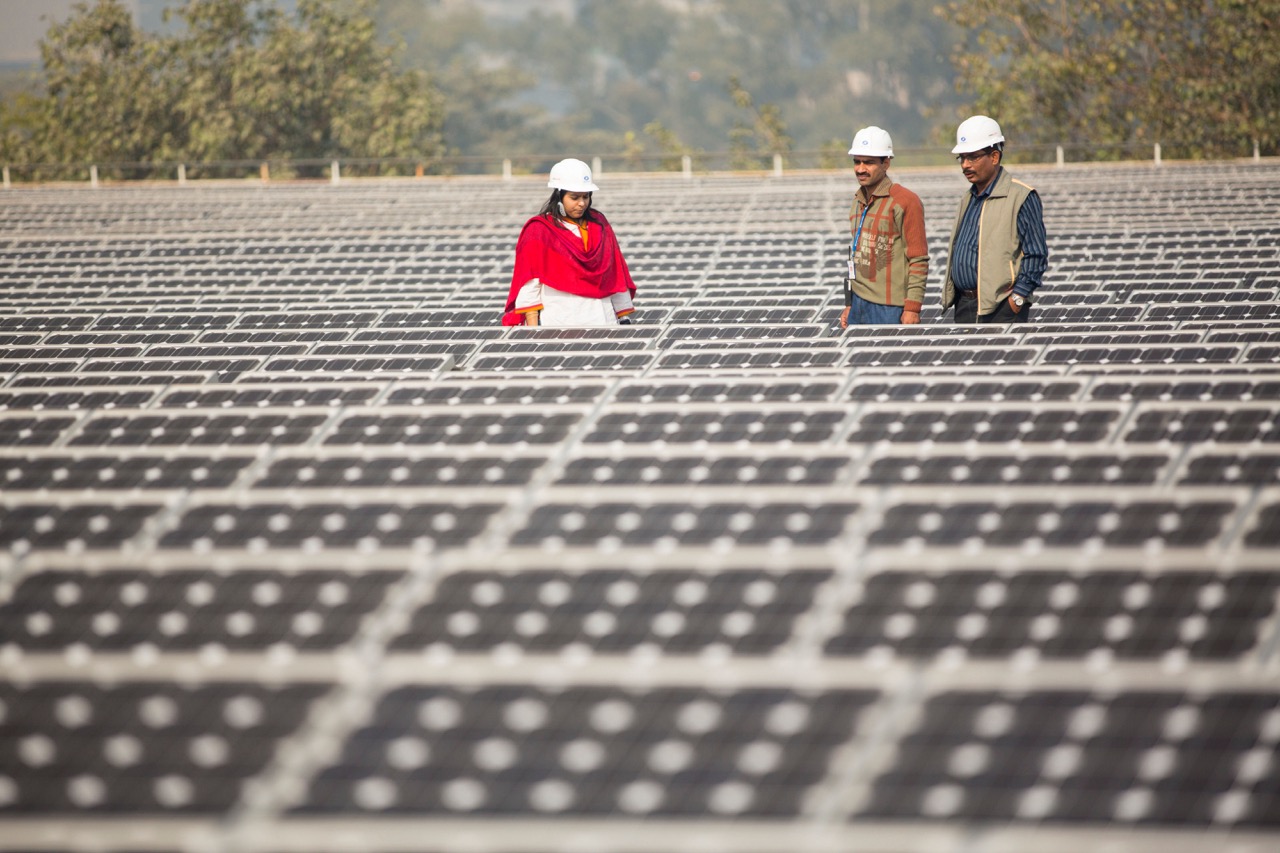
Workers at a 1 MW solar power station run by Tata power on the roof of an electricity company in Delhi, India
Credit: Ashley Cooper pics / Alamy Stock Photo
Related Content
Analysis
Storage target ambition is rising, but not fast enough to reach the goal
14 October 2026
Analysis
Electric energy security: how EVs are reducing oil import vulnerabilities
13 October 2026
Analysis
Bankable by design: Financing ASEAN's energy system transformation
06 October 2026
Analysis
Renewable Caribbean: towards energy independence
01 October 2026