

Building resilience after another energy shock
Ember Current – April 2026 Newsletter

The US-Israel war with Iran is a powerful reminder that our import-dependent energy system is vulnerable to shocks. The impact has been widespread, but many Asian countries are particularly affected due to their high reliance on oil and gas supplied through the Strait of Hormuz, leaving them exposed to supply disruptions and price volatility. Petrol prices have risen in Singapore, work-from-home measures have been introduced in the Philippines, while Thailand has enforced mandatory energy saving. Indonesia, where I am writing from might soon face a fuel shortage – alarming for a country with 27 million registered vehicles.
Scaling electrification and renewables is the only reliable way to shield countries from future energy crises. Short-term measures can keep the lights on and wheels turning, but lasting energy security and affordability come from reducing reliance on fossil fuels and accelerating the shift to a clean, electrified economy.
Ember has produced a number of analyses over the past few weeks to provide clarity on how accelerating the energy transition can dampen the effects of fossil market shocks. A round-up of these pieces is provided below.
Insights, analyses and commentaries
Energy security tested globally
Fossil fuel supply disruptions and price volatility are a growing reality for much of the global economy right now. Many Asian countries that depend on fossil fuel imports are seeing renewed energy insecurity and widening inequality, as rising costs disproportionately affect vulnerable populations. Without a decisive shift toward renewables and electrification, these inequalities will only continue to grow.
Latest energy shock reminds Europe of its risky gas reliance
Gas prices are spiking as conflict escalates in the Middle East. The cost of gas-fired power has spiked 50% since the beginning of the US-Israel war with Iran. The EU’s overall fossil fuel costs also increased by €2.5 billion in the first 10 days of the conflict.
The energy security fallout: from fossil fuel fragility to electric independence
The fragility of global fossil fuel supply underscores why scaling renewables and electrification is essential for lasting energy security. Net importers of fossil fuels spent $1.7 trillion in 2024, and as fuel prices rise, this number will surge. Electrotech has the potential to provide energy independence for every country in the world.
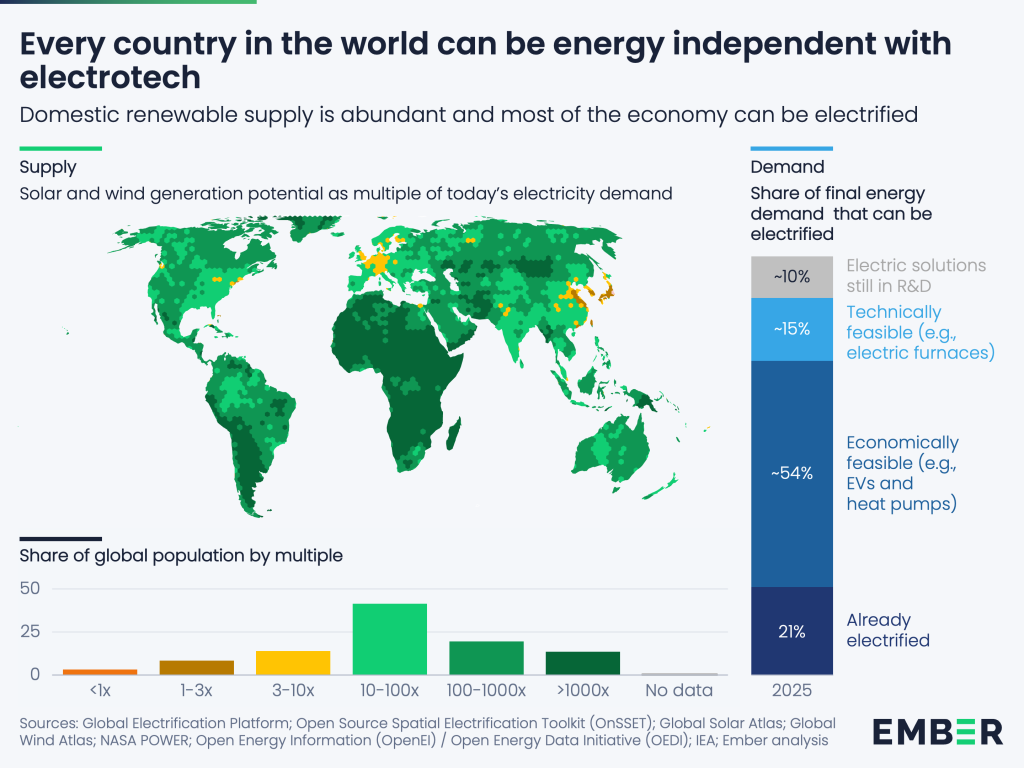
Overcoming fossil lock-in is pivotal for Asia to buffer against energy shocks
Structural redesign of the energy system is becoming more urgent to shield Asian countries against recurring oil and gas trade turmoil. Steering countries off the fossil path and back towards clean energy will ensure countries mitigate potential risks, maintain energy security and remain on track for decarbonisation.
There’s more!
- AI to unlock the next wave of renewable integration in ASEAN | Read the report
- Renewables cut annual electricity bills by one month in Türkiye | Read the report
- Solar growth in South Asia has cut fuel imports for power but deeper reductions need electrification and regional grids | Read the report
- Ember’s response to the public consultation on European Resource Adequacy Assessment | Read the report
Ember in the news
- EVs Avoided the Use of 2.3 Million Barrels of Oil Per Day in 2025 | Bloomberg
- Asia Turns Back to Coal as War Chokes Off Natural Gas | The New York Times
- Spain is a role model in weathering Iranian oil shocks | Financial Times
What I’m reading
Visual storytelling corner
Chart of the month
In 2024, importing enough solar panels or gas to generate 1.5 TWh of electricity a year cost around the same amount, $100 million. Yet solar panels can generate that amount of power every year throughout their lifespan, while importing fossil fuels is a recurring expense. Solar panels can therefore avoid hundreds of millions of dollars in gas costs within just a few years, while also leaving electricity systems less exposed to price shocks in global gas markets.
Turning data into action
Data highlights

Wind and solar monthly capacity installations and additions
Follow country-level progress on deploying renewables and compare between countries.
China cleantech exports
Track exports of solar, batteries, EVs and more from China to every country in the world.
EU electricity prices
Track the impact of rising oil and gas prices on power generation in the EU.
Region spotlight
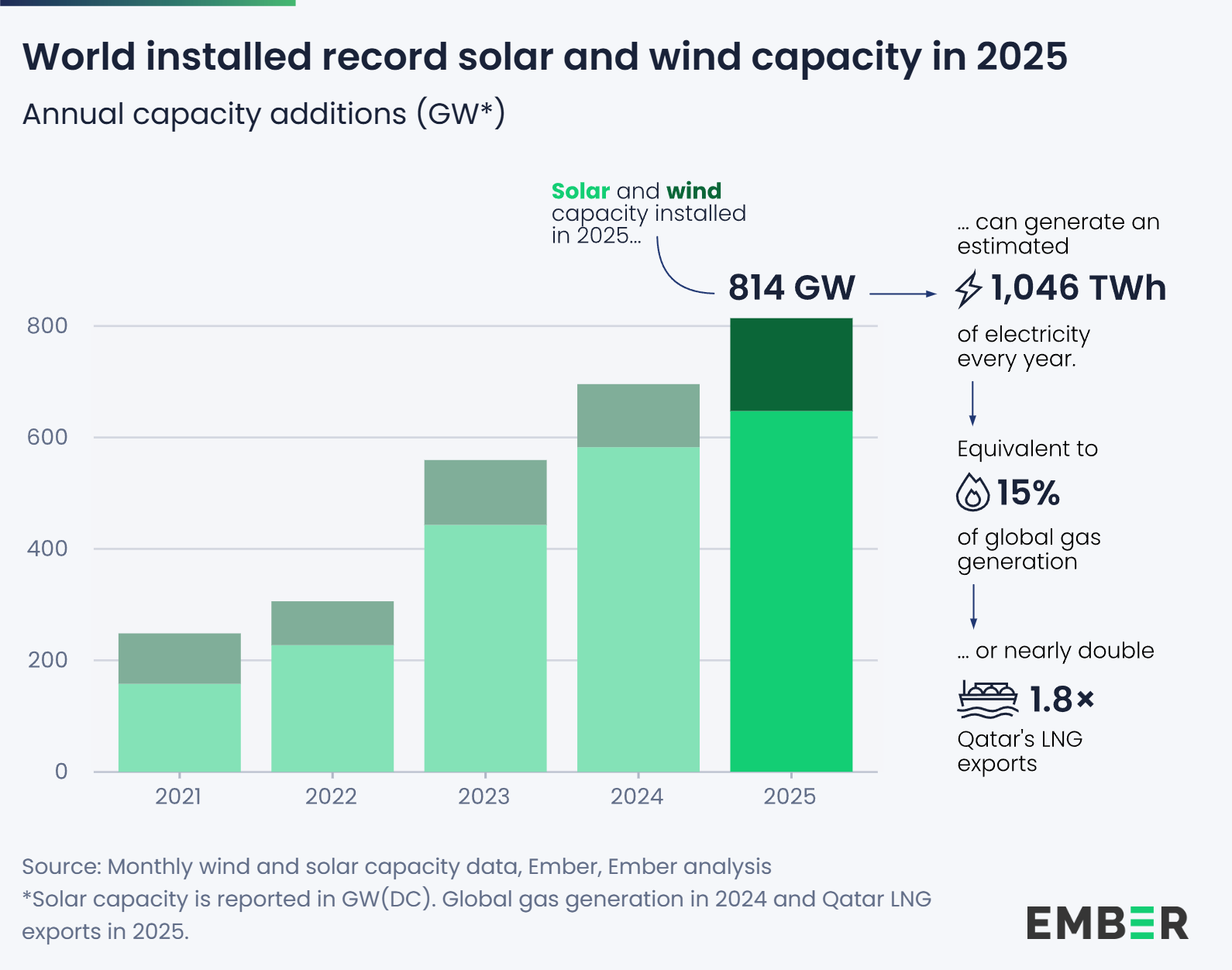
Renewables are cushioning the impact of today’s gas price crunch. New data released by Ember (explorable in a new data tool) shows that a record 814 GW of global wind and solar capacity was added in 2025 – 17% more than in 2024. This additional capacity could generate an estimated 1,046 TWh of electricity each year – enough to displace more than a seventh of global gas generation or almost double (1.8x) Qatar’s annual LNG export volume.
Webinar
Building resilience to global fossil fuel import vulnerability
Watch our webinar, where I am joined by fellow analysts Dr Beatrice Petrovich and Daan Walter to discuss how countries can strengthen their energy security by accelerating renewables and electrification.
Acknowledgements
Dinita Setyawati, Eli Terry, Chelsea Bruce-Lockhart, Claire Kaelin, Hannah Broadbent, Rocío Rodríguez Almaraz, Rashmi Mishra and Matt Ewen.