

UK solar homes power equivalent of five hours of daily air con use during heatwave
As a weeklong heatwave rolls over Europe, increased domestic solar generation matches well with air conditioning.
24 Jun 2026
3 Minutes Read

Temperatures rose in the UK as a weeklong heatwave rolled over Europe in late June 2026. Solar generation matches well with active cooling measures such as air conditioning, however. A typical UK home with rooftop solar powered the equivalent of over five hours of air conditioning per day during the June heatwave.
- A typical UK home with rooftop solar powered the equivalent of over five hours of ‘free’ air conditioning per day during the June heatwave. As solar and air conditioning have similar seasonal patterns, the technologies complement each other.
- Across the 1.9 million UK homes with rooftop solar, the equivalent to 10 million solar-powered air conditioning hours were generated each heatwave day. The UK’s significant recent solar deployment means there is already large potential for cost-effective cooling.
- Over 2.5 GW of solar power was installed in both 2024 and 2025. This is more than the total capacity installed between 2017 to 2021. Solar rooftop installations have jumped in recent years, even without government subsidy support.
- The UK is in its second solar boom. The peak solar power half-hourly generation record was broken eleven times in the first half of 2026 alone, the most in a year since 2016. Rooftop solar was installed at the highest ever annual rate in 2025, with 2026 on track to overtake.

The UK is firmly in its second solar boom as air con enters centre stage
UK homes with solar panels generate the equivalent of around 5 hours of air conditioning use per day
Active cooling and solar power are complementary
During the first days of the June 2026 heatwave, which coincided with the summer solstice, UK homes with solar panels generated the equivalent of five hours of ‘free’ self-supplied air conditioning.
Solar power and air conditioning are complementary technologies with similar seasonal patterns, though air conditioning use tends to be weighted later in the day. On the 21st and 22nd of June 2026 a typical UK rooftop solar installation generated 15 kWh, equivalent to five hours of electricity demand from a full-house air conditioning set up (at 3 kW) per day.
The UK Met Office issued a ‘Red Extreme Heat Warning’ in parts of England and Wales for the 24th and 25th of June 2026, with peak temperatures over 37°C forecast, upgrading the Amber warning in place from the 22nd. As heat-related risks loom larger in British life, active cooling technologies such as air conditioning are receiving increasing attention.
Though passive cooling remains an important part of climate adaptation, the Climate Change Committee 2026 Independent Assessment of UK Climate Risk suggests almost a quarter (22%) of UK buildings will need active cooling in a future with 2°C warming. Furthermore, they warn of a 70% increase in days when the temperature in English schools reaches 35°C. Uptake of passive and active cooling in the UK is currently low, but it is increasing in urgency.
Rooftop solar booms, with potential for cost effective cooling
Deployment to date already represents significant cooling potential. Across the 1.9 million UK homes with rooftop solar, the equivalent to 10 million solar-powered air conditioning hours were generated each heatwave day. In reality, rooftop generation will be split across all household electricity use, but home battery installations are also increasing, helping households to make the most of their solar generation across the day. Monthly installations of home batteries doubled between 2024 and 2025, as recorded in the official Microgeneration Certification Scheme database.
This increase coincides with accelerated solar too, homes are currently installing rooftop solar at the fastest ever annual rate, a record 253,500 domestic-scale solar installations were completed in 2025 alone. The rate continues to increase into 2026, which in the first four months of 2026 so far is 3% above the 2025 total over the same period.
This surge in development is not limited to household solar. A large number of solar farms are also in development, supported by the government Contracts for Difference scheme. Although just 854 MW of solar is installed through the scheme so far, 10,343 MW is also contracted to be built before the early 2030s.
Increased electricity consumption in summer has grid benefits
Air conditioning has an additional benefit to the UK grid too, facilitating increased and flexible demand during high solar generation hours. In its 2026 summer outlook, the electricity system operator NESO highlighted that surplus electricity in the summer months was expected. A new service, the ‘Demand Flexibility Service’ is to be used to reward consumers for increasing electricity use during these periods. Even for households without rooftop solar, flexibility payments mean a wider pool of consumers can benefit by increasing demand during reward periods, for example through the use of air conditioning.
Britain has entered its second solar boom
In the first solar development boom in Britain, supported by the Feed-in Tariff and the Renewables Obligation subsidies, 10 GW of solar was built in just five years from 2012. This was followed by a period of stagnation. In the following five years less than 2.5 GW was installed as subsidies were wound up. Following a turbulent period with consumer bills affected by two international fossil fuel crises, solar development is once again accelerating, despite no subsidy available to households. Over 2.5 GW of solar power has been installed in both 2024 and 2025, more than the total across the stagnation period of 2017 to 2021.
Britain has firmly entered its second boom period for solar power, as solar records are being broken more frequently. The peak solar power half-hourly generation record was broken eleven times in the first half of 2026 alone, the most for any year since 2016.
By the summer solstice (21 June), total solar generation in 2026 was 2% ahead of 2025, itself a record breaking year with generation 30% above 2024. UK solar generation peaked above 16 GW for the first time in 2026, more than 50% higher than during the 2022 energy crisis.
Supporting materials
Methodology
Domestic solar generation per day
Domestic solar generation is taken for the days of the 21st and 22nd of June 2026, the first two days of elevated temperatures in the late June heatwave. Domestic-scale capacity and generation is defined as those installations up to 10 kW. Naturally there are edge-cases where domestic solar installations are above 10 kW, or commercial developments are below 10 kW, which cannot be accounted for in the available data. This is therefore not an annual average for domestic generation, but based on the conditions during the heatwave.
National solar generation (average 109.7 GWh) was scaled down to the domestic solar capacity (6.3 GW) proportion of total national solar capacity (23 GW), split as estimated by Sheffield Solar, in line with the capacity bands defined above. This was on average 28.5 GWh, produced by 1.88 million domestic-scale installations in the UK, the equivalent of 15.2 kWh per day.
Please note an earlier version of this report had the incorrect units, showing 15 MWh not kWh as outlined correctly in the detailed methodology.
Air conditioning demand per day
Due to the nascent quality of air conditioning in UK homes, precise data on average air conditioning size is not available. Furthermore, the operation and cooling demand varies significantly by user.
The DESNZ Energy Innovation Research Office: Air-to-Air Heat Pumps Literature Review (another name for modern air conditioning units which can provide both heating and cooling) found a wide range of cooling output from available units between 3 and 12 kW. This report noted a lack of ‘real world’ data on the efficiency (coefficient of performance) of air-to-air heat pumps, with a range of 1.2 to 4.5 kW. Assuming an average heating output of 7.65 kW and an average COP of 2.85, a typical air conditioning demand can be assumed of 2.7 kW. Due to the lack of specific data, a more conservative 3.0 kW has been assumed for air conditioning demand. It is worth noting that some manufactures, such as Daikin, publish air-conditioning unit specifications which state a seasonal COP of 5.2, which would almost halve the power requirement of the unit compared to what assumed here, but we have used the figures in the DESNZ review for consistency.
Therefore, taking these assumptions altogether, the equivalent of a 3 kW air conditioning unit can be run for 5.1 hours per day based on an average 16 kWh of domestic-scale solar generation during the first two days of the heatwave. This has been conservatively rounded down to 5 hours, again due to lack of data specificity.
Acknowledgements
Thanks very much to Ali Candlin for supporting this piece.
Cover image
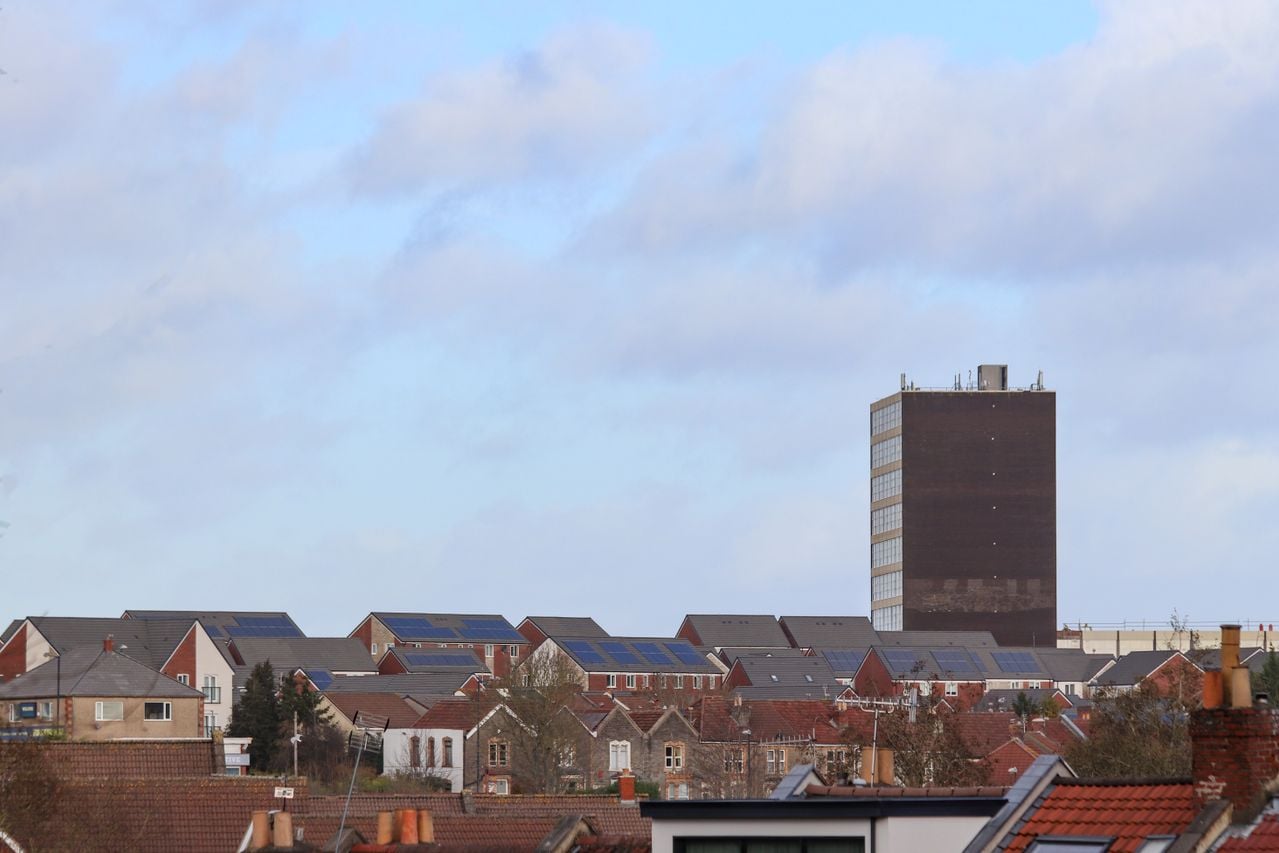
A wide view of residential rooftops equipped with solar panels in Bristol, United Kingdom. A tall, brown high-rise building stands on the right side against a cloudy blue sky.
Credit: Boys in Bristol Photography / Pexels
Related Content

Analysis
A quarter of EU power came from solar for the first time in June
14 July 2026
Analysis
UK's largest emitter Drax reports record emissions in 2025
09 July 2026

Analysis
Energy Institute Statistical Review of World Energy
30 June 2026
Analysis
The solarisation of Pakistan’s energy economy
25 June 2026