

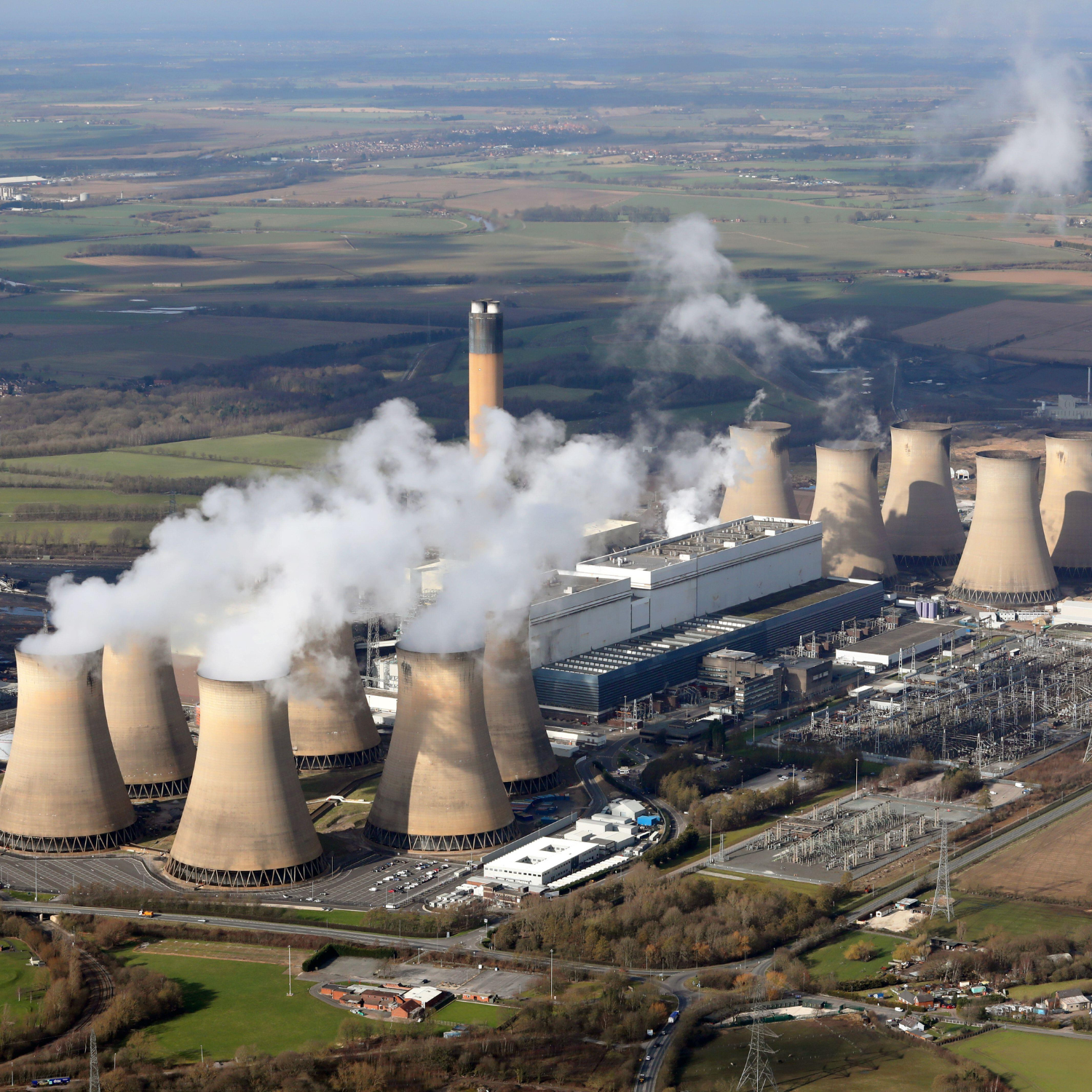
UK’s largest emitter Drax reports record emissions in 2025
Drax power station’s carbon emissions hit a new high while receiving record public subsidies in 2025.
9 Jul 2026
8 Minutes Read

- Drax power station was the UK’s largest emitter in 2025. High generation led to a 1% increase in year-on-year emissions. Drax emitted four times as much carbon dioxide equivalent (CO2e) as the second-largest emitter, Pembroke gas power station, and more than the top six gas power stations combined.
- Drax set a new annual emissions record in 2025, beating its previous record set in 2024. Emissions from large-scale biomass power plants reached a record high in 2025.
- Drax received record annual subsidies of £999 million in 2025.
- Drax power station is likely to remain the UK’s largest emitter out to 2030. Although Drax generation is due to halve from 2027, Drax will continue to emit more CO2e than the second-largest emitter.

After many years of burning a high volume of polluting biomass, Drax will rightly see its subsidised generation capped from 2027 and its emissions will finally fall. Burning biomass for power generation will never stop being bad value for billpayers or our environment, and must be phased out entirely.
Drax is the UK’s largest emitter for eleventh year running
Drax biomass power station was the single largest source of carbon dioxide equivalent (CO2e) in the UK in 2025. Drax emitted 14.1 million tonnes of CO2e last year, a 1% increase from the previous year. This was in line with increased generation, which rose from 14.9 TWh in 2024 to 15.4 TWh in 2025. This accounted for 5% of Britain’s power generation, for which Drax burnt 7.5 million tonnes of wood. The high carbon content of wood and high volumes burned was behind the record emissions in 2025, with the biomass power station breaking its previous record set in 2024, marking the eleventh year that Drax power plant has been the UK’s top emitter. Despite this high level of emissions, Drax’s generation is backed by a publicly funded subsidy.
Biomass plants rank high in the list of the UK’s largest emitters
Emissions from large-scale biomass power plants reached a record high in 2025, but will fall from 2027 as subsidy cuts for large-scale biomass power plants come into effect. Lynemouth biomass power station is now the 6th largest emitting facility, emitting around 2.4 MtCO2e in 2025 – a 35% increase from 2024, when Lynemouth entered the top 25 for the first time. Teesside biomass power station emitted 1.2 MtCO2e, making it the 16th largest emitting facility. Drax alone emitted more than four times as much carbon as the second largest emitter Pembroke gas power station (3.3 MtCO2e) and more than the top six gas power stations combined. Together, Drax, Lynemouth and Teesside emitted 17.7 MtCO2e in 2025 – more than the nine most polluting gas power stations combined.
Changes in Britain’s power and industrial sectors saw gas and biomass power stations account for higher shares of the UK’s territorial emissions in 2025 than in previous years. The closure of two of the UK’s largest emitters in 2024 (Ratcliffe-on-Soar coal power station and Port Talbot Steelworks) and a small year-on-year increase in gas generation saw two new gas power stations enter the top twenty-five. Despite the higher rankings for gas power stations in the list of the UK’s largest emitters, gas generation in the UK was at its second-lowest this century.
Drax reported record subsidies in 2025 despite emissions concerns
Public subsidies to Drax biomass power station reached a record £999 million in 2025, paid for through consumer bills and costing UK households £13 each. Altogether, Drax set new emissions, generation and subsidies records in 2025.
Despite being the UK’s largest emitter, Drax’s emissions from burning woody biomass are not counted in official UK emissions statistics. This is due to a United Nations Framework Convention on Climate Change accounting convention designed to avoid double counting emissions between the energy and land use sectors. This means biomass power emissions are not included in the UK Emissions Trading Scheme and biomass generation is eligible for public subsidies earmarked for renewable energy. In total, Drax has received £8.72 billion in public subsidies for biomass burning since 2012.
Biomass power generation is currently defined as renewable because it is assumed that carbon emitted during combustion is sequestered through replanting and removed from the atmosphere as part of the natural carbon cycle. However, the carbon payback period for woody biomass can be significant, as it can take decades for regrowth to sequester the same volume of carbon emitted. Bodies including the European Academies Science Advisory Council have cautioned against unabated biomass generation for this reason. The immediate, direct emissions from burning wood at Drax are almost twice as high as direct emissions from gas generation (see Methodology for further details). Including emissions from biomass power plants in analysis of UK emitters accounts for the fact that the carbon saving from biomass power is far from guaranteed.
Drax continues to be highly dependent on wood pellet imports
Over 99% of fibre burned by Drax biomass power station between 2023 and 2025 was imported. The majority (86.7%) of feedstock consumed in 2025 was sourced in the US and Canada, where Drax operates 17 pellet mills. A further 13.2% was sourced in Europe, primarily Latvia. Less than 1% of feedstock consumed by Drax was sourced in the UK. This is despite long-term recommendations from independent bodies to develop domestic biomass supplies, including the Climate Change Committee (CCC) and Dr Alan Whitehead in his Independent Review of Greenhouse Gas Removals.
Drax biomass power station’s continued reliance on imported feedstock is a risk for Britain’s homegrown power mission. Biomass generators are exposed to knock-on price volatility from other markets. As the price of gas jumped during the 2021-23 energy crisis, other imported fuels (including wood pellets) also saw price shocks. Furthermore, the CCC has recommended developing domestic supplies as it is more difficult to ensure imported biomass meets sustainability standards, due to differences in regulatory oversight around land use and forest management in other countries. Continued reliance on imported wood runs against official guidance and recommendations, while increasing exposure to volatile international supply chains.
Reliance on wood pellet imports will remain an issue for biomass power generation in the near-term. Drax would need to change close to 100% of its woody biomass feedstock sourcing, a significant pivot away from its current supply chains and import infrastructure. Domestic supply would also need to increase significantly to meet Drax’s consumption requirements. In 2025, Drax consumed the equivalent of more than twenty times the UK’s annual wood pellet and briquettes production. While Drax has stated plans to increase the proportion of pellets sourced in the US, increasing the share of domestic material would require a significant shift from current sourcing practices.
Drax will likely remain UK’s largest emitter until 2030, despite generation cap
Biomass generation in the UK will fall from 2027 due to cuts to public subsidies. In April 2026, Drax and Lynemouth power stations entered the final twelve months of high subsidy payments. From 1 April 2027, both power stations will enter new government support agreements that cap subsidised generation at a capacity factor of 27%, which the government claims will halve the subsidy that each power plant receives. Both plants will receive a higher strike price of £153/MWh (2024 prices). A 50% cut in subsidised biomass burning at the UK’s largest biomass power station will reduce the estimated annual cost per household from around £13 to £6, delivering cost savings for consumers.
Drax will likely remain the largest emitter despite subsidy cuts. Drax’s emissions will fall to around 5.8 MtCO2e between 2027 and 2031, unless unsubsidised generation increases. Emissions will continue to be higher than the second largest emitter in 2025 (Pembroke gas power station, 3.3 MtCO2e), cementing Drax’s status as the UK’s largest producer of carbon emissions into the early 2030s.
A British homegrown clean energy system is possible without large emitters
Electricity generation from biomass and gas power stations can be displaced by low-carbon renewables including wind, solar and batteries. The rapid deployment of renewable energy helped to enable the full phase-out of coal in Britain’s electricity system. Cutting emissions from gas and biomass plants will require further deployment of renewables, and replacing other services, such as grid stability and carbon removal, with proven clean alternatives.
While gas and biomass power currently play an important grid stability role, this function can increasingly be replaced by clean solutions which have lower emissions and are not import reliant. Deploying clean flexibility technologies, such as batteries and long-duration energy storage, is critical to reducing gas and biomass powered generation and their associated emissions further.
Plans to deploy carbon capture technology and become a source of carbon removal have been a key factor behind continued subsidies for Drax and Lynemouth. However, these long-delayed projects continue to face challenges and appear unlikely to deliver in the near term. In its latest financial reporting, Drax once again distanced itself from investment in carbon capture technology. This follows the reported closure of a carbon capture trial and cuts to hundreds of jobs, as Drax moves investment to more proven energy technologies. Any transition to bioenergy power generation with carbon capture at Drax would require around £30 billion in new subsidies, more than the entire announced carbon capture and storage budget. Without the motivation for subsidies to keep carbon capture, the wind-down in subsidies for unabated biomass generation from 2027 is a further step towards a phase-out.
Supporting materials
Downloads
Download the full report
Methodology
Drax 2024 reported biogenic emissions change
The previous Ember review of the UK’s largest emitters in 2024 (July 2025) reported Drax biogenic emissions of 13.3 MtCO2e in 2024 based on Drax Group plc’s 2024 annual report and accounts (published May 2025). The Drax Group plc 2025 annual report and accounts (published March 2026) includes a revised 2024 biogenic emissions figure of 13.9 MtCO2e. The revised figure has been used for the analysis in this report.
Direct emissions
The ranking focuses on direct carbon dioxide equivalent (CO2e) emissions in the full 2025 calendar year, emitted within UK borders.
The ranking of CO2e emitters is mainly analysed using UK Emissions Trading Scheme data. The UK Emissions Trading Scheme data published for 2025 is for direct emissions, so excludes upstream and downstream indirect emissions. For example, this excludes upstream emissions from purchased electricity, or downstream emissions from the sale of fossil fuels. Data cleaning of account holder and site name entries has been performed for clarity. Currently, energy from waste facilities are not required to submit emissions into the UK ETS, but will need to from 2028.
Please note that although this is a review of the UK Emissions Trading Scheme, Northern Ireland electricity generators remain in the EU ETS under the Ireland / Northern Ireland Protocol.
Biomass burning for power generation is effectively excluded from UK carbon accounts, so Ember has sourced emissions from biomass power station annual reports. The UK ETS uses the same biomass emissions factor as the EU ETS directive 2003/87/EC. Annex IV of the Directive 2003/87/EC states: “The emission factor for biomass shall be zero”. Drax emissions are taken from the Drax Group plc Annual report.
Lynemouth and Teesside emissions have been calculated by Ember from facility generation data published by the LCCC, as biogenic emissions are not published publicly. An emissions factor has been used to align with average large-scale biomass emissions factors. While this is a likely accurate estimate, and shows inter-year changes well, it is not as precise as self-reporting in the ETS.
Notes on biomass emissions accounting concerns
Serious concerns remain about the overall emissions of using biomass for power generation. The EU and UK emissions trading schemes do not require wood-burning power plants to report their emissions, assuming the emissions are offset by forest regrowth. Unfortunately, the assumed carbon savings from biomass is far from guaranteed.
There is a mounting body of evidence and expert opinion that this assumption is critically flawed and must be overturned. The European Academies Sciences Advisory Council states that using woody biomass for power “is not effective in mitigating climate change and may even increase the risk of dangerous climate change”. Furthermore, BBC investigations have shown examples of rare old growth forests being cut down and turned into wood pellets, increasing the potential ecological harm inflicted. It is therefore likely that burning biomass to generate power is failing to deliver any carbon savings and is in fact a contributor to climate change.
According to the IPCC, direct emissions from gas (0.48 tCO2e/MWh on average) are almost half that of direct biogenic emissions from wood pellets burned at Drax (0.94 tCO2e/MWh – average from 2020-25).
Classification of facilities
The UK ETS uses ‘NACE’ descriptions, which offer some insight into the facility type, but do not specify for instance fuel type used within ‘3511 – Production of electricity’. Ember has independently researched the sub-sector description for individual facilities. For most, particularly the largest facilities, this is clear, but for smaller sites or sites which occupy the same industrial park for instance, sub-sector classification has not been possible.
Acknowledgements
Frankie Mayo, Alison Candlin, Reynaldo Dizon, Sachin Sreejith.
Photo credit: Chris Chambers / Alamy Stock Photo
Related Content
Analysis
Renewable Caribbean: towards energy independence
01 October 2026
Analysis
Methane doesn't read the label
30 September 2026

Analysis
Annual coal mine methane emissions are linked to tens of thousands of deaths
30 September 2026

Analysis
Indonesia's captive coal giant: better data to shape industrial competitiveness
23 September 2026