


Hot air: carbon removals risk high costs and underdelivery in the UK
Rushing to invest in carbon removal projects will come at a high cost and risks overreliance on technologies that are currently unproven.
27 Nov 2025
18 Minutes Read

Featured in the media
The Times
Summary
The UK has high ambitions for carbon removal projects scaling up in the 2030s – but risks spending billions on unproven technologies.
The UK Government includes ‘carbon removal’ technologies in its plans to meet net zero. Two specific technologies are expected to provide high volumes of carbon removals from the 2030s: bioenergy with carbon capture and storage in the power sector, and direct air carbon capture and storage. To date, ten projects aiming to deploy these technologies at commercial scale have been announced in the UK, including six government-funded pilot projects.
Analysis of available documentation of announced projects shows:
- A single project to deploy carbon capture at Drax biomass power station could cost £30 billion in subsidies, more than the entire carbon capture and storage budget. Similar projects are also expected to be costly, but insufficient disclosed data prevents accurate estimates. Direct air capture pilot project costs are also significantly above government commercial-scale cost targets, and international carbon removal project costs remain significantly higher than planned.
- The status of almost every project in the UK is either delayed, cancelled or undisclosed. No project has moved beyond the pilot phase or begun construction. No carbon has been captured at commercial scale. This means there is a high degree of uncertainty regarding their deliverability, reliability to carbon capture as stated, or their value-for-money.
- The ability of carbon removals technologies to deliver remains uncertain. International direct air capture projects have underperformed against carbon removal targets to date. There are concerns that deploying carbon capture at biomass power stations does not deliver genuine carbon removal.
With the clock ticking on cutting emissions, the UK doesn’t have time or money to waste on carbon removals tech that may never deliver. In the next decade we should focus funds on guaranteed solutions that can come online quickly: wind, solar, grid improvements, heat pumps and EVs.

Government support for these technologies to date has been limited to pilot projects, but commercial-scale projects in the 2030s could require billions in public funds, with no guarantee that they will deliver expected carbon removals.
The most cost-effective way to ensure the UK reduces carbon emissions is to focus on proven approaches in the near term. Since carbon removal technologies are unlikely to deliver at scale in the next decade, the UK Government must prioritise deploying renewables and ensuring that limited public funds are dedicated to meeting electrification targets, such as heat pump deployment. The government should delay support for these carbon removals technologies until they are proven and cost-effective, while continuing to explore other greenhouse gas removal methods.
The UK risks overreliance on unproven carbon removal technologies
Carbon removal technologies are heavily relied upon to meet UK carbon budgets
On the pathway to decarbonising the UK economy, the UK Government is supporting a range of solutions, including the deployment of renewables and the electrification of heating and transport. The government also expects novel carbon removal technologies to scale up in the coming decades, with the expectation that they will balance emissions from hard-to-decarbonise sectors. (See Box 1 for more details.)
The two carbon removal technologies currently expected to play the biggest role in the UK are bioenergy with carbon capture and storage (BECCS) – with deployment in the power sector (power-BECCS) accounting for the largest share of assumed BECCS removals by 2050 in the Climate Change Committee (CCC)’s 7th Carbon Budget – and direct air carbon capture and storage (DACCS).
Carbon removal expectations have been scaled back
The UK Government previously assumed high levels of deployment of commercial-scale BECCS and DACCS technologies in 2030, but no project has reached commercial scale as of November 2025.
To date, ten power-BECCS and DACCS projects have been announced in the UK, including the six pilot projects included in the second phase of a government-funded innovation programme, with many project developers targeting commercial-scale operation from the late 2020s onwards. However, none of these projects have moved beyond the research and development stage, making it increasingly unlikely that they will begin commercial-scale operation by 2030.
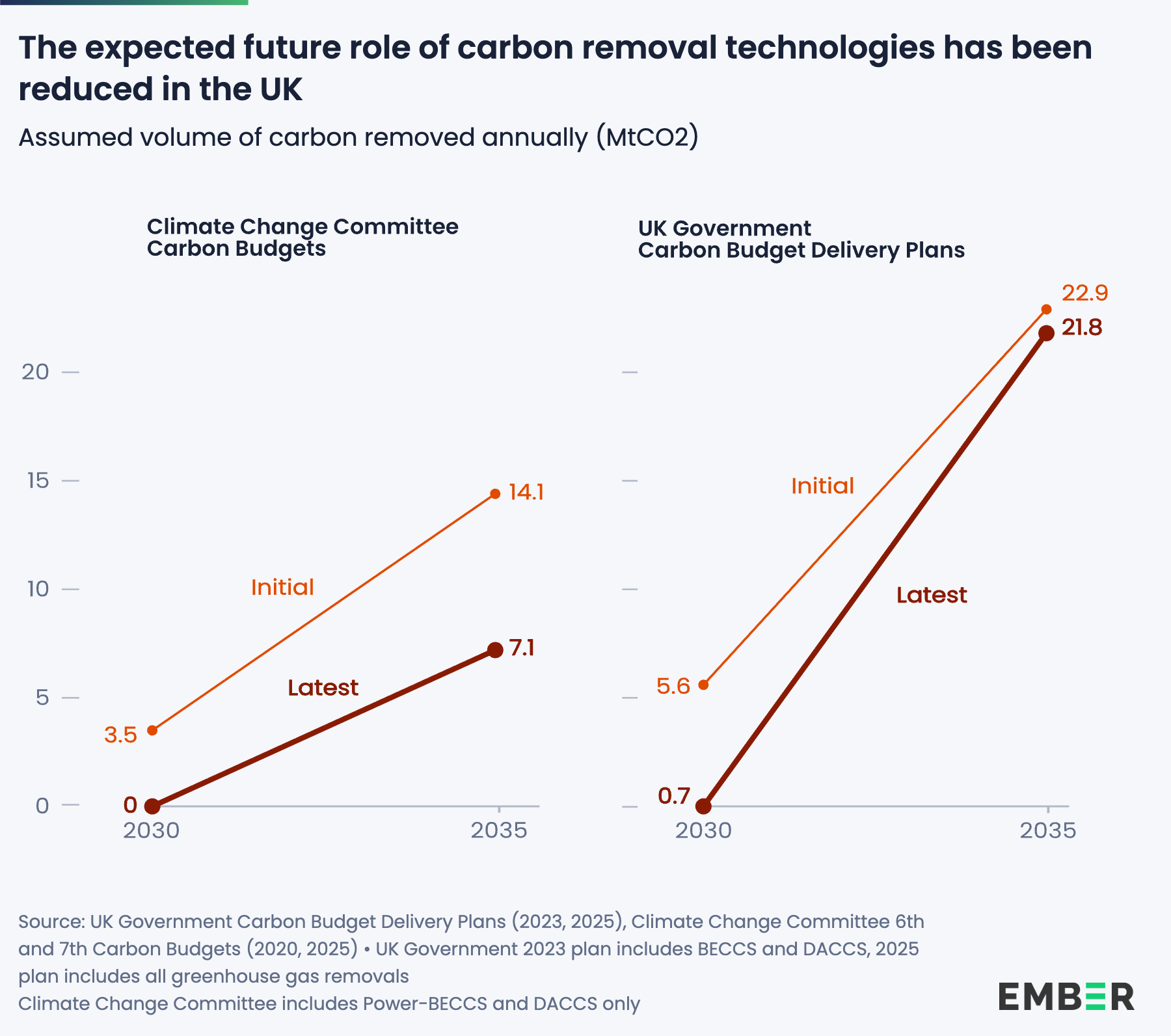
These project timeline delays have been reflected in reduced near-term ambition in government plans. The government’s first UK Carbon Budget Delivery Plan (2023) assumed BECCS and DACCS projects together would remove 5.6 MtCO2 annually from the atmosphere in 2030, scaling to 22.9 MtCO2 in 2035. However, the latest plan (2025) reduced the expected volume of all types of greenhouse gas removals in 2030 to just 0.7 MtCO2. (The government is still targeting 21.8 MtCO2 of removals in 2035, with plans to provide revenue support to projects that reach commercial-scale.)
The CCC also reduced its expected volume of power-BECCS and DACCS removals in the 2030s between the 6th (2020) and 7th Carbon Budgets (2025). These changes signal that, although carbon removals still play a key role in government and CCC plans, confidence in their near-term delivery is waning.
Delivering the current carbon removal technologies strategy will require billions in subsidies
A single BECCS project could cost £30 billion in subsidies, more than the entire carbon capture and storage budget
The largest proposed carbon removal project in the UK involves installing carbon capture technology at Drax biomass power station – the biggest emitter in the UK – thereby converting it into a power-BECCS plant. Drax originally planned to begin operation of its BECCS facility in 2027, but the project is currently delayed until 2030. New analysis estimates that converting Drax to power-BECCS could cost £30 billion in public subsidies if built (in 2023 prices).
To put this into context, the UK Government has announced funding of up to £21.7 billion for carbon capture, use and storage (CCUS) and hydrogen projects over 25 years. This means the cost of delivering a single carbon removal project would be higher than the existing funding for all types of CCUS projects.
That level of support is urgently needed for other solutions that bring down emissions and benefit households: if the subsidies for power-BECCS at Drax were instead allocated as grants through the Boiler Upgrade Scheme, this could fund air source heat pumps for a sixth of households in England and Wales.
Carbon removals subsidies would increase existing payments to biomass power plants
Drax earned £869 million in public subsidies for unabated biomass power generation in 2024. Drax is now seeking additional support to cover the upfront investment and operational costs of adding carbon capture to its generating units, which Drax claims could remove up to 16 MtCO2 annually. If built, carbon capture at biomass power plants could receive a novel subsidy structure, with payments both for carbon removals and power generation.
Drax has previously published plans to add carbon capture to its generating units incrementally, starting in 2030. Drax has also expressed interest in simultaneously generating unabated biomass power using its unconverted units. If it continues to receive revenue support for unabated biomass power generation while converting to BECCS, its total subsidies could increase to £33 billion.
However, the timeline for deploying carbon capture at Drax remains highly uncertain. The project, already delayed from 2027 to 2030, is likely to be delayed further into the early 2030s as Drax reduced BECCS investment in February 2025, citing a lack of policy support. This will significantly impact the total subsidies received if the project is built.
The true cost of deploying BECCS is unknown
There are no examples of commercial-scale power-BECCS plants in the world. This means estimates for the final cost come with a very significant degree of uncertainty. While there are two other proposed power-BECCS projects in the UK (Lynemouth and InBECCS), it is not currently possible to estimate subsidies for these projects due to a lack of publicly disclosed data.
The cost of direct air capture would need to fall significantly before the technology can be deployed at scale
The cost of commercial-scale direct air carbon capture and storage would need to fall significantly to meet the UK Government’s target of £200 per tonne of CO2 removed.
Five direct air capture projects received UK Government funding for research and development between 2020 and 2025, at an average of £28,000 in funding per tonne of carbon captured. Two of the five project developers disclosed commercial-scale direct air capture targets in line with government targets before the pilot began. One project developer has published pilot results (as of November 2025), concluding that there is a significant risk that high direct air capture costs will be a barrier to selling credits on the international carbon credit market and confirming plans to pursue development of an alternative type of carbon removal technology instead.
The costs of international commercial-scale direct air capture projects remain above targets
Outside the UK, commercial-scale direct air capture plants help demonstrate the performance of the technology. The largest commercial-scale direct air capture plant in the world is the Climeworks Orca facility in Iceland. The plant originally planned to bring costs down to $100 per tonne of carbon captured. However, costs were reportedly still as high as $1,000 per tonne as of March 2025, with the plant only meeting around a quarter of its annual carbon removal target to date. The Climeworks Mammoth project, also in Iceland, captured 105 tCO2 in its first ten months against a target of 36,000 tCO2 annually, with costs reportedly above $600 per tonne.
Carbon removal technologies are not proven to deliver at scale
UK projects face delays and cancellations
There remains a high degree of uncertainty about the deliverability of the pipeline of power-BECCS and DACCS projects in the UK, with no project yet operating at commercial scale to its disclosed timeline.
Available documentation of the status of announced projects is varied, but the general trend reflects delays and challenges. Deployment of carbon capture at Drax biomass power station has been delayed by at least three years. While InBECCS has been announced as moving to government negotiations, the project’s expected carbon capture rate has reduced by 13% since it was announced in 2023. Four of the five direct air capture pilot projects are yet to disclose results. A lack of disclosed information about other announced projects – such as Lynemouth power-BECCS or Climeworks’ Silver Birch direct air capture – make their deployment timeline and targeted capture rate unclear.
These challenges mean that delivering the existing project pipeline to schedule, in line with target costs and capture rates, is not guaranteed.
BECCS may not deliver genuine carbon removals
Despite its expected role in carbon budgets, the true extent to which power-BECCS can be considered carbon removal is disputed.
Biomass power generation is currently “zero-rated” under the Greenhouse Gas Protocol used by Drax and other biomass power stations for its emissions reporting. This is based on the assumption that the carbon emitted during combustion is sequestered through replanting and removed from the atmosphere as part of the natural carbon cycle. This means that the annual emissions of Drax biomass power station (12.7MtCO2 between 2020-2024, on the woody biomass sourced from forests – the feedstock type used by Drax and Lynemouth biomass power stations – the carbon payback period can be significant, as it can take decades for regrowth to sequester the same volume of carbon emitted. Bodies including the European Academies Science Advisory Council have cautioned against overreliance on BECCS for this reason.
Furthermore, both Drax and Lynemouth power stations are reliant on importing woody biomass to the UK, which produces supply chain emissions. The CCC and Dr Alan Whitehead Independent Review of Greenhouse Gas Removals have recommended that power-BECCS feedstock be sourced domestically. However, Drax imported over 99% of its feedstock in 2024, which means that switching to a UK supply chain would require a significant shift from its current sourcing practices.
Deploying BECCS at scale before addressing imports and feedstock challenges risks locking in support for projects which may not deliver genuine carbon removals.
Carbon removal technologies risk near-term distraction from proven decarbonisation methods
Proven, affordable technologies should be prioritised
The UK Government has made progress towards reaching net zero by deploying renewables and setting ambitious targets to decarbonise the UK power sector, where emissions have fallen by 71% over the past two decades. The government has also set targets to electrify transport and heating. Maintaining this momentum is essential to achieve net zero by 2050.
However, deployment of heat pumps, tree planting and peatland restoration risk falling short of rates required in the CCC’s 7th Carbon Budget. To reduce costs, proven decarbonisation approaches must be advanced in the immediate term – otherwise there is a risk of overshooting carbon budgets and increasing reliance on expensive carbon removal technologies in the future.
Future support for carbon removal technologies must be conditional to ensure value for money and reliability
If the UK Government continues to provide support for carbon removal technologies, it must introduce measures to minimise costs and guarantee reliability of removal. In order to reduce dependence on power-BECCS and its associated risks and high costs, the CCC and government should explore a wide range of alternative greenhouse gas removal methods, supported by targeted UK trials. The pathway for engineered removals that is lowest-cost, homegrown and proven should be prioritised, once progress on electrification has been delivered.
Supporting Materials
Downloads
Download the complete report here.
Methodology
View the complete methodology for this report here.
Acknowledgements
Contributors
Frankie Mayo, Alison Candlin, Lauren Orso, Tomos Harrison and Harriet Fox
Header Image
An aerial view of Drax Power Station and the greenhouses that grow salad and vegetables from the excess heat that the power station uses
Credit: Getty Images Plus / Teamjackson
Related Content
Analysis
Renewable Caribbean: towards energy independence
01 October 2026
Analysis
Methane doesn't read the label
30 September 2026

Analysis
Annual coal mine methane emissions are linked to tens of thousands of deaths
30 September 2026

Analysis
Indonesia's captive coal giant: better data to shape industrial competitiveness
23 September 2026