No transition without transmission
Ember Current – March 2026 Newsletter

My first publication upon joining Ember in 2021 was on power grids. The biggest challenge of that piece was not analysing the data, but persuading people that the topic mattered. At the time, grids were seen as an engineer’s purview without much political relevance. Fast forward a few years, and suddenly grids were thrust out of the technical fringes into the headlines.
I’m still struck by how quickly focus has swung towards grids – and I hope that speed is mirrored by action for, of course, this shift did not happen in a vacuum. Europe and other countries learnt the hard way that energy security, competitiveness and affordability all depend on having infrastructure that is ready to accommodate a growing economy and clean energy future. Grids can no longer be an afterthought. They must be planned in lockstep with national and international ambitions – because there will be no transition without transmission.
Insights, analyses and commentaries
My top picks
Action on grids is not just about building new power lines and substations. Some of the most powerful solutions are simpler or take a fraction of the time to deploy. Grid capacity can be unlocked by activating flexibility on the demand or supply side, deploying grid enhancing technologies (GETs) and investing in digitalisation to turn grids “smart”. By alleviating congestion and increasing available capacity, these solutions allow more producers and consumers to connect to the grid. This means we do not have to put development or the transition on hold until new power lines are built – real change can be delivered much faster.
How cheap is battery storage?
Batteries are a central tool in the portfolio of clean flexibility solutions. Ember dives into the latest real-world evidence from auction results and expert interviews and provides an assessment of the latest capex and Levelised Cost of Storage (LCOS) for large, long-duration utility-scale Battery Energy Storage Systems (BESS) across global markets outside China and the US. This, combined with the incredibly low cost of solar power, means dispatchable solar is becoming economically feasible.
From baseload to flexibility: How coal’s role in China is changing
As China rapidly expands its wind and solar, the need for power system flexibility is becoming increasingly urgent. Alongside its massive battery deployment (almost 150 GW by the end of 2025), China is also transitioning its massive coal fleet from baseload to system flexibility provider. Its total flexible coal power capacity already exceeded 600 GW by the end of 2024 and 100% of China’s vast coal fleet is on track to be retrofitted for flexibility by 2027.
ASEAN’s low-carbon future flows through smart grids
Renewable deployment and industrial demand is rising fast across ASEAN, placing significant strain on the power grid. Smart grid technologies, such as real-time monitoring and automated control, can enhance reliability and support renewable integration, with regional assessments estimating avoided outage costs of around $2.3 billion annually by 2040.
There’s more!
- Indian States’ Electricity Transition 2026 | Read the report
- Reframing Energy for the Age of Electricity | Read the report
- EU coal mines still vent methane: satellite findings from Poland | Read the report
- Hot stuff: geothermal energy in Europe | Read the report
- Turkiye ranks fourth in Europe in electric car sales | Read the report
- Beyond capacity: why India’s power system must get flexible to harness its solar potential | Read the report
Ember in the news
- China is the clean energy superpower, but there’s another snapping at its heels and it’s moving even faster | CNN
- Geothermal could replace almost half of the EU’s fossil fuel power | Grist
- Storms Goretti, Ingrid and Chandra see UK break records for wind power in January | The Independent
What I’m reading
Visual storytelling corner
Chart of the month
This graphic captures a turning point for geothermal, which should be a turning point for policy too. Major progress in geothermal and drilling technologies means it can now be deployed across many new geographies and – perhaps most importantly – at prices comparable to coal and gas in Europe. At a moment when countries are looking for firm, domestic alternatives to fossil fuels, this graphic underlines that geothermal is no longer marginal, but a technology which could become a serious pillar of a clean, resilient power system.
Turning data into action
Data highlights

Explore India’s electricity transition by state with our new data tool, launched alongside the Indian State Electricity Transition (ISET) 2026 report
Track state-wise progress on decarbonisation, power system readiness, and renewable energy market enablers across India.
Europe electricity interconnection data tool
Explore our interactive map of current and projected cross-border electricity transmission capacities and flows across European and neighbouring countries.
Country spotlight
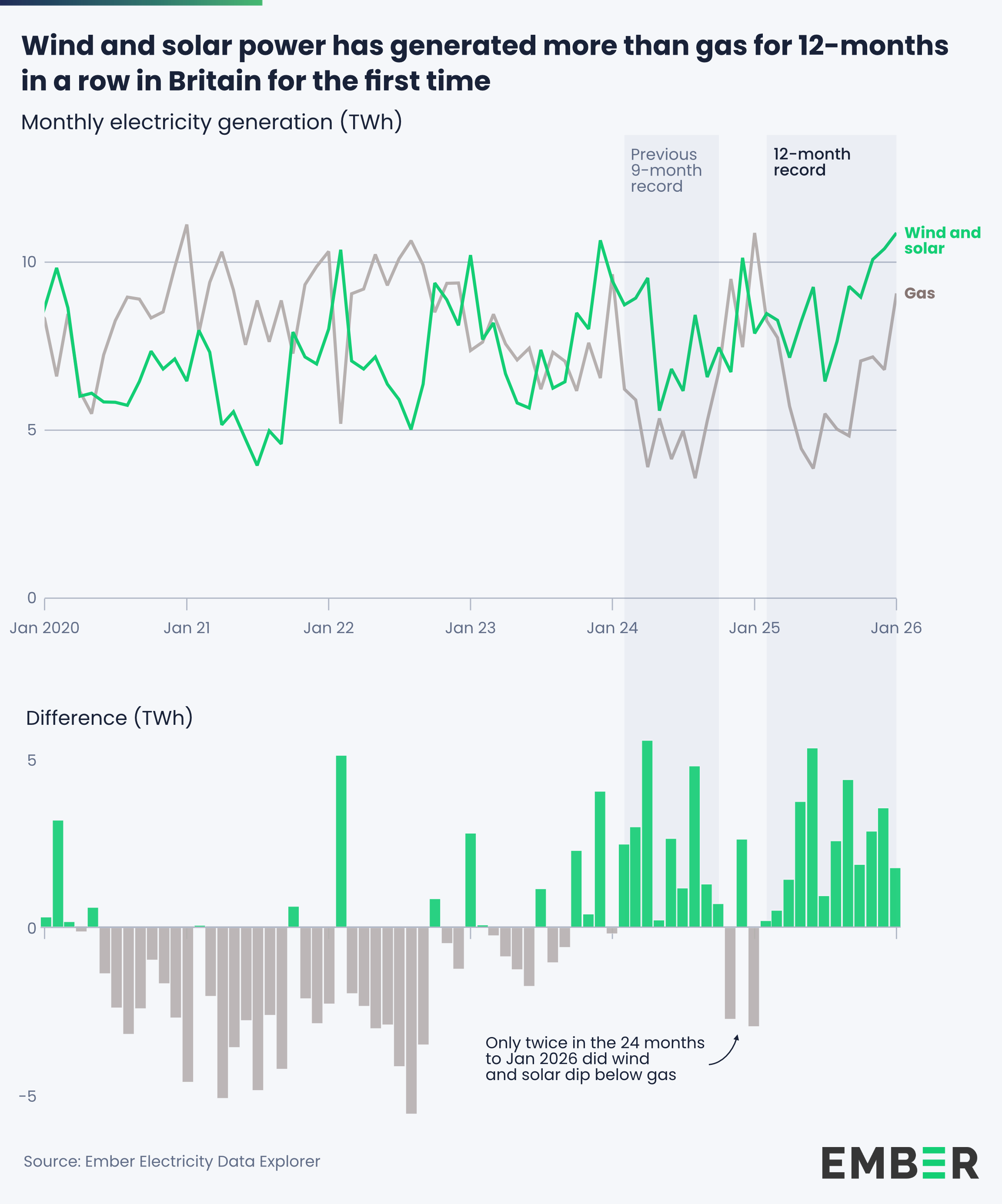
In Britain, combined wind and solar generation exceeded gas generation over the past 12 months, surpassing the previous record of 9 months. This marks a major milestone in decarbonising the country’s power supply, demonstrating that combined wind and solar outperformed gas across all seasons. Over the past 24 months, combined wind and solar dipped below gas only twice. January 2026 also marked a record high for combined wind and solar in Britain, reaching 10.87 TWh.
Acknowledgements
Elisabeth Cremona, Rocío Rodríguez Almaraz, Eli Terry, Claire Kaelin, Burcu Unal, Reynaldo Dizon and Neha Rajput