

Germany’s battery opportunity
The battery market is ready to fortify Germany’s energy security, and it is time for policy to catch up. The lack of a clean flexibility strategy, combined with the preferential treatment of gas in forthcoming auctions, risks locking Germany into a costly dependency on gas imports.
Available in: Deutsch (IKND)
13 May 2026
5 Minutes Read

Beatrice Petrovich
Principal Energy Analyst, Europe
Ember
Principal Energy Analyst, Europe
Ember

Clara Mewes
Lead Analyst
Initiative Klimaneutrales Deutschland (IKND)
Lead Analyst
Initiative Klimaneutrales Deutschland (IKND)

Leonard Heberer
Senior Data Analyst
Ember
Senior Data Analyst
Ember
A long-awaited package will determine whether Germany’s electricity backup power is secured entirely by new fossil gas power plants or whether clean flexibility solutions, such as batteries, are allowed to compete on an equal footing.
Germany has a strong grid-scale battery pipeline, but the lack of an ambitious clean flexibility strategy and the preferential treatment of gas in forthcoming auctions risk slowing deployment, causing the country to forego the benefits of batteries and remain locked into gas import dependency for decades.

- Germany hosts around a quarter of the EU’s total large-scale battery capacity, with over 2.5 GW operational by the end of 2025 – more than double the capacity of just two years earlier. A robust project pipeline and high social acceptance of the technology among German municipalities point to continued growth, with over 10 GW expected capacity, but policy barriers could hold it back.
- If Germany’s expected new large-scale battery projects had been operational in 2025, they could have avoided approximately one-third of wind and solar curtailment, cutting redispatch costs and gas purchases by about €0.8 billion. This exceeds the required investment in batteries.
- Germany’s residential battery market is Europe’s largest and shows prospects for continued growth – roughly one in six homeowners already has a battery installed, and 30% are considering purchasing one within the next five years. Smart charging of these batteries could relieve bottlenecks in the distribution grid and avoid significant system costs.
Batteries cut energy costs for consumers, stabilise grids and enable greater use of homegrown renewables. All they need to continue to scale is a fair access to capacity auctions and a stable policy framework. Amid Germany’s current fossil fuels crisis, eliminating policy barriers to batteries and other non-fossil flexibility solutions will fortify energy security and prevent costly long-term reliance on gas imports.
Beatrice Petrovich
Senior Analyst, Ember
Senior Analyst, Ember
We’re seeing strong and growing demand for battery storage among both municipalities and households. By 2030, up to 7 million single-family homes – about half of them – could be equipped with home storage systems. Interest is just as high at the municipal level, where by 2035, one in three municipalities could be running their own storage solutions. The focus now is on creating the right conditions to turn these plans into reality – making sure they’re cost-efficient, flexible and support a reliable energy supply.
Clara Mewes
Lead Analyst, Initiative Klimaneutrales Deutschland (IKND)
Lead Analyst, Initiative Klimaneutrales Deutschland (IKND)
German battery market is ready, policy has yet to catch up
Germany’s energy policy debate is at an inflection point. Its electricity system is being shaped by three pieces of legislation moving through the political process simultaneously: the reform of the country’s renewables support system (Erneuerbare-Energien-Gesetz, EEG), the grid package and the Electricity Supply Security and Capacity Act (Strom-Versorgungssicherheits- und Kapazitätengesetz, StromVKG). The long-delayed StromVKG aims to secure remunerated backup power capacity for “Dunkelflaute times of little wind and sunshine” through tenders which are expected to start in September 2026.
The decisions made in these laws will determine whether Germany’s electricity supply is secured through clean technologies that are already available and cost-competitive, or through new fossil gas capacity that locks in fuel import dependency for decades and exposes the German economy to price shocks driven by geopolitical events.
Recent reporting has raised serious questions about whether battery storage is being considered on equal terms with gas in this process, a concern shared by Germany’s national competition regulatory agency (Bundeskartellamt). The evidence suggests it should be.
Germany has a strong grid-scale battery pipeline, but the lack of an ambitious clean flexibility strategy and the preferential treatment of gas in the forthcoming auctions risk slowing deployment and causing the country to forego battery benefits. Batteries can ensure that as many solar- and wind-generated kilowatts as possible are put to use, reducing clean power curtailment, associated costs and reliance on costly fossil generation by shifting clean electricity to non-sunny and non-windy hours. They increasingly support the grid by providing voltage control, emergency power and inertia, competing directly with fossil generators for these services.
Germany leads Europe in battery storage, but policy could hold it back
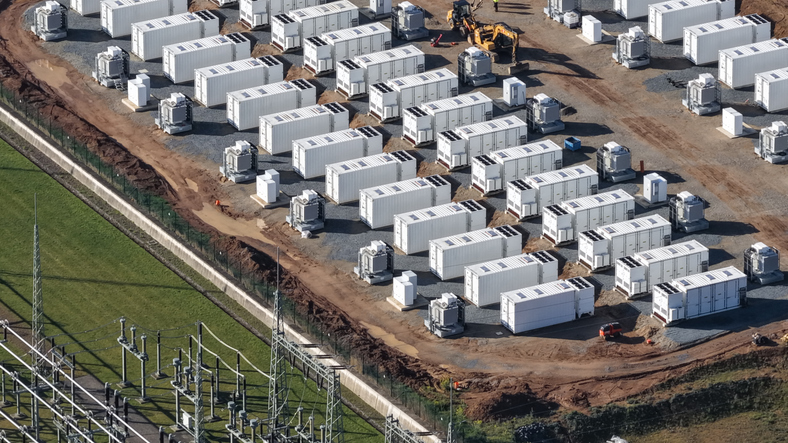
Germany currently hosts around 25% of the EU’s total large-scale battery capacity, with over 2.5 GW operational by end-2025. That is more than double the 1.2 GW recorded just two years earlier. Falling battery prices are driving the rapid scale-up in deployments.
There is more to come. A robust project pipeline points to continued growth, with over 10 GW of new battery projects as of December 2025, of which 1.5 GW is already under construction. Battery projects are increasingly cost-competitive and faster to build than new gas power plants, particularly in countries reliant on expensive LNG imports and given the current global shortage of gas-power equipment leading to rising equipment prices for new-build gas plants. Batteries’ performance over longer time frames has also been improving, with a 4-hour duration expected as the standard in the short-term future across Europe and storage tenders creating demand for projects with longer duration. All awarded battery storage projects in Italy’s MACSE storage tenders held in October 2025 had duration above 6 hours.
This signals strong market momentum, but whether Germany can fully capitalise on battery benefits remains an open question. Uncertainty over the regulatory framework and the prospect of preferential treatment for gas capacity in upcoming auctions risk undermining investor confidence in battery projects and could slow the pace of deployment.
Wasted power hits consumers’ wallets
Germany curtailed 8 TWh of wind and solar generation in 2025, nearly 3.4% of their total output. This is not an abstract efficiency loss: curtailment costs are passed directly to consumers via grid fees. If Germany’s announced large-scale battery pipeline (10.5 GW / 26.3 GWh) had been operational in 2025, it could have avoided around one third of that curtailment, cutting approximately €0.8 billion in redispatch costs (€613 million) and avoided gas purchases (€219 million).
These benefits would have exceeded the required investment in batteries. To deliver annual savings of €0.8 billion, the additional investment is estimated at €145 million per year over the technology’s lifetime. The cost-benefit ratio for investing in batteries improves further when accounting for additional grid stabilisation services and multi-year lifetime of these assets. Batteries increasingly support the grid by providing voltage control, emergency power and inertia, competing directly with fossil generators for these services.
Moreover, batteries are a core enabler of the next stage of solar growth. As Germany’s power system reaches high daytime solar shares, batteries will be critical for shifting clean electricity into non-sunny hours and sustaining solar expansion.
This shift brings tangible benefits by reducing reliance on costly fossil generation and stabilising prices during hours when power demand is typically high, as already demonstrated in countries ahead of the curve, such as Australia, where batteries are lowering evening peak power prices.
Germany’s homeowners signal readiness for a battery boom
The market signal from households is equally clear. Germany’s residential PV-plus-battery market is Europe’s largest. It already has more than two million home battery systems installed – roughly one in six homeowners.
According to a survey of German homeowners by the Institute für Demoskopie Allensbach, 30% of homeowners are considering purchasing a home battery within the next five years. If this purchase intent translates into action, the number of residential battery users could rise from two million today to seven million by 2030. Key drivers include high self-consumption value, resilience against outages, and EV charging optimisation. Small-scale batteries are also increasingly benefiting from a supportive adoption framework, including VAT exemptions and the rollout of dynamic tariffs.
Beyond individual energy costs, this matters at the system level: smart charging of these batteries on sunny days could relieve bottlenecks in the distribution grid and reduce federal budget costs by tens of millions of euros annually. The main barrier to uptake remains the upfront cost.
Mayors back large-scale storage, but face steep barriers
Local governments are equally engaged, as shown by a survey of German mayors conducted by the Initiative Klimaneutrales Deutschland and Heimatwurzeln. Energy storage tops the list of technologies municipalities are interested in: it is the single technology with the highest level of stated interest among all options tested, ahead of wind, solar and heat networks.
Yet 60% of mayors report poor or no knowledge of battery storage technology among their administrations. Financial constraints are acute: 72% of surveyed municipalities describe their budgets as tight or very tight, and 50% cite financing as their primary barrier to implementing energy transition projects. Another key barrier is grid connection capacity: 97% of respondents see local challenges to grid access.
A clean flexibility strategy is the missing piece
The data from households, municipalities and the electricity market converge on the same conclusion: demand for battery storage is real and growing at both the residential and grid scale. The economics are favourable.
What is missing is regulatory clarity. The upcoming Electricity Supply Security and Capacity Act and grid package should treat battery storage as a first-order solution for grid stabilisation and flexibility – not an afterthought. Preferential pathways for gas in capacity auctions – as envisaged in the current draft bill – would delay the deployment of clean technologies that are already cost-competitive and shovel-ready.
What Germany needs is a coherent clean flexibility strategy: a framework that gives equal standing to batteries at all scales, demand-side flexibility (including from electric vehicles and heat pumps) and smarter grid infrastructure, alongside concrete targets for non-fossil flexibility capacity.
Such a strategy would provide the investment predictability the market requires, remove structural barriers in auction design and ensure that the upcoming legislative package secures Germany’s electricity supply through clean technologies that are available today – rather than through a new generation of gas infrastructure that extends fuel import dependency.
Supporting materials
About Ember
Ember is an independent energy think tank that aims to accelerate the clean energy transition with data and policy. Its vision is a clean, electrified energy system for all. It gathers, curates and analyses data on the global energy system, publishing this openly and accessibly. It uses data-driven insights to shift the conversation towards high impact policies and empower other advocates to do the same. Founded in 2008 as Sandbag, it formerly focused on analysing and reforming the EU carbon market, before rebranding as Ember in 2020. Its diverse team brings together energy analysts, data scientists, communicators and team-builders based around the world in over 20 countries, including Australia, Brazil, Colombia, Germany, India, Indonesia, Poland, South Africa, Türkiye, the UK and US.
About Initiative Klimaneutrales Deutschland (IKND)
The Initiative Klimaneutrales Deutschland (IKND) is a Germany-based non-profit dedicated to strengthening constructive debate on climate and energy policy. It is guided by the conviction that the transition succeeds better when everyone understands what is to be gained in a climate neutral Germany. IKND connects key stakeholders across sectors, prepares complex knowledge in an accessible way and amplifies solution-oriented voices in climate and energy debates.
Acknowledgements
Contributors
Paweł Czyżak, Izabela Urbańska, Kostantsa Rangelova
Cover image
Aerial view of a large-scale battery storage construction site with white containers and electrical infrastructure.
Credit: Maik Falk / Getty Images Plus
Related Content
Analysis
Plugging storage into India's rooftop solar revolution
21 October 2026
Analysis
Storage target ambition is rising, but not fast enough to reach the goal
14 October 2026
Analysis
Electric energy security: how EVs are reducing oil import vulnerabilities
13 October 2026
Analysis
Bankable by design: Financing ASEAN's energy system transformation
06 October 2026