
Rewiring Resilience: AI for Climate-Adaptive Power Grids in Asia-Pacific
In a warming climate, power grids must manage not only transition-driven variability, but also adapt towards proactive, climate-ready system design. AI offers strategic capabilities to support this shift by integrating fragmented data, linking models across sectors and translating system complexity into actionable guidance for planning and operations.
21 May 2026
42 Minutes Read

Muyi Yang
Senior Energy Analyst, Asia
Ember
Senior Energy Analyst, Asia
Ember

Prof. Xunpeng Shi
President
International Society for Energy Transition Studies
President
International Society for Energy Transition Studies

Xiwei Wu
Principal Research Scientist
CSIRO
Principal Research Scientist
CSIRO

Wenjie Zhang
Head of the Data and Knowledge Research Group and Deputy Head of School (Research)
School of Computer Science and Engineering, the University of New South Wales
Head of the Data and Knowledge Research Group and Deputy Head of School (Research)
School of Computer Science and Engineering, the University of New South Wales

David Lo
Director, Information Systems & Technology Cluster Co-Director
Centre for Research for Intelligent Software Engineering, Singapore Management University
Director, Information Systems & Technology Cluster Co-Director
Centre for Research for Intelligent Software Engineering, Singapore Management University
Table of Contents
Executive summary
Read
+
Chapter 1: The Great Grid Redesign: Building for Flexibility
Read
1.1 Leading the renewable surge: From growth to variability
Read Section
1.2 Powering demand growth: From scale to complexity
Read Section
1.3 Future-proofing the grid: Scaling flexibility
Read Section
+
Chapter 2 The Climate Stress Test: A More Volatile Operating Environment
Read
2.1 Escalating climate stress
Read Section
2.2 Extremes are already disrupting the grids
Read Section
2.3 Even at 1.5°C, system stress intensifies
Read Section
+
Chapter 3 Evolving Responses: From Asset Resilience to System Adaptation
Read
3.1 Firefighting the crisis: Repair and recovery
Read Section
3.2 Reinforcing vulnerable assets: Infrastructure hardening
Read Section
3.3 Rewiring the system: Designing for systemic adaptation
Read Section
+
Chapter 4 Scaling Systemic Adaptation: AI as a Strategic Enabler
Read
4.1 Data fusion: Integrating diverse datasets
Read Section
4.2 Analytical choreography: Orchestrating different models
Read Section
4.4 Building the capabilities for AI-enabled adaptation
Read Section

Executive summary
Scaling climate-adaptive power grids with AI
From the manufacturing hubs of East Asia to the fast-growing economies of South and Southeast Asia and the mature systems of Oceania, the Asia-Pacific region operates some of the world’s largest, most dynamic, and highly climate-exposed electricity systems.
These grids now face a dual mandate: managing increasingly variable supply and demand, while maintaining reliability under volatile climate conditions.
Current regional efforts focus heavily on flexibility — scaling storage, interconnectors, and demand response. While essential, these measures address only half of the challenge.
Key takeaways
01
Variability is also climate-induced
Redesigning grids for flexibility manages the variability created by renewables and shifting demand. But climate change introduces a second, external layer of variability. Increasing heatwaves, droughts, and floods are reshaping the operating environment of the grid. Even at 1.5°C, extremes become more frequent and intense. Climate adaptation is no longer an optional add-on; it is a core design requirement for system reliability.
02
System-level adaptation is needed
Traditional responses often focus on reactive repair or “hardening” individual assets. While necessary, these are insufficient. True resilience requires a system-level understanding of vulnerability: how power systems depend on critical sectors like water, transport and emergency services, where failures could cascade, and where targeted reinforcement can strengthen resilience across the whole system.
03
AI can provide capabilities to scale systemic adaptation
Several countries are already taking steps towards system-level adaptation, but scaling it remains difficult. Data are fragmented, models are siloed and complexity is rising. AI can help close these gaps by integrating diverse datasets, linking models across sectors and supporting faster, better-informed decisions. It does not replace engineering expertise or planning tools; rather, it provides the computational “connective tissue” required to build and operate climate-adaptive grids at scale.
Chapter 1
The Great Grid Redesign: Building for Flexibility
A fundamental redesign of power grids is underway across the Asia-Pacific, driven by the world’s fastest renewable expansion and accelerating electrification. Together, these forces are stretching grids past their traditional design limits, injecting greater variability into supply while making demand larger, more dynamic and more complex to manage. As a result, grid development is shifting from traditional capacity expansion to a broader redesign centred on flexibility — the ability to balance supply and demand across time and space under increasing uncertainty.
1.1 Leading the renewable surge: From growth to variability
Asia-Pacific has recorded the fastest growth in renewable capacity globally, particularly in wind and solar. Since 2014, roughly nine in ten new renewable megawatts added in the region have come from these two technologies. Meanwhile, hydropower capacity growth, by contrast, has been modest, constrained by factors such as high upfront capital requirements, long development timelines, limited available economic sites, and growing environmental and social scrutiny.
As a result of sustained capacity build-out, the region generated almost 50% of the world’s renewable electricity in 2024. Under the IEA’s Stated Policies Scenario, this share is projected to surpass 60% by mid-century. Growth would be driven predominantly by wind and solar, whose combined generation is expected to increase from about 3,000 terawatt hours (TWh) in 2025 to just over 20,000 TWh by 2050. By mid-century, they would account for more than 85% of total renewable generation in the region, up from less than 60% in 2025.
This is no longer just a China story. Renewable growth is spreading across the Asia-Pacific, with India and major Southeast Asian economies rapidly emerging as new centres of expansion. Together, these economies are projected to generate approximately 6,100 TWh of renewable electricity annually by 2050, exceeding Europe’s total electricity generation today (around 5,000 TWh in 2025). Growth is also accelerating across other regional markets.
1.2 Powering demand growth: From scale to complexity
Asia-Pacific is the main driver of global electricity demand growth. In 2024, the region consumed just over half of the world’s electricity and is set to drive roughly 60% of all demand growth through 2050, far outpacing other major regions.
This expansion is driven by multiple interacting and mutually reinforcing forces. Rising affluence is increasing electricity use across households and commercial sectors. Deepening industrialisation, particularly in emerging economies across South and Southeast Asia, is adding new sources of high-intensity demand. Furthermore, the electrification of transport, buildings and industry is shifting broader energy consumption directly into the power sector.
1.3 Future-proofing the grid: Scaling flexibility
Taken together, these shifts in supply and demand are redefining how grids must operate. The interaction of variable renewable supply and increasingly dynamic electricity demand is creating a new operational challenge: maintaining balance across time and space under rising variability and uncertainty.
Managing this new reality demands a fundamental redesign of power grids, with a stronger focus on flexibility, the ability to balance supply and demand across hours, seasons and geographies while maintaining system reliability and energy security at scale. In practice, this means expanding and upgrading transmission networks, deploying energy storage and strengthening system coordination mechanisms to manage variability more effectively.
This shift is already underway. In China, grid investment has accelerated significantly, exceeding 600 billion RMB (about $85 billion) in 2024, with plans to invest 4 trillion RMB (approximately $574 billion) in grid upgrade through 2030. At the same time, energy storage capacity is scaling rapidly: total capacity has more than tripled since 2021, with a record 37 GW/91 GWh of battery storage commissioned in 2024 alone, more than the combined additions of the United States (12 GW/37 GWh) and Europe (12 GW/21 GWh).
Momentum is also building in Southeast Asia. A new financing platform, launched in 2025 by the Asian Development Bank, the World Bank and the Association of Southeast Asian Nations (ASEAN), aims to help double cross-border interconnection capacity by 2040. Meanwhile, early-stage storage deployment is emerging to support growing renewable integration.
The direction of travel is clear: power systems are moving beyond conventional capacity expansion towards flexibility-centred grid redesign. Storage, transmission, interconnection, demand response and market coordination are becoming core tools for managing the variability created by renewable growth and more dynamic demand.
But this is only part of the story. The rise in variability is not coming only from within the power system. As extreme weather increasingly becomes the “new norm”, grids must also operate under more volatile external conditions — from heatwaves and droughts to floods, storms and compound events.
Chapter 2
The Climate Stress Test: A More Volatile Operating Environment
In Asia-Pacific, power grids must be designed not only for efficiency and flexibility, but also to adapt to increasing climate volatility. Extreme weather is no longer a distant risk, it is already becoming an operational constraint. Rising temperatures, shifting rainfall patterns, and more frequent extreme events are altering the conditions under which power systems must operate, and this will intensify even in a 1.5°C world.
2.1 Escalating climate stress
As global temperatures rise, the climate baseline in Asia-Pacific is shifting, bringing more frequent and severe extremes.
Record-breaking heatwaves are occurring with growing frequency across East and South Asia during the summer months, when electricity demand is typically already at its seasonal peak. Extremes that historically only occurred once every several decades, or even once a century, are increasingly appearing back-to-back.
In China, sustained high temperatures from June to August 2025 pushed the national average summer temperature to 22.31℃ — the highest recorded since observations began in 1961. This followed a sequence of recent records, including the country’s hottest August in 2023 and its warmest year on record in 2024. Elsewhere in East Asia, Japan recorded its third consecutive year of record-breaking summer heat in 2025, while South Korea experienced its hottest summer the same year, surpassing the previous record set just one year earlier.
In India, the decade from 2016 to 2025 has been the warmest on record, marked by more frequent and prolonged heatwave episodes. Pakistan has likewise endured repeated periods of extreme summer heat in recent years, with temperatures regularly exceeding historical norms.
Further south, Southeast Asia’s tropical climate has always meant high temperatures, but climate change is pushing those temperatures higher. The region’s average annual temperature has increased by around 0.14℃ to 0.20℃ per decade since the 1960s, raising the likelihood of extreme heat events.
In April-May 2023, mainland Southeast Asia experienced an exceptional heatwave. Around 70% of weather stations across Cambodia, Laos, Thailand, Malaysia and Vietnam recorded daily maximum temperatures above 42°C. Thailand’s city of Tak reached a record 45.4°C on 15 April, while Laos’s Sainyabuli province set a new national record of 42.9°C four days later. In early May, Vietnam also broke its previous national temperature record, reaching 44.1°C.
Extreme heat returned the following year. In April 2024, large parts of Southeast Asia — from Thailand and Vietnam to Indonesia, Malaysia and the Philippines — experienced a “historic heatwave“, with temperatures exceeding 40℃ for multiple days. Later in the year, Jakarta and Manila experienced unusual heat beginning in December and lasting until February 2025. In April 2025, temperatures in Thailand again reached “very dangerous” levels in Phuket and “dangerous” levels across Bangkok and 34 other provinces.
Rainfall patterns across Asia and the Pacific are also becoming more volatile and extreme.
East Asia is increasingly experiencing what is often described as “climate whiplash”, with swings between intense rains and periods of drought. Across Southeast Asia, particularly in island economies, climate risks are increasingly linked to tropical cyclones and typhoons that bring destructive winds, extreme rainfall and widespread flooding.
In South Asia, the monsoon season (June-September) is growing more unpredictable, with longer dry spells often followed by sudden bursts of intense rain. In 2022, Pakistan was hit by catastrophic floods after exceptionally heavy monsoon rains submerged large parts of the country. In India, delayed or weaker early monsoon rains are often followed by intense downpours in recent years that trigger urban flooding and landslides in vulnerable regions.
Much of southern Australia has become progressively drier in recent years, particularly during the cool season from April to October, with rainfall in 19 of the 22 years between 2000 and 2021 falling below the 1961–1990 average. Northern Australia, by contrast, has generally become wetter. At the same time, extreme rainfall events are becoming more intense across many regions, increasing the risk of flash flooding, particularly in urban areas.
2.2 Extremes are already disrupting the grids
Climate stress is already translating into operational disruption for power systems across Asia-Pacific.
Heatwaves drive sharp increases in cooling demand while also reducing supply capacity through derating of thermal power plants, overheating of transformers and reduced ampacity of transmission lines. The April-May 2022 heatwave in India illustrates this dynamic clearly. Unusually high temperatures sharply increased the use of air conditioners, fans and refrigerators, pushing electricity demand close to system limits and contributing to widespread power shortages in several states. Similar stress was observed in Japan during the summer of 2022, when extreme heat pushed electricity demand in the Tokyo region close to peak capacity, prompting authorities to issue rare electricity supply warnings and ask households and businesses to conserve power.
Drought affects power systems primarily by constraining water-dependent electricity generation. Prolonged dry conditions reduce hydropower output as reservoir levels fall, while low river flows can also limit the availability of cooling water for thermal power plants. This can significantly reduce baseload generation capacity, particularly in regions where hydropower plays a major role in the electricity mix. The Mekong basin provides a clear example. During the severe drought in 2019–2020, water levels across the Mekong River dropped to historically low levels, reducing hydropower generation and tightening electricity supply in several countries across mainland Southeast Asia.
Temperature-related extremes can also increase the risk of bushfires. Fires can damage transmission and distribution lines, destroy poles and substations, and force grid operators to shut down parts of the network to prevent power lines from igniting new fires. Australia’s 2019–2020 “Black Summer” bushfires demonstrated how wildfires can disrupt electricity supply across large areas and force preventive power shutoffs during periods of extreme fire weather.
Heavy rainfall can inundate substations and allow water ingress into underground cables. These disruptions can cause localised outages and may cascade into wider system failures when major network assets are affected. The 2021 Zhengzhou floods in China and the catastrophic floods in Pakistan in 2022 both disrupted electricity infrastructure and delayed restoration efforts due to widespread infrastructure damage and limited access to affected sites.
Tropical cyclones and typhoons pose some of the most severe risks to electricity supply across coastal parts of East and Southeast Asia, particularly in countries such as the Philippines, Japan, Vietnam and along China’s southeast coast. These storms combine destructive winds, intense rainfall and coastal storm surges, causing widespread damage to transmission lines and substations and generation facilities. The Philippines was hit by six tropical storms in November 2024 alone, triggering major power outages across several regions. In 2025, typhoon Kajiki affected several Southeast Asian countries as well as Hong Kong, Macau, and Hainan in China. In Vietnam alone, power blackouts in Ha Tinh and Nghe An provinces disrupted electricity supply for around 1.6 million people.
Increasingly, risks are not isolated but compound, where multiple hazards occur simultaneously or sequentially, amplifying system stress. Typhoon Trami in 2024 brought intense rainfall and flooding to parts of the Philippines, damaging electricity infrastructure and leaving over 350 municipalities without power. China’s 2022 heatwave coincided with severe drought, sharply tightening electricity supply in hydropower-reliant Sichuan province. At the peak of the crisis, hydropower generation dropped to less than half of the normal levels. Authorities responded by imposing power rationing on industrial users and calling on households and commercial buildings to reduce electricity consumption.
2.3 Even at 1.5°C, system stress intensifies
These are not isolated headline events, but early warning signals of a more volatile operating environment.
Despite growing mitigation efforts, global carbon emissions continue to rise, increasing by 1.1% in 2025 compared with the previous year. At this pace, global warming is likely to continue. The UNEP’s Emissions Gap Report 2025 warns that, if current trends persist, the multi-decadal average of global temperature will very likely exceed 1.5°C within the next decade.
Even if global warming is limited to 1.5°C, power systems will not return to past operating conditions. Once-rare extremes will become more frequent and intense. Adaptation is therefore not optional, even under strong mitigation.
According to the IPCC Sixth Assessment Report, a 1-in-10-year hot extreme would occur 4.1 times as often at 1.5°C warming and 5.6 times as often at 2°C warming, while a 1-in-50-year hot extreme would occur 8.6 times and 13.9 times as often, respectively. A 1-in-10-year heavy precipitation event would occur 1.5 times as often at 1.5°C warming and 1.7 times as often at 2°C.
For power system planners, the implication is clear: future electricity networks must be designed not only to integrate large shares of renewable energy, but also to operate reliably under increasingly volatile climate conditions.
Chapter 3
Evolving Responses: From Asset Resilience to System Adaptation
Managing climate-induced variability requires power systems to do more than balance supply and demand. Unlike variability from renewable generation or changing demand patterns, climate risks come from outside the power system: they cannot be engineered away by redesigning the grid alone. Power systems must therefore be adapted to anticipate, absorb and recover from disruption under more volatile operating conditions.
This means moving beyond past reactive repair and recovery, while expanding asset-level hardening into system-level adaptation. Several Asia-Pacific countries are already taking steps towards this approach, but the challenge is no longer recognising what is needed; it is how to scale this shift in practice.
3.1 Firefighting the crisis: Repair and recovery
Historically, responses to weather-induced power outages across Asia-Pacific economies have been reactive, triggered only in the wake of disruption. The priority is straightforward: bring the lights back on as quickly as possible.
In practice, this “repair and recovery” approach operates on two fronts:
At the community level: The focus is on localised coping mechanisms, such as deploying backup generators, setting up communal charging stations and providing emergency support to vulnerable residents during the blackout.
At the infrastructure level: Responsibility often falls on electric utilities and system operators. Repair crews are deployed to fix downed transmission lines and damaged substations, gradually bringing the grid back online. These efforts are typically guided by historical experience, with teams addressing damage site-by-site. Following major disasters, such as a severe typhoon, this recovery process can stretch into days or even weeks, particularly when multiple segments of the local grid are compromised.
Relying solely on a firefighting strategy in an era of intensifying climate risk creates a cycle of escalating costs. When utilities are forced to repeatedly repair vulnerable segments of the grid, the cumulative cost of emergency labour, replacement parts and, most critically, protracted economic downtime far exceeds the cost of preemptive adaptation.
3.2 Reinforcing vulnerable assets: Infrastructure hardening
In response to escalating climate risks, many power systems across Asia-Pacific are moving towards infrastructure hardening. Rather than waiting for assets to fail and then fixing them, the focus has shifted to strengthening vulnerable components to reduce the likelihood of failure.
Typical measures include reinforcing transmission towers to withstand high winds, elevating substations above flood levels and, in high-risk areas, relocating exposed distribution lines underground. Routine practices, such as vegetation management along transmission corridors, have also become more systematic to minimise outages caused by falling branches or debris during storms.
In China, the impacts of Typhoon Lekima, which caused more than 4,000 transmission line faults, prompted a surge of investment in strengthening transmission infrastructure against extreme wind events. Utilities in Japan have similarly focused on asset-level reinforcement to reduce failure risks during typhoon seasons.
These efforts are increasingly supported by advanced risk modelling tools. Fragility-curve-based models help system operators identify weak points in the network, while cascading failure models allow them to anticipate how disruptions may propagate under climate stress. Together, these tools enable more targeted and efficient investment in asset protection.
3.3 Rewiring the system: Designing for systemic adaptation
Infrastructure hardening is critical, but its effectiveness depends on whether planners know where the system is most vulnerable and where failure could cascade.
Climate extremes rarely occur in isolation. Tropical cyclones often combine strong winds with heavy rainfall, storm surge, landslides, and inland flooding. Summer heatwaves are frequently accompanied by prolonged drought and reduced rainfall. When climate hazards converge, the limitations of the “fixing parts” approach become evident. During Japan’s Typhoon Hagibis in 2019, parts of the grid designed to withstand high winds were ultimately compromised by storm surge and flooding, leading to prolonged outages.
These vulnerabilities are further compounded by cross-sector dependence. Power systems depend on transport, telecommunications, water and digital infrastructure. As a result, disruptions in one system can cascade across others, undermining overall resilience.
Addressing these challenges requires a shift from asset-level resilience to system-level adaptation. This means designing and operating the power system as part of a wider network of interdependent infrastructure, where reliability depends not only on the strength of individual assets, but also on how the system anticipates, absorbs and recovers from disruption.
Some countries are beginning to move in this direction. In Australia, Infrastructure Australia has called for a “whole-of-system” and “all hazards” approach to resilience. Building on this, the government commissioned its first National Climate Risk Assessment in 2023, undertaken by the Australian Climate Service. Rather than focusing on individual hazards or assets, it assesses how climate risks can combine and cascade across sectors — from energy to transport to the wider economy.
Similarly, Japan’s National Resilience framework brings together multiple ministries under a coordinated disaster management system, emphasising all-hazard preparedness and integrated planning across critical infrastructure. In China, progress is also being made to strengthen cross-sector coordination in infrastructure resilience.
However, scaling systemic adaptation is not straightforward.
Data. Systemic adaptation requires information on climate hazards, grid assets, demand patterns, water availability, transport networks, telecommunications and emergency services. Yet these datasets are often fragmented, incomplete, inconsistent or held by different institutions. Without a shared data foundation, planners struggle to identify where vulnerabilities overlap or where failures could cascade.
Analytical tools. Climate, power, water, transport and emergency response systems are often analysed through separate tools, with different assumptions, timeframes and spatial resolutions. This makes it difficult to assess compound risks or understand how disruption in one system may affect another.
Decisions under complexity. Even where risks are identified, decision-makers must prioritise investments under uncertainty, balance resilience against affordability and efficiency, and coordinate across agencies with different mandates. As systems become more complex, the gap between analysis and actionable planning widens.
These constraints are not identical across Asia-Pacific. Mature power systems, large emerging economies and smaller developing systems face different degrees of data availability, analytical capacity and planning complexity. But the scale of grid expansion now underway across the region makes addressing these constraints critical.
As power systems grow larger, more renewable-based and more interconnected, the cost of fragmented data, siloed models and delayed decisions will rise. This is where AI can play a strategic role — not as a silver bullet, but as an implementation enabler for scaling systemic adaptation.
Chapter 4
Scaling Systemic Adaptation: AI as a Strategic Enabler
As power systems become more complex and climate risks become more volatile, the limits of conventional planning and operational tools are becoming increasingly evident. AI does not replace conventional approaches. Instead, it adds a coordination layer, integrating fragmented data, linking models and supporting decision-making across increasingly complex and interconnected systems. In doing so, it enables capabilities that are essential for managing climate risk at the system scale.
4.1 Data fusion: Integrating diverse datasets
Systemic adaptation begins with data — the foundation for mapping climate risks, understanding asset vulnerabilities and tracing cross-sector interdependencies in a consistent and sufficiently detailed way.
Across the Asia-Pacific, this foundation remains uneven and often weak. Climate data are frequently scarce and fragmented, particularly in parts of South and Southeast Asia. Long-term weather records are often incomplete, monitoring networks lack density, and high-resolution projections are limited. This constrains the ability to assess both hazard-specific and compound risks.
The challenge is further complicated by non-stationarity: the past is no longer a reliable guide to the future, as climate change shifts baseline conditions and amplifies variability.
Power system data faces similar constraints. High-resolution datasets on grids and renewable resources — critical for understanding variability, congestion and system dynamics — are often siloed or restricted. In some cases, they exist only as isolated case studies rather than as continuously updated resources.
The gaps are even more pronounced when it comes to cross-sector interdependencies. Data on how power systems interact with water, transport, telecommunications and emergency services remains limited and fragmented. Where such data exist, they are rarely aligned, differing in format, resolution and definitions. Weak data governance, lack of standardisation and poor interoperability further hinder integration across sectors.
AI can act as a data fusion layer, integrating datasets that differ in format, resolution and completeness into a coherent system view. This contrasts with conventional data tools, which typically rely on pre-defined data structures and require inputs to be cleaned, standardised and aligned before they can be used. Machine learning models — including deep neural networks, graph-based models and spatio-temporal architectures — can instead learn to align and connect different data streams, reconciling differences in formats and definitions and converting unstructured or semi-structured information into usable, structured data. They can also address gaps in incomplete or sparse datasets through interpolation, imputation and synthetic data generation, improving coverage where observations are limited.
More fundamentally, techniques such as knowledge graphs and representation learning enable data to be organised in ways that capture underlying semantics, relationships and even causal dependencies across systems. This allows AI to move beyond data aggregation, constructing a coherent, connected and continuously updated representation of complex systems — integrating grid operations, weather patterns, transport networks and satellite imagery into a high-fidelity data layer for risk assessment and decision-making.
Case study
The Future Smart Energy (FUSE) project, a joint Finnish–German research initiative, demonstrates how AI can be used to integrate diverse data streams in power distribution systems. It develops a hierarchical AI architecture that integrates data from distribution networks, weather conditions and engineering practice into a coherent, system-level view of grid conditions, supporting operators in monitoring, predictive maintenance and operational decision-making.
The Indo–Dutch Digital Twin City Project, developed through collaboration between the Indian Institute of Technology Hyderabad and the City of Amsterdam, uses an AI-based platform to integrate traffic, energy, emissions and spatial data in real time, supporting a more coordinated and system-level approach to urban infrastructure planning.
4.2 Analytical choreography: Orchestrating different models
If data is the foundation of systemic adaptation, analytical tools are what turn that foundation into actionable insights — translating data into forward-looking scenarios, risk assessments and stress tests.
In many Asia-Pacific countries, these tools already exist but remain fragmented. Sectoral models — covering power systems, climate risks, transport infrastructure and water networks — often operate with different assumptions, temporal scales and modelling architectures. As a result, they struggle to capture interactions across systems or reflect how risks propagate under real-world conditions.
AI can function as a connective layer, linking these models into a coherent analytical workflow. This can be achieved through a multi-agent AI system, where each agent represents a specific domain, model or analytical function such as grid simulation, climate forecasting or transport disruption analysis.
Within such a system, AI helps align inputs by organising and standardising different datasets and model interfaces, for example, through knowledge graphs and data harmonisation techniques. It also enables models to interact by bridging differences in assumptions and modelling approaches, allowing outputs from one model to inform others through approaches such as ensemble modelling and coordinated agent-based interaction. In addition, it can orchestrate how models are run, linked and updated, supporting more adaptive and integrated analysis over time. Agents today are also capable of writing source code that can be run to perform data alignment steps and beyond; such code can be inspected, audited and enhanced by human experts.
Importantly, many of these capabilities do not require building entirely new models from scratch. Existing analytical platforms, energy management systems and simulation environments can be incrementally extended with AI agents to enable more automated and responsive decision-making.
Case study
The Model INTegration (MINT) platform, developed under DARPA’s World Modelers program, combines semantic ontologies, automated workflow planning and machine learning to integrate models across climate, hydrology, agriculture and economics. It is designed to address complex, real-world challenges, where outcomes depend on interactions across multiple systems. The platform has been applied to support food insecurity analysis and early warning systems in Sub-Saharan Africa, linking climate variability, water availability, agricultural production and market dynamics within a unified modelling framework.
Shanghai’s AI orchestration platform illustrates how AI can support analytical choreography in a complex urban power system. The platform integrates intelligent agents for forecasting, trading, regulation and settlement into a unified system used by grid operators and energy managers. Rather than functioning as isolated tools, these agents are orchestrated to support real-time grid balancing and virtual power plant operations, with generative AI optimising decisions under tight constraints and human-in-the-loop dashboards visualising real-time data and resource flows.
4.3 Capacity augmentation: Supporting decision-making under complexity
Across much of the Asia-Pacific, turning insights into action remains a key challenge, often held back by limited capacity and weak coordination across sectors. At the same time, systems are becoming more complex and interconnected. As a result, the demands on decision-makers are growing rapidly — often faster than the institutions designed to support them.
AI can support decision-making by augmenting the ability to interpret complex information and guide choices under uncertainty. AI-enabled decision support systems can process large volumes of data and model outputs simultaneously, evaluate multiple scenarios and surface trade-offs across competing objectives. Unlike conventional planning tools, which tend to optimise on expected conditions and may underestimate risks in volatile and multi-hazard environments, AI-enabled systems can operate more adaptively, updating recommendations as new information becomes available.
Case study
DeepMind’s AI system, using machine learning and reinforcement learning techniques, has been applied in Google’s data centres to evaluate different cooling configurations and energy use patterns, identifying actions that optimise performance under changing conditions.
4.4 Building the capabilities for AI-enabled adaptation
AI can help close some of the implementation gaps that make systemic adaptation difficult to scale. But it is not a shortcut. To use AI effectively for system adaptation, countries need the capabilities to integrate it into the planning and operation of power grids: high-quality data systems, technical expertise and computing infrastructure.
Without these foundations, AI risks becoming another layer of complexity rather than a tool for improving resilience. This means countries will need to invest in grid and digital capabilities in parallel. For governments and planners, this points to three practical priorities.
First, climate stress testing should become a standard part of grid planning, so that infrastructure is assessed against heatwaves, droughts, floods, storms and compound events. Second, governments should build the institutional and digital foundations for systemic adaptation, including cross-agency resilience coordination and common interoperability standards for grid, demand and climate data. Third, AI-for-grid pilot programmes should be developed to test real applications in data fusion, model integration and decision support.
The stakes are high. Power systems are a system of systems: they underpin industry, transport, water, communications, public services and everyday life. When they fail, impacts can cascade far beyond the electricity sector. The goal is therefore not AI instead of planning, but AI-enabled planning at the speed and scale that climate adaptation now demands.
Supporting materials
Downloads
Download the full report PDF
Methodology
This report is a synthesis and framing paper rather than a formal modelling exercise. It draws on publicly available data and literature from a range of sources, including the International Energy Agency, Ember, the IPCC Sixth Assessment Report, government documents, media reporting and relevant academic and industry publications.
The analysis combines evidence on renewable energy growth, electricity demand, climate risks and power system resilience to develop the report’s central argument: Asia-Pacific power grids must manage both transition-driven and climate-induced variability. Chapter 4 draws additionally on insights from consultations with AI experts, which informed the report’s framework for understanding AI as an implementation enabler of systemic adaptation through data fusion, analytical choreography and capacity augmentation.
Acknowledgements
Contributors
Thanks to Ember colleagues: Jivan Zhen Thiru, Matt Ewen, Shiyao Zhang, Ardhi Arsala Rahmani, Taiki Asato
Cover image
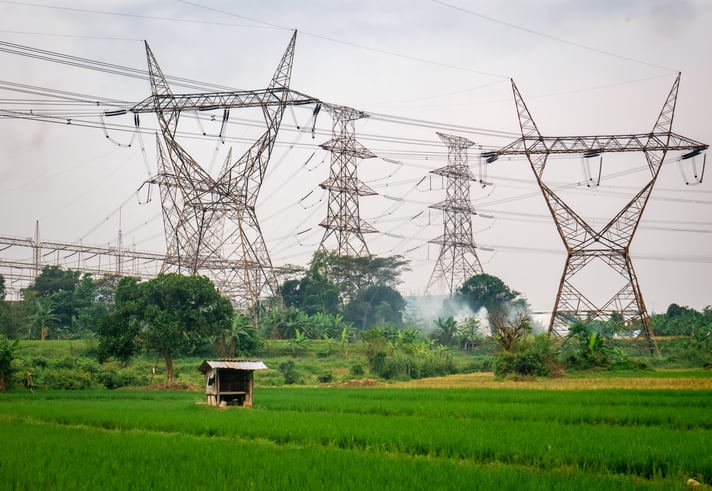
A picture of iron towers that rise high in the rice fields are used to carry electricity cables across the city
Credit: Rio Prastyo / Getty Images Plus