

Power on tap: EU hydro giants can add 25 GW renewables without new grids
Adding new renewable generators to existing hydro installations allows countries to bypass grid limits and reduce network expansion.
21 Jul 2026
8 Minutes Read

Elisabeth Cremona
Energy Infrastructures Lead
Ember
Energy Infrastructures Lead
Ember

Gianluca Geneletti
Grids and Flexibility Analyst – Europe
Ember
Grids and Flexibility Analyst – Europe
Ember

Taylor Gosk
Summer Fellow
Ember
Summer Fellow
Ember

Adding wind and solar to the same grid connection of existing generation plants, referred to as hybridisation, is a near-term way for renewables to bypass grid constraints and lower network build-out costs.
Hydropower assets in Europe are especially suited to hybridisation because they typically leave substantial grid capacity unused for much of the day. By adding wind and solar behind the same grid connection point, operators can maximise utilisation of existing grid infrastructure while staying within injection limits.
The opportunity is concentrated in seven EU hydro giants – Austria, Bulgaria, France, Italy, Portugal, Romania and Spain – which together account for 93 GW of the EU’s 131 GW hydropower.
Key takeaways
01
25 GW of wind and solar can be added to existing hydropower plants across seven EU countries, taking into account environmental constraints.
Through hybridisation, Austria, Bulgaria, France, Italy, Portugal, Romania and Spain could integrate 18% of the new renewables anticipated by 2030 without using additional grid capacity.
02
Hybridisation can almost double the use of existing grid connections, reducing the need for costly network expansion.
Hydropower plants eligible for hybridisation operate at just 19% of their maximum output on average, leaving room for wind and solar to increase utilisation to 36% and 31%, respectively. The impact varies by site and country, and in some cases, wind and solar can even triple use of the same grid connection.
03
Across the seven focus countries, only Portugal and Spain have dedicated rules for hybrid projects, while regulatory support is absent elsewhere.
Establishing national legislation, alongside streamlining and prioritising hybrid project applications would unblock renewable deployment and help maximise the use of existing infrastructure.
Political ambitions mean nothing if clean electrons are stranded in connection queues. For countries facing gridlock, hybridisation offers an immediate, zero-intervention solution. By stacking wind and solar behind existing grid connections, we can unlock the large-scale renewable deployment that underpins Europe’s security and competitiveness, while reducing the need for costly network expansions.
25 GW of wind and solar can be added to EU hydropower plants without any grid interventions
Hybridisation of hydropower – the “forgotten giant of electricity” – allows additional renewables to be connected to the grid, even in countries facing a shortage of grid capacity. With clean electrification now a strategic EU priority, rapidly unlocking grid capacity is critical.
Maximising the use of existing grid infrastructure has become a matter of urgency
The EU’s response to its second fossil fuel price crisis in four years has reinforced its commitment to the energy transition. AccelerateEU, published by the European Commission in April 2026 in response to the Strait of Hormuz shutdown, confirms that clean electrification is the only pathway towards homegrown energy and reduced exposure to fossil fuel price volatility.
Renewable deployment and accelerated electrification have become strategic security priorities. Their success depends in no small part on the grid’s ability to integrate more renewables and accommodate new demand.
A grid capacity gap of more than 120 GW risks delaying new connections
Signs of grid strain are already visible in certain countries, creating barriers to new renewable deployment and triggering tangible financial consequences.
Looking ahead, a shortfall of at least 120 GW exists between available grid capacity and anticipated renewable growth by 2030, threatening to derail Europe’s strategic ambitions. The financial impacts of constrained capacity are becoming increasingly evident, from large volumes of renewables stuck in grid connection queues to data centre developers choosing to relocate to areas with available grid capacity.
As grid development has not kept pace with the evolution of the energy system or Europe’s industrial ambitions, solutions are urgently needed to relieve this infrastructure bottleneck.
Hybridising existing assets will allow renewable investment to continue, even where grid capacity is constrained
Grid scarcity calls for immediate solutions. Ramping up grid expansion is crucial but will take time to deliver results. In the meantime, countries should maximise the use of existing grid infrastructure to ensure continued renewable deployment and support electrification efforts.
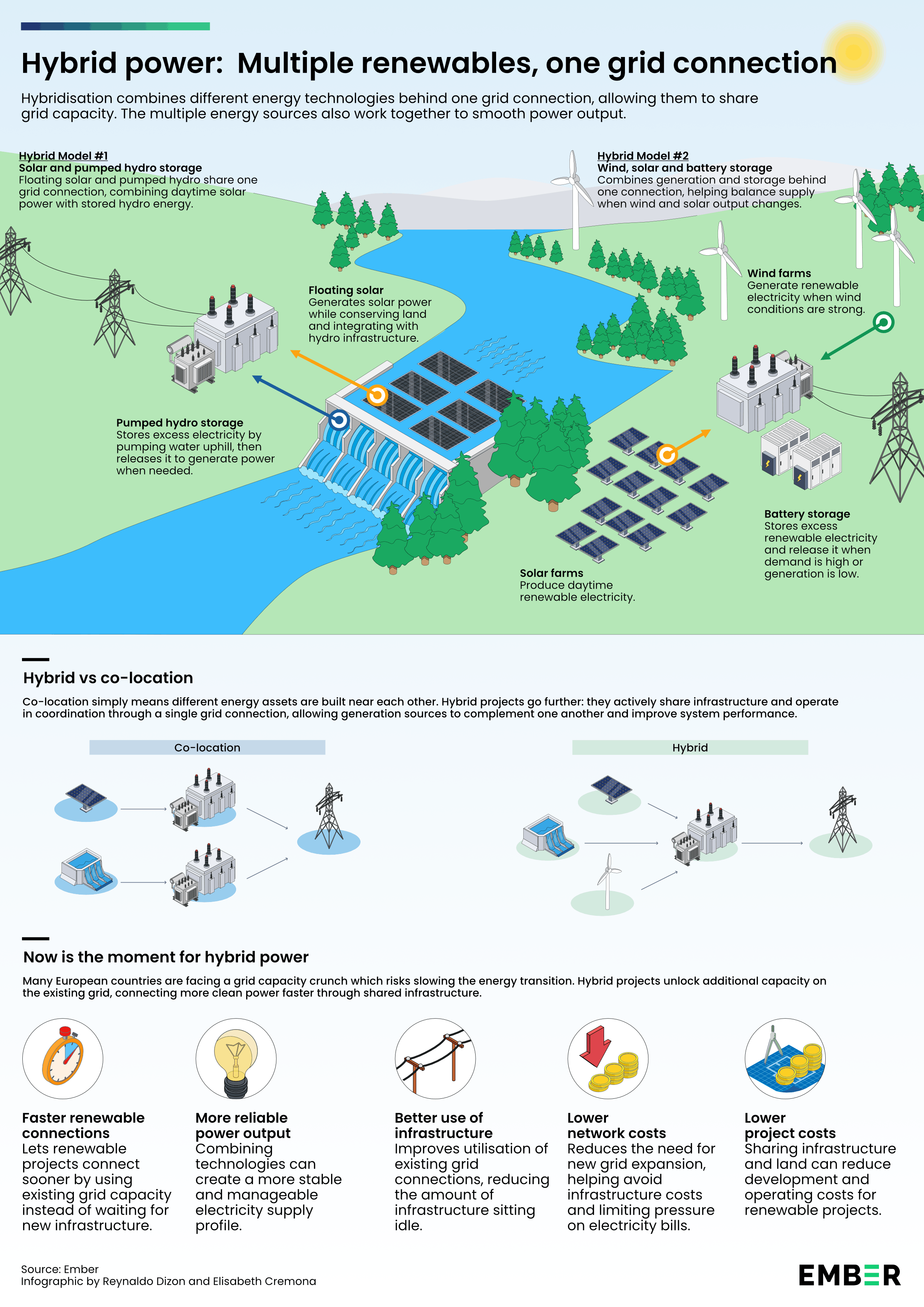
Hybridisation is one option in the vast portfolio of solutions to increase utilisation of grid infrastructure – yet it is often overlooked. Hybrid projects bring together complementary generation technologies, typically alongside storage assets, behind the same grid connection point. The core mechanism is infrastructure sharing, referred to as cable pooling. Sites can operate as partially integrated hybrids, with fixed export limits for each component, or as a single commercial entity with an overall export limit that optimises output. The latter offers the additional advantage of managing the variability of renewable generation and contributing to a more stable power supply.
For countries where grid capacity is scarce, adding new renewable generation and storage assets to an existing installation offers a rapid, zero-grid-intervention solution. It can also reduce the need for additional infrastructure, as more capacity is deployed on the existing grid, helping to keep network tariffs down.
18% of planned wind and solar across seven major EU hydropower markets require no extra grid capacity
The seven focus countries are anticipating the deployment of about 138 GW of wind and solar between 2026 and 2030, according to scenarios from grid operators. This represents an increase of more than 50% on their existing wind and solar capacity (235 GW in 2025), to be added to the grid in just five years – a demanding task, particularly as many of these countries face limited or even zero grid capacity. For instance, transmission networks in Austria and Bulgaria have zero capacity for new generation, and in Portugal and Romania, available grid capacity is negligible compared to the countries’ renewable ambitions.
Our analysis demonstrates that 25 GW of new wind and solar can be added behind the meter of existing hydropower plants without disrupting their typical dispatch behaviour. This means that 18% of upcoming renewable capacity could be integrated without using additional grid capacity or requiring grid interventions – a crucial advantage in grid-locked countries.
The potential share of anticipated new renewables that can be covered by hybridisation of hydropower plants varies significantly between countries, ranging from 77% in Austria to just 7% in Bulgaria.
This variation stems in part from the eligibility of adding new generation facilities to hydropower plants. Hydropower facilities are often located in ecologically sensitive regions where new wind and solar development may be prohibited. Any plant falling within areas protected under European or national legislation is excluded from our analysis. Applying this strict guardrail reveals that around 28% of large hydro plant capacity across the seven studied countries are eligible for hybridisation. This ranges from just 6% of total hydropower capacity in Bulgaria to 41% in Austria and Italy.
The theoretical potential of hydro hybridisation is already being validated by frontrunner projects across Europe. The Tâmega wind farm in Portugal will be the country’s largest and is being developed as a hybrid project, connected to the same substation as the Tâmega hydroelectric complex.
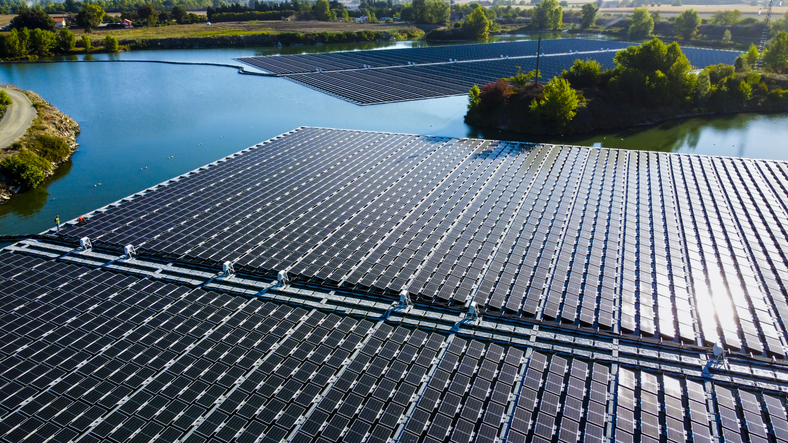
Floating solar is emerging as an increasingly attractive option for hydro hybridisation, offering a solution that eliminates land-use conflicts while boosting solar cell efficiency through the water’s natural cooling effect and reducing reservoir evaporation. France commissioned the Lazer floating solar plant in 2023, with 50,000 panels installed on the reservoir at the Lazer dam hydropower plant, doubling the site’s existing renewable capacity.
Utilisation of the existing grid connections can almost double through hybridisation
Hydropower plants in Europe are excellent candidates for hybridisation, as their hourly dispatch is typically far below their nominal grid connection capacity. Many of these facilities operate as peaking plants, generating primarily during the morning and evening high-demand hours. This leaves many vacant hours during which the grid connection could be used by a secondary generator.
The reservoir storage and pumped storage assets eligible for hybridisation have a weighted average capacity factor of 19%. That means the hydropower plants operate at only about one-fifth of their maximum capacity on average, leaving substantial unused potential that could be shared with wind or solar.
Adding wind and solar increases this figure to 36% and 31%, respectively, although the impact varies across countries and sites. For instance, certain hydro facilities in Spain and France utilise their grid connection for just 7% of hours in a year, but this would increase to about 25% with the addition of wind or solar – more than tripling the use of the same infrastructure.
Run-of-river plants have a higher average capacity factor of 29%, but our analysis shows that this still leaves room for a secondary generator. In this case, use of the grid connection would increase to 47% and 42% with the addition of wind and solar, respectively.
Solar complements, and wind follows, typical hydro dispatch
With hydro outputs largely concentrated in the morning and evening hours, there is a clear diurnal complementarity with solar, whose generation coincides with the in-between peak hours. To make better use of the grid connection, some developers may choose to strategically oversize the solar facility, as solar rarely generates at its full nominal capacity. This strategy would be especially viable at pumped storage facilities. On the rare occasions when solar generation would exceed connection export limits, the hydro asset can pivot to pumping mode, capturing the solar surplus as stored water rather than forcing costly curtailment.
Complementarity between hydro and wind is less pronounced, but the combination remains potentially effective due to its alignment with broader electricity market dynamics. Wind generation seasonality typically mirrors that of power demand in Europe.
Beyond the two-technology configurations discussed in this report, developers are increasingly looking toward fully integrated wind-solar-hydro systems. Co-optimisation of all three sources would enable the maximum utilisation of a single grid connection, and much of the existing research is focused on optimal sizing of these three-way hybrid systems.
The EU’s hybrid policy landscape is fragmented but offers a base for wider regulatory support
Despite the advantages of hybrid renewables, regulatory frameworks for such projects remain underdeveloped across much of the EU. This limits their use as a solution to grid scarcity, as project developers have to grapple with grid connection rights, capacity allocation and permitting rules designed for single-technology projects.
Hybrid projects are still being developed, even in the absence of specific legislation, as a practical response to grid constraints. However, their wider deployment will depend on regulatory frameworks that explicitly recognise and accommodate hybrid configurations. Practices that are already emerging across Europe provide a foundation for such reforms.
Out of the seven focus countries, only Portugal and Spain provide supportive regulatory frameworks for hybrid projects
Among the seven focus countries examined in this report, only two – Portugal and Spain – have explicit regulatory frameworks or market mechanisms designed to facilitate hybrid projects.
Spain and Portugal are clear frontrunners, having introduced dedicated regulations for hybrid projects as early as 2020 and 2022, respectively. Since then, both countries have continued to refine their frameworks to remove administrative and financial barriers and speed up hybridisation. Both waive environmental screening for hybridisation of existing generation, provided that the additional asset remains within the existing perimeter. In Spain, hybrid connection permits can bypass the “first come, first served” connection process, where many renewable projects often get stuck, and financial guarantees for such connection requests are reduced by 50%.
Both countries also plan to anchor hybrid projects in renewable acceleration zones, which are areas for streamlined renewable deployment. Portugal’s Green Maps, published for public consultation in May 2026, explicitly charts the geographic areas with the greatest hybridisation potential, based on the natural complementarity of wind and solar profiles. Other technologies, such as hydropower, were not included due to time constraints. Spain’s Royal Decree-Law 7/2026, published in March 2026, sets out the legal obligation for Renewable Acceleration Zones (ZAR), explicitly including hybrid projects.
Hybrid projects are already online, even where regulatory frameworks are absent
In several countries, commercial deployment is advancing ahead of regulation as developers seek ways to overcome grid constraints and improve project economics. This is evident in existing hybrid sites in France, such as the Lazer 20 floating solar and hydropower site and the Savigné wind and solar site. Bulgaria also illustrates this trend: although it lacks a dedicated regulatory framework for hybrid projects, the state-owned utility NEK is converting several hydropower facilities into battery-coupled hybrid assets and considering the development of two floating solar plants at existing dams.
Targeted policy reform can accelerate the rollout of hybrid projects
National regulation is required to fully unlock hybridisation
Legal clarity and established procedures provide investors with market and regulatory certainty, while also highlighting options to bypass grid bottlenecks. Indeed, setting up national rules allowing for hybridisation of assets is one of the recommendations put forward by the European Commission in its toolbox for timely grid connections, published as part of the December 2025 Grids Package. The robust frameworks already operating in Spain and Portugal, alongside those of other EU Member States such as Lithuania, offer a blueprint for regulatory authorities in other countries. Integrating hybrid projects into other policy documents, such as Renewable Acceleration Zones, would further serve to embed hybridisation in strategic energy plans.
EU guidance would expedite national reforms
Small steps have been taken at the EU level that lay the groundwork for developing a dedicated guidance document on hybrid projects. These include a definition of hybrid projects and hybridisation in the Commission’s Proposal to Accelerate Permit Granting Procedures, as well as their implicit inclusion in the draft revision of network codes for grid connection of generators.
Publishing a dedicated guidance document in the near term would provide additional support and likely accelerate national reforms. This would follow similar precedents, such as the Commission’s recent guidance on the design of 2-way contracts for difference. Additionally, EU-level guidance would foster regulatory harmonisation across the bloc, lowering barriers for project developers investing across multiple countries.
Hybrid projects should move faster through connection requests and permitting
Hybrid projects should benefit from simplified and accelerated grid connection procedures, given their negligible network impacts and ability to unblock grid bottlenecks. In recognition of this, the Commission’s Proposal to Accelerate Permit Granting Procedures establishes a maximum timeframe of three months for a grid connection permit for hybrids. This should ensure hybrid projects are given preference in the currently backlogged grid connection queues. Countries may need to adopt legal provisions similar to those in Spain to allow hybrid projects to bypass the “first come, first served” queue.
Streamlining also extends to environmental requirements. Where adding a secondary generator and/or storage to an existing site does not exceed the original site specifications, environmental screening requirements could be reduced or even waived, as in Spain and Portugal.
Where feasible, national legislation should allow overcapacity in hybridisation
In this case, overcapacity refers to adding a secondary generator with a capacity that exceeds the nominal connection capacity of the existing plan, while retaining the condition that combined injection of the two generators will never exceed the grid connection capacity. In other words, at a 200 MW hydropower site, it may be financially advantageous to add a 300 MW solar plant. This reflects the complementarity between their generation profiles, the limited hours during which solar production nears its nominal capacity and the potential role of on-site storage to absorb excess production.
To make the best use of existing grid connections, provisions that specifically allow for overcapacity during hybridisation should be incorporated in national legislation.
Supporting materials
Methodology
Hybridisation potential
Hybridisation potential estimates presented in this report are the result of analyses conducted on the hydroelectric fleets of Austria, Bulgaria, France, Germany, Italy, Portugal, Romania and Spain.
The starting list of individual operating hydroelectric plants was extracted from the Global Hydropower Tracker (March 2026 release) by Global Energy Monitor (GEM), which was also the main source for a plant’s geographical coordinates and generation capacity.
Hydro dispatch data refers to Day-Ahead Markets (DAM) in the focus countries for 2025 only, and was extracted from ENTSO-E’s Transparency Platform.
Within the latter, only units with generation capacity higher than 100 MW are required to publish their hourly dispatch data, meaning that hourly profiles are available for a small subset of the European plants list. For this reason, “Below Threshold” (i.e. <30 MW capacity) plants from the GEM source were not included in the starting list.
Generation profiles were assigned to non-disclosing plants by scaling the publicly available profile of the geographically closest same-technology plant linearly with respective generation capacities. This approximation, which affects roughly half of the capacity under analysis, relies on the basic assumption that, net of DAM prices in a country, the two main drivers of a hydroelectric plant’s operation would be its hydrological context (proxied by location) and its type (proxied by technology).
Wind and solar capacity factors were computed by combining Ember’s hourly generation data (largely sourced from ENTSO-E’s Transparency Platform, consolidated through data from E-Control and Terna for Austria and Italy respectively, with the exception of Germany, sourced from Energy-Charts), with Ember’s monthly capacity data for 2025 and the focus countries only, consistently with hydro dispatch.
For each hydroelectric plant in the starting list, hybridisation potential was computed using solar and wind as secondary assets singularly. The generation capacity of the secondary asset was constrained by grid connection capacity – conservatively set to the generation capacity of the underlying primary hydroelectric asset – and by compatibility with the original plant’s dispatch profile – enforced by limiting yearly generation curtailment of the primary asset through secondary asset overlay to a 5% threshold.
A screened list of hydroelectric plants was finally derived from the starting list by completely excluding sites with high proximity to protected areas. Such exclusion criterium was established by combining the most conservative set of land protection criteria mentioned by Ryberg, Robinius and Stolten through the superposition of PRIOR raster layers sourced from the World Database on Protected Areas, covering proximity with protected birds, habitats, landscapes, natural monuments, parks, reserves and wilderness areas. A hydroelectric plant, together with its hybridisation potential, was not included in the screened list if the majority of the area in a 5 km radius around it does not exceed protected area proximity thresholds. This approximation is based on the conservation subset of the land eligibility criteria cited in the sourced study, excluding sociopolitical, economic and physical criteria since the scope of the present report is limited to maximisation of existing grid connection utilisation and not to renewable potential estimation. At this stage, Germany was excluded from the analysis as none of the pre-selected plants in its hydroelectric fleet (around 7 GW) were found to be compliant with the spatial criteria described here.
The hybridisation potential figures mentioned in this report are limited to the screened list of hydroelectric plants in Europe, after the various steps explained above. For clarity purposes, both wind and solar capacities are expressed in AC (measured in alternating current).
Downloads
Download the full analysis and infographic.
Acknowledgements
The authors thank Izabela Urbańska, Leonard Heberer, Pawel Czyzak, Reynaldo Dizon and Lauren Orso for their contributions.
Cover image
Tsvetan Ivanov / Getty Images
Related Content
Analysis
Bankable by design: Financing ASEAN's energy system transformation
06 October 2026
Analysis
Renewable Caribbean: towards energy independence
01 October 2026
Analysis
Methane doesn't read the label
30 September 2026

Analysis
Annual coal mine methane emissions are linked to tens of thousands of deaths
30 September 2026