Governance reforms can accelerate the deployment of Indonesia's 100 GWp solar target | Ember

Governance reforms can accelerate the deployment of Indonesia’s 100 GWp solar target

Six policy reforms can unlock new investment, accelerate solar deployment and strengthen Indonesia’s power system.

Available in: Bahasa Indonesia

25 Nov 2026
58 Minutes Read
Download PDF

Table of Contents

Highlights

0.5 GW
Solar capacity comes from PLN, a third of Indonesia’s installed total (1.5 GW) as of 2025.
12 GW
Potential additional solar capacity in 2025 with the introduction of a VPPA mechanism
IDR 1.9tn
The state’s potential savings in 2026-2030 from reinstating net billing without the coal price cap

Executive summary

Five policy reforms and a battery storage framework can deliver Indonesia’s 100 GWp solar target

Indonesia’s goal of 8% economic growth depends on electricity that is reliable, affordable and increasingly clean. Industries need clean power to stay competitive and attract investment, while the June 2026 blackouts and recent fuel-price shocks have shown the risk of relying on a few large fossil plants. Diversifying the power mix means both adding fuel-free generation and spreading it across the system. Solar, paired with storage and other flexibility measures, can do both.

The 100 GWp solar programme, launched in August 2026 with a 2029 target, is a strong signal of intent. Yet more than a decade after the first solar feed-in tariff, Indonesia had only 1.5 GW of solar installed by the end of 2025. Closing that gap will need policy reform, revising PLN’s current electricity supply plan (RUPTL) and enacting a new presidential regulation to accelerate the momentum.

Today’s policy design does not yet let solar compete on its strengths. Administered ceiling tariffs do not reflect solar’s falling costs, slow procurement and land acquisition add cost and delay, companies have limited routes to guarantee solar offtake, and rooftop solar has earned nothing for exported surplus electricity into the grid since 2024. Grid expansion and storage rules also lag behind the scale of the plan.

This report proposes six policy fixes that build on existing institutions, with PLN remaining at the centre of the system. It draws mainly on India, which, like Indonesia, faced fragmented land ownership and a financially stretched state utility, yet built 171 GW of solar by September 2026 by redesigning how solar is priced, procured and sited. Examples from other markets add further lessons where relevant.

Businesses have pushed for cleaner power in Indonesia, and solar can scale quickly enough to meet this demand. However, the current policy framework has not kept pace. Reaching the 100 GWp target within three years requires governance reform, including a new route for businesses to fund additional solar through virtual power purchase agreements (VPPAs), while keeping PLN at the centre of the system.

Solar can be Indonesia’s fastest route to affordable, secure electricity. Its modular design means projects can be built quickly, close to demand, and in many places at once. Getting there means pairing ambitious targets with the grid connections, financing and permitting needed to build projects at scale. When these pieces move together, solar can deliver for households, industry and the wider economy.

Lucky Luqman Nurrahmat
‍
Director Technology Advancement, Danantara Indonesia

Key takeaways

01

While industrial demand has delivered most of Indonesia’s solar capacity so far, replacing PLN’s solar ceiling prices with reverse auctions could unlock the larger potential of utility-scale solar

Industrial demand anchors account for the largest share of Indonesia’s solar capacity, double that delivered under PLN’s solar purchase price regimes. Since 2013, PLN’s purchase prices have attracted limited developer interest, suggesting their design has yet to offer a compelling business case. Industrial demand is the fastest route to scale, while the larger potential of PLN-led utility-scale solar needs policy reform. Replacing the ceiling tariff with reverse auctions would help reveal falling solar costs: awarded prices dropped by 44% to 87% in India, Chile, Germany and South Africa. Additionally, scoring local content as one bid criterion, instead of mandating it, would limit cost pressure for developers.

02

Centralising land access and procurement for utility-scale solar and promoting land leasing as a standard route could ease some of the biggest barriers to deployment

Lengthy, complex land acquisition and procurement processes add significant costs and uncertainty to project development, which can discourage developers from participating. The current framework requires a long lead time before construction, up to 40 months based on reported project timelines and four to six years to reach commercial operations. The deployment target only works if land and grid are pre-cleared before tenders. Designating a government-backed entity to centralise these steps could ease the burden on PLN. Pairing it with land leasing as an additional default arrangement could speed up the early stages of getting projects started. With these in place, developers will not need to secure land project by project; they will be passed on projects with tender-ready land once awarded.

03

Enabling virtual power purchase agreements could unlock 12 GW of new solar capacity, without changing who sells the electricity

Ember estimates only 8% of large industrial and commercial consumption was met by renewables in 2025. By allowing a virtual power purchase agreement (VPPA) mechanism, solar could add an extra 12% renewables share to supply that demand, unlocking 12 GW of new solar capacity. A VPPA lets a company agree a fixed price with a solar developer and settle the difference against the price PLN pays the developer. The company receives the plant’s environmental attributes while continuing to buy its electricity from PLN or its estate utility. The mechanism serves economic potentials for PLN as it helps the state utility achieve its solar target without losing its customers and revenue.

04

Fair net billing could revive rooftop solar, with safeguards that protect PLN’s revenue

Since bill credits ended in 2024, Indonesia’s rooftop solar only offsets on-site use, stalling adoption below 1 GW. Reintroducing a credit for surplus power would drive private investment, displace midday coal and cut state subsidies. To prevent cost-shifting to non-adopters – as seen in Pakistan – Indonesia could adopt short credit cycles, prosumer network fees, capacity-based limits and tailored surplus power rates (1:1 for industry, near avoided cost for households). With these safeguards, Ember estimates net billing would add about 1.4 GW of rooftop solar by 2030, save the state IDR 1.9 trillion, and leave PLN’s finances close to unchanged, with lower coal costs and network fees offsetting most of its lost revenue.

05

A dedicated policy for battery energy storage systems would improve project bankability

Indonesia’s 100 GWp solar plan includes batteries, but the IEA identifies the lack of regulation for standalone storage as the key barrier to bankability. Experiences from India and China offer solutions. Initial growth can be sparked by time-limited support, like India’s 30 GWh viability gap funding. Revenue models can then be layered, moving from contracted availability payments to ancillary reserve services and eventual spot arbitrage. China’s transition from mandatory co-location to capacity remuneration for standalone batteries demonstrates the benefits of paying for performance. Establishing clear remuneration rules and including BESS in reverse auctions will lower costs through competition and turn Indonesia’s pipeline into a viable market.

Chapter 1

Solar can secure Indonesia’s growth if policy reform comes first

In August 2026, President Prabowo launched a 100 GWp solar power programme targeted for 2029 to strengthen national energy security. It is a much-needed commitment amid Indonesia’s economic agenda and global energy tensions, but one that the country’s current policy framework is not yet set up to deliver.

1.1 Blackouts and fuel-price shocks make a diversified power mix urgent

Indonesia aims to reach 8% economic growth by 2029, with downstreaming industries as one of its foundations. Attracting the private investment this requires depends on a faster shift to clean energy, as industrial buyers increasingly demand cleaner supply chains. A survey found that 69% of 105 companies operating in Indonesia would consider relocating if electricity remains fossil fuel-based, suggesting that subsidised ‘cheap’ coal power alone will not keep the country competitive. The EU’s Carbon Border Adjustment Mechanism (CBAM) points the same way: a clean power system is now also about competitiveness and attracting investment, not only emissions.

Geopolitical turmoil is adding urgency to diversifying the power mix. The case for the energy transition is shifting from emission reductions towards system resilience: less exposure to global fuel-price and supply shocks. This concern is shared across Southeast Asia. Coal still accounts for 58.3% of Indonesia’s installed capacity. Although Indonesia is the world’s largest coal exporter, building new coal plants is not a sound route to faster and more resilient growth.

Coal’s apparent cost advantage also rests on policy support. Subsidies and price caps commit the state to high fiscal spending to cover the gap between regulated tariffs and PLN’s coal-dominated generation costs (Biaya Pokok Produksi, BPP). The domestic coal price cap, an indirect subsidy, makes coal look the cheapest option and tilts the playing field against renewables. The cap is also under pressure: producers, who bear the gap to international prices, have requested a higher cap of between $80 and $90 USD per tonne. Over the past three years, international prices (about $150 USD per tonne) have run at about twice the domestic price ($70 USD per tonne), which has not changed since 2018. Raising the cap would increase the cost of coal-based electricity.

Recent outages show the reliability risks. The June 2026 rolling blackouts in the Java-Madura-Bali (Jamali) system stemmed largely from coal supply chain failures. The shutdown of Kalimantan’s combined-cycle gas plants resulted from mechanical failures, and supply took about a month to restore. The common thread is concentration risk: relying on a few large, centralised assets running on gas and coal leaves the system exposed to disruptions in fuel availability, logistics, regulation or equipment.

Diversification therefore has two dimensions: the types of generation and where it is located. A mix including fuel-free resources such as solar and wind, complemented by storage and other flexibility measures, can strengthen resilience. Spreading generation across regions can also reduce transmission losses and exposure to single points of failure.

1.2 The 100 GWp target is the right ambition that needs to be mainstreamed in regulation

PLN’s National Electricity Supply Business Plan (RUPTL) 2025–2034 has not yet incorporated the 100 GWp solar target, as the target announcement was made after the document was published. Across its two scenarios, reaching 100 GWp would require up to 10 times the solar capacity planned for 2029 (an additional 92 GWp).

Separately, Indonesia’s government has developed a breakdown of the 100 GWp solar target. It plans to deliver the programme in three phases, with a further 30 GWp still under study. All three phases can start once the RUPTL is revised, with Phases 1 and 2 ranked as top priority.

Targeting 100 GWp of solar by 2029 is the right move towards achieving the net zero target by 2060. The country has abundant solar resources, estimated at 3,294 GW of potential. However, with only 1.5 GW of installed solar capacity by the end of 2025, Indonesia must grow solar far faster than it did over the last decade.

This gap also presents an opportunity. The government has already signalled that the 100 GWp programme can only move forward once the RUPTL is revised, making the upcoming revision the natural moment to align Indonesia’s power plan with its solar ambition. How the target is translated into the plan, and the policies that accompany it, will shape whether the ambition becomes deployed capacity. The chapters that follow set out what that alignment would need.

The scale is daunting but not unprecedented. India faced the same combination of fragmented land ownership, a financially stretched state utility and a clear renewables target, and still scaled past 100 GWp of solar within a decade, reaching 171 GW by September 2026. It did so by deliberately redesigning its procurement, pricing and land rules – the subject of Chapter 3.

Globally, the cost of utility-scale solar power has fallen by 90% since 2010, from $0.417 USD per kWh to $0.043 USD per kWh in 2024, making it about 41% cheaper than the lowest-cost fossil fuel alternative. Indonesia has every reason to move away from new coal and gas plants and to build solar faster and at a larger scale.

Indonesia’s installed solar capacity has reached 1.5 GW as of 2025, most of it (1 GW) came from industrial estates and own-use generators, representing industrial and demand anchors. Only a third of the total came from PLN’s system.

The result indicates that market economics, not PLN’s administered price mechanisms, currently create revenue certainty for Indonesian solar: projects sited at mills, mines, refineries and industrial estates compete against high industrial retail tariffs. PLN’s solar price regimes have so far attracted little solar investment, and the growth that has materialised has largely come from outside them.

Two takeaways follow. First, industrial demand is a route Indonesia needs to keep opening for renewables deployment. Second, the larger potential of utility-scale solar through PLN, as the sole electricity provider, requires a thorough fix.

Industrial and commercial users are Indonesia’s fastest route to scale: they can sign long-term offtake agreements and are already pulling solar demand through corporate procurement.

However, market-driven industrial growth depends on individual sites choosing solar one at a time. Hitting 100 GWp by 2029 means contracting at a pace no amount of opportunistic industrial uptake can deliver on its own.

A 100 GWp pledge needs an offtake structure that can absorb gigawatts per year. Only a balanced mix of utility-scale, PLN-mediated and private-driven channels can do that.

Firming and expanding the storage market to support round-the-clock solar supply is also inherently utility-scale – a grid-integration challenge PLN has to own as system operator.

Beyond utility-scale solar, decentralised solar can add substantially to the target but has so far contributed little to total installations. This includes rooftop solar and solar for productive use, such as agriculture, small industry and fishing.

Official records do not show how much rooftop solar has been installed in the country so far. One report put Indonesia’s rooftop solar installations at 773 MW by November 2025, with a potential increase to 1.4 GW by 2026.

To achieve the target, the government needs to reformulate its solar policy framework. The existing policies, unfortunately, have not advanced the country’s solar progress. The market should be redesigned to cultivate new business opportunities, spark healthy competition and accommodate innovations to grow.

Utility-scale solar feeding the public grid, and specific mechanisms to cater to industrial and commercial demand, are Indonesia’s most strategic levers for growth. Prioritising these is the quickest way to convert the 100 GWp ambition into deployed capacity.

Chapter 2

Indonesia’s solar policy raises costs for utility-scale projects and gives rooftop solar no incentive

Today’s solar rules cap utility-scale pricing and give rooftop surplus power no value

Utility-scale solar is currently procured under Presidential Regulation 112/2022. It replaced earlier feed-in-style tariffs with ceiling tariffs negotiated between developers and PLN, and with direct appointment or direct selection of projects. Ministry of Energy and Mineral Resources (MEMR) Regulations 5/2025 (power purchase agreements) and 19/2025 (hybrid plants) add implementing detail.

Rooftop solar follows a separate track. MEMR Regulation 2/2024 ended net metering for new installations and replaced capacity caps with a system quota, while earlier systems kept their terms for ten years.

The 100 GWp pledge, formally launched in August 2026, requires this framework to change. The current framework will not work effectively to achieve the target in time. Only about 8.1 GW of new capacity is planned by 2029 in the RUPTL, rising to 17 GW of planned capacity by 2034. The framework is the product of a decade of changes since the first solar feed-in tariff in 2013, which led to 1.5 GW of installed capacity by the end of 2025.

The ambition exceeds what these mechanisms were built to deliver. The rest of this chapter looks at the barriers facing each route to scale in turn: utility-scale solar, corporate buyers, rooftop solar, and storage and grid flexibility.

2.1 Solar price caps, slow land access and complex procurement make utility-scale solar costly

The current solar price regime does not reflect solar generation cost, so the business case is weak

The current solar price follows Presidential Regulation 112/2022, which sets a ceiling price for each renewable technology, adjusted for location factor and plant size. Although Presidential Regulation 112/2022 removed the BPP-based cap used in the previous regulation, solar ceiling prices are still set administratively in the regulation itself, rather than discovered through competition that would reflect solar’s falling costs.

However, this pricing structure has not attracted businesses. The regulated ceiling prices have not been updated since 2022, and the power industry does not see them as an investment incentive. There is also no ceiling tariff for floating solar PV plants, which may need a different approach given their distinct cost structure.

PLN’s caution is understandable. For years the Java-Madura-Bali (Jamali) system carried more capacity than it needed, with a reserve margin of 44% in 2023. Most coal plants are also contracted on take-or-pay terms, so PLN pays for their capacity whether or not it uses their output. The surplus capacity costs are estimated at $1.2 billion USD a year in fixed operating costs (2021) and at least $2 billion USD a year in capacity payments. From PLN’s position, new solar could look like added cost rather than savings, especially as most solar projects planned in the RUPTL will be deployed in Java.

That surplus is now narrowing. The Jamali reserve margin fell to an estimated 37.5% in 2025 and could drop below the recommended 33–35% range by 2027 if demand keeps growing at about 4.5% a year. New capacity will be needed soon. Solar, paired with storage to meet evening peaks, can be built faster than new thermal plants. Bought at its real, falling cost, it lowers PLN’s fuel bill even while existing capacity contracts run.

Lengthy and complex land acquisition processes have stalled solar projects

Land is where Indonesian solar projects lose the most time. Our analysis of reported projects shows the pre-construction phase, dominated by land and permits, can take up to 40 months, the longest stage of development. Utility-scale projects that clear land and permitting still take four to six years to reach commercial operation, more than double the time in comparable markets.

Land acquisition and permitting are seen as opaque rather than a fixed sequence. Acquiring land for large-scale projects is especially challenging when it involves multiple individually owned plots rather than concession areas.

Acquiring customary land (tanah adat) for public interest projects requires deliberation (musyawarah) with indigenous leaders and fair compensation, though legal frameworks continue to balance communal traditional rights with national development goals.

Floating PV faces added complexities in securing space, beyond those of ground-mounted installations. The problems come from three places: the approval chain for using the water, the onshore land for transmission and substations, and customary claims over natural lakes.

The government has identified 91.6 GW of floating solar potential across about 325 lakes and reservoirs, using up to 20% of each reservoir’s surface under Public Works Regulation 7/2023. Using this potential well needs structured approvals for water use, shoreline land and community consent, which section 3.2 addresses.

Uncertainty in the duration of the procurement process has become one of the cost drivers

As both the sole offtaker and the main procurement body, PLN has to balance competing priorities: meeting renewable targets, protecting its financial health and keeping tariffs affordable for its customers.

Repeated delays and revisions to the RUPTL can also undermine investor confidence. The procurement schedules in the RUPTL are non-binding administrative guidelines rather than strict mandates, which creates ambiguity for securing project financing.

Despite the 90- to 180-day lead time set by Presidential Regulation 112/2022, it can take one to two years between a request for proposals and a signed power purchase agreement. This could happen due to non-standardised contracts, leaving both parties to negotiate many aspects of the contracts on a case-by-case basis. In some cases, the tender could be cancelled for no clear reason.

Ownership is another source of delay. The RUPTL classifies each planned plant as built by PLN, by a PLN subholding or by an independent producer, but some of these structures require further decisions after the plan is published, adding steps before procurement can begin.

Complex and vague procurement processes have also weakened developers’ view of solar as a business case. Procurement suffers from short tender windows, weakly standardised documentation and a dedicated track for PLN’s own subsidiaries that observers note distorts competition against independent developers.

Local-content rules have been a further cost driver, and the government has begun to ease them. MEMR Regulation 11/2024 and its implementing Ministerial Decision cut the minimum local content (TKDN) for solar plants to 20%, from between 41% and 46% previously, and allowed a temporary exemption for projects with power purchase agreements signed by the end of 2024. In April 2025, President Prabowo called for local-content rules to become more flexible and realistic, possibly replaced with incentives, signalling room to go further.

2.2 Corporate buyers want new clean power but can mostly only buy certificates from existing plants

Companies in Indonesia already pay for renewable electricity, but they have few ways to fund new plants. PLN sold 6.4 TWh of renewable energy certificates (RECs) in 2025, up from 0.3 TWh in 2021. These certificates come mostly from existing geothermal and hydro plants.

Among the buyers of RECs are RE100 members, companies committed to 100% renewable electricity. Indonesia-based members sourced 33% of their electricity from renewables in 2023, mainly through certificates from plants commissioned in 2003 on average. RE100’s technical criteria limit claims from plants older than 15 years, so much of this supply will no longer count towards their targets. Exporters face further pressure from supplier targets set by global brands and from the EU’s Carbon Border Adjustment Mechanism (CBAM).

2.3 Three policy changes since 2018 have left rooftop solar with no incentive to grow

Since MEMR Regulation 2/2024 ended surplus power credits, rooftop solar in Indonesia only pays back on electricity used on site. That still works for factories with steady daytime demand. It largely shuts out households, whose demand peaks in the evening. MEMR acknowledged this when it introduced the rule, saying household rooftop solar is hard to justify without batteries. There is also no upfront financial support for any customer group.

Rooftop policy alone has changed direction roughly three times since 2018: weak net metering, an improved but capped credit, then abolition in favour of a quota. The 2024 reform, which revoked net metering, did more than cap growth: it removed the last price incentive entirely, leaving households and businesses with no compensation for exported power.

The effect is visible in the numbers. The rooftop fleet reached only 773 MW by November 2025, below an annual quota of around 1 GW, which the government has proposed raising to 1.4 GW in 2026. The quota is not the binding constraint; the lack of any value for exported surplus power is.

2.4 Grid and storage plans are in place, but the rules to make them flexible are not

Grid expansion and flexibility have yet to catch up with solar ambitions

Carrying 100 GWp of solar will need a much larger grid. The RUPTL 2025–2034 plans 47,758 circuit-km of new transmission by 2034, at a cost of IDR 392 trillion, with the largest share, about 13,900 circuit-km, in the Jamali system. New lines can take five to 15 years to build, longer than solar plants themselves, so sites without nearby grid capacity risk waiting years for a connection.

New lines are only part of the answer. Much of the existing system is still run inflexibly. Coal plants largely run as baseload under take-or-pay contracts, and the IEA notes that rules on how grid services are paid for remain unclear, leaving little reward for fast ramping, reserves or demand response. With solar at about 1.5 GW, this is not yet a constraint. At the scale of the 100 GWp programme, it would raise the risk of midday curtailment unless the system makes better use of the grid and plants it already has.

Battery energy storage systems (BESS) have a limited dedicated framework

Plans for BESS deployment exist, but the policy framework is not yet robust. RUPTL plans to install a total of 3.6 GW of solar-BESS plants and 6 GW of standalone BESS capacity by 2034. The 100 GWp programme already assumes batteries, planning to roll out 68.5 GWh of BESS by 2029. Yet frameworks that can capture the multiple roles of BESS are not yet established.

Battery storage is legally recognised in Indonesia’s planning, but market readiness is limited. Storage is addressed mainly as a component of renewable or hybrid plants. Presidential Regulation 112/2022 caps the price of batteries paired with solar or wind at 60% of the electricity purchase price. MEMR Regulation 19/2025 covers hybrid plants on small-scale grids, and a ministerial decree issued in June 2026 sets a highest and lowest reference price for each hybrid configuration rather than a separate storage cap. This leaves a gap between planning-stage recognition and operational market access.

However, standalone BESS has no dedicated framework, which the IEA identifies as a bankability barrier. A lack of BESS-specific policy creates uncertainty about long-term cash flows, which can deter investors. The funding mechanism, risk allocation and revenue framework for storage, particularly standalone BESS, have not been set out.

BESS is a cornerstone of the energy transition

As solar grows, battery energy storage systems (BESS) are a key enabler for integrating variable renewables. Beyond electricity storage, they shift midday solar output to evening peak demand, reduce curtailment and provide firm capacity. They also support grid stability by smoothing output and supplying ancillary services such as frequency and voltage control, and can defer network upgrades or replace diesel generation in isolated systems.

Chapter 3

Auctions, land, procurement and corporate demand: four fixes to reach 100 GWp

Of the many challenges identified in Chapter 2, this chapter takes immediate concerns and proposes solutions. They draw on India’s policy design, adapted to the Indonesian context. India is the closest parallel because it faced the same combination of fragmented land ownership, a financially stretched state utility and a clear renewables target, and still scaled past 100 GWp within a decade.

The solutions in this chapter aim to speed up utility-scale solar and to create new demand for solar from industrial and commercial users, where near-term bankability is strongest. Rooftop solar, which faces different financing and governance barriers, is covered in Chapter 4.

Each fix is designed to work with PLN, under existing mechanisms, rather than around it. PLN remains the national offtaker and grid operator in every proposal. Reverse auctions lower the price PLN pays for new solar. Centralised land access and a dedicated procurement body take administrative work and early-stage risk off PLN’s hands. VPPAs let corporate buyers, rather than PLN, cover any premium new projects need.

How India has engineered its solar boom

Unlike Indonesia’s vertically integrated PLN, India’s power sector is unbundled into separate generation, transmission and distribution companies. They procure mainly through long-term power purchase agreements (PPAs), supplemented by a functioning power exchange and open access rules that allow direct contracts between large consumers and generators.

India’s solar growth is built on deliberate policy design. The Solar Energy Corporation of India (SECI) and the National Thermal Power Corporation (NTPC) have run centralised reverse auctions since 2010, pulling tariffs down by 87% by 2017. The Solar Park Scheme pools land and grid infrastructure upfront, cutting developer risk.

Since 2023, the government has committed to tendering 50 GW of renewables a year, and a waiver of interstate transmission charges, now being phased out, has made projects cheaper to connect.

Open access reforms are also letting companies sign virtual power purchase agreements (VPPAs) directly with solar generators, bypassing state utilities.

Rooftop solar has been driven largely by PM Surya Ghar, launched in February 2024. The scheme has reached over 5 million households, with 1.9 million now paying no electricity bill.

India’s solar story now spans every scale, from rooftops to reservoirs. Total installed solar capacity reached 171 GW by the end of September 2026.

3.1 Replacing ceiling prices with reverse auctions will let solar prices fall naturally

The current pricing structure pairs a formula-set ceiling tariff with direct selection as the default rather than competitive bidding, so price is set administratively rather than tested against what the market could offer. This leaves little room for solar prices to follow market trends.

Given the scale the 100 GWp pledge calls for, it is worth asking whether an untested, non-competitive pricing mechanism can carry that much weight.

Reverse auctions have produced genuine price discovery in the markets where they replaced an administered tariff outright. India’s tariffs fell 87% once auctions replaced its feed-in tariff, and Germany’s auctions also beat its earlier feed-in tariff.

However, global cost declines have driven most of the fall in solar prices everywhere, auction-based or not. Auctions are therefore better understood as a faster, more transparent way of capturing those cost declines in the price PLN actually pays, not as a mechanism that lowers costs on its own.

Competitive bidding could reveal real costs better than an administered price, letting solar prices adapt more quickly to the market. Developers can propose more competitive prices with a wider range of supplier options. Solar panel and inverter prices can fall faster than any benchmark tariff can track.

India’s National Solar Mission launched in 2010 with a flat feed-in tariff, but regulators quickly decided a fixed price was too costly for utilities to absorb at scale. The government then moved to reverse auctions where developers bid down from a benchmark tariff. Bids came in far below the benchmark, from INR 18.44 per kWh under the last pre-auction administrative tariff in 2009 to INR 2.45 per kWh by 2017, with most of that decline coming after reverse bidding was introduced in 2010.

Chile’s official auction results show a similar pattern: the government’s average awarded price fell from $129 USD per MWh in 2013 to $32.5 USD per MWh in 2017.

Even in Germany, where tariffs started much closer to actual cost, competitive bidding still brought the average ground-mount solar award down by 44% between 2015 and 2024.

South Africa’s experience shows competitive bidding can drive real price discovery even under a single, financially stretched offtaker: REIPPPP’s average solar PV tariff fell by around 52% between its first bid window in 2011 and its fourth in 2015. However, the model has strained under Eskom’s weak finances: in 2019 the government asked early-round developers to voluntarily accept lower payments, and Eskom’s balance sheet and its ‘limited’ National Treasury guarantees remain an open risk rather than a solved one.

The same argument extends to storage. The current regulations only allow procuring storage as one package of hybrid plants by direct selection, with the storage tariff add-on capped at 60% of the base price rather than market-priced. India’s SECI has already tested the alternative: its 1 GW tender for firm, round-the-clock renewable power paired solar, wind and battery storage, and competitive bidding found a tariff of INR 5.25–5.26 per kWh (about $0.055 USD per kWh) for firm supply. A reverse auction could do the same for Indonesia’s solar-plus-storage ambitions.

A reverse auction for Indonesia would need safeguards: a credible offtaker or guarantee structure, and a plan for what happens if PLN’s own finances come under similar strain.

Given PLN’s financial constraints, any new auction should be paired with a credible payment backstop. This could be the guarantees PT Penjaminan Infrastruktur Indonesia already provides on some PLN-linked financing, or the intermediary role SECI plays in India. Either would let bidders price risk out of their bids rather than into them.

Local-content requirements should also stay flexible. Scoring local content as one criterion in bid evaluation, rather than a hard domestic-content mandate, would ease the cost-driver concerns it currently raises.

Pre-clearing land and transmission access before bidding opens could matter even more for Indonesia, where archipelagic geography likely makes land and grid-connection costs a larger, less predictable share of project cost.

Reverse auctions work best where enough developers compete for large, grid-ready projects — a situation that has not always existed outside Java. IRENA’s review of Southeast Asian auctions found Indonesia’s early solar tenders outside Java allocated just 15 MW across seven rounds, geothermal auctions saw only three of 15 announced rounds awarded, and PLN cancelled a 2017 Sumatra solar auction outright over grid-reliability concerns. That record reflects thin competition and grid constraints, not a flaw in the mechanism itself.

Bundling several large off-Java sites into fewer, bigger tenders would restore the competitive scale that small, dispersed lots undermine, as India did with PM-KUSUM programme. Pre-clearing land and grid connection before bidding opens would remove the grid risk that occurred at the Sumatra round. Reverse auctions remain a viable route for large-scale solar outside Java, provided scale and grid readiness are designed in advance rather than left to the market to solve.

Reverse auctions remain the best option for Indonesia not because competition guarantees low prices, but because Indonesia currently has no way of finding out what solar actually costs. The ceiling tariff was set administratively, and direct selection has offered limited competition to test it.

An auction would not invent savings that are not already there: the cost declines are real regardless of mechanism. But it is the fastest, most transparent way to pull those declines into the price PLN actually pays. Used with safeguards – a credible offtaker or payment guarantee, realistic bid limits and local-content rules that do not undercut the bidding itself – it is a lower-risk way to find Indonesia’s real solar price than leaving it to administrative guesswork. For PLN, a lower and transparently discovered price also means a lower cost of supply and a clear, defensible basis for every contract it signs.

3.2 Centralised land access, with leasing as an additional default, could solve Indonesia’s siting bottleneck

Indonesia’s land access today

Indonesia’s land framework offers two routes to land for power plants (see chart below), and the law decides who may use each. Public-interest land acquisition is open only to qualifying public bodies: ministries, local governments, the Land Bank Agency and state-owned companies with a special government assignment, such as PLN. A business entity can use this route only when a written agreement with one of these bodies authorises it.

The route runs through 12 mandatory steps and involves six groups of parties, from the governor’s team and the land agency (BPN) to appraisers and the courts. If every step runs to its legal limit, it takes about 362 working days. In reality on the ground, it could take longer. In return, it offers a fallback: if a landholder refuses, compensation is deposited with the court and acquisition goes ahead. For parcels of five hectares or less, Government Regulation 19/2021 lets the acquiring agency buy or exchange land directly instead.

Private developers, including independent power producers, use the second route: a direct agreement with each landholder to buy or lease the land. It needs only four core steps: title due diligence, negotiation, a signed deed and registration at the land office. It has no location decree, public consultation or legal timeline. But buying and leasing follow the same steps, and neither offers a fallback. If one landholder refuses, the layout has to change, or the project has to move.

This matters most for solar and wind. Utility-scale solar generally needs more land per megawatt than a coal or gas plant, and that land is often spread across many smallholders. The Tolo wind farm involved about 500 landowners and 100 sharecroppers across eight villages. On projects like these, the number of landholders to negotiate with matters more than the total area. Today each developer does this work alone, site by site.

Making leasing an additional default

Leasing is legally available, but it is not promoted as a route for solar. A 2015 proposal would have let PLN lease land for up to 50 years for power plant projects, supporting the 35,000 MW coal plant programme. However, the idea has not been taken further. As the government scales up solar, leasing should become an additional default for new solar land, alongside acquisition and purchase.

The case differs by developer. For PLN and other public bodies, leasing by direct agreement would offer an alternative to the 12-step acquisition route, skipping the location decree, public consultation and court stages. For private developers, leasing does not shorten the procedure. Its value is that more landholders are likely to agree: they keep their land and earn regular rent, which reduces refusals on a route with no fallback. For both, rent spreads land costs over the project’s life, and the land returns to its owners at the end of the term.

Four fixes would make leasing the easier choice. First, promote registered leases, such as a building right (HGB) or right of use (Hak Pakai) over the owner’s land; lenders can take these as collateral, unlike a plain lease contract.

Second, certify land on candidate sites early, since an HGB over owned land needs certified title. This matters because around two-thirds of Indonesians held land under informal titles such as girik as of 2020. Girik is a land claim based on tax records that predates formal certification.

Third, set lease terms that cover the power purchase agreement and decommissioning: an HGB over owned land runs up to 30 years and renews only by a new deed, so renewal should be agreed upfront. Fourth, provide template leases and rent benchmarks, so each deal does not start from scratch.

Leasing does not remove the ownership question; it defers it. A lease signed with a disputed holder carries the same exposure as a purchase. Three safeguards would reduce this risk. Customary and informal claims would be verified independently at the village level before signing. Rival claimants would get a grievance window before payments begin. And a government-backed indemnity would make the leasing body, not the landholder or the developer, responsible for any dispute that surfaces later.

A centralised land access programme

Leasing would reduce refusals, but each developer would still negotiate site by site. A centralised programme could do this work once for every project. A single government-backed body, which section 3.3 proposes should also prepare procurement, would identify and verify sites, settle landholder claims, and agree lease or purchase terms with landholders before each tender. The winning bidder would then sign those agreements and pay for the land, with the cost built into its bid. The agency would cover only the cost of preparing these.

The agency and PLN would need clearly separate roles. The agency would prepare sites, coordinate land and permits, and run tenders. PLN would identify where capacity is needed through the RUPTL, sign the power purchase agreement as offtaker, and connect plants to the grid. Both would agree a standard power purchase agreement and land terms before each tender, so every bidder prices the same risks.

This differs from existing land schemes in its purpose, its governance and how it is planned. The Land Bank Agency (Badan Bank Tanah) is a general-purpose land manager. It obtains and holds land for public interest, social, economic equity and agrarian reform purposes, and must set aside at least 30% of its state land for agrarian reform. Public-interest acquisition works project by project: BPN acquires land only after an agency such as PLN has planned a specific project and requested it. Neither is tied to an electricity plan or a solar deployment target.

The programme proposed here would be dedicated to renewable energy, with land prepared before tenders rather than after them. Sites would be chosen to match PLN’s procurement schedule, the electricity supply plan (RUPTL) and grid capacity, so that land, permits and grid connection are ready at the same time. That alignment matters for the 100 GWp solar programme.

A programme jointly governed by the energy ministry, PLN, the land agency and local governments could provide bundled, tender-ready sites for the utility-scale share of the 100 GWp solar programme. The Land Bank could still contribute, for example, by supplying state land such as former mining sites alongside leased private plots.

The programme could also add particular value for floating solar. Water surface brings its own approvals on top of the usual land process. Indonesia’s first large floating plant, Cirata, needed a water resource use permit and a dam safety analysis, plus land and resettlement planning for its onshore facilities. These involved national ministries, provincial and district governments, PLN and lenders.

The same body could prepare the water-use approval and dam safety review once per reservoir, arrange the shoreline land leasing needed for substations and transmission, and lead consultation and consent with communities where necessary. It could then offer the site to developers with these already in place.

The programme should also include benefit-sharing safeguards consistent with a just energy transition. These could include rent indexed to inflation, enforceable local employment commitments and infrastructure for host communities with clear delivery timelines.

Better land access could also benefit PLN. PLN currently secures land through the public-interest route, which can take up to around 362 working days and even more if every step runs its full course. Land and permit processes can also affect project timelines, as at the Saguling floating plant, now postponed to March 2027. A centralised, government-backed land agency could support PLN by preparing sites ahead of tenders, in line with the electricity supply plan (RUPTL) and grid capacity, and by resolving landholder claims early. This could help PLN tender ready sites and bring new capacity online closer to plan.

Centralising land processes is recommended to improve project certainty and reduce risks, attracting more private participation. Taking this approach will require PLN, local governments, the Land Bank Agency and cross-ministerial coordination between the Ministry of Agrarian Affairs and Spatial Planning (ATR/BPN) and the Ministry of Energy and Mineral Resources (MEMR).

3.3 A dedicated agency could prepare land and tenders for utility-scale solar alongside PLN

A designated entity to administer solar deployment can take on some of the risks PLN carries

How a project is procured depends on how RUPTL assigns it. PLN classifies every planned plant as Porsi PLN (built by PLN itself, directly or allocated to a subholding/subsidiary), Porsi SH-PLN (built from the outset by a subholding, PLN Indonesia Power or PLN Nusantara Power, alone or with a partner holding 49% or less) or Porsi IPP (built by an independent private developer under a PPA, with PLN’s subholding optionally taking a minority equity stake). Some of these ownership structures require further decisions after the RUPTL is published, lengthening procurement steps (see chart below).

Indonesia could assign a government-linked agency to run renewable procurement, including solar, and to aggregate land. It would work alongside PLN as a complementary layer, not replace PLN’s role as the national offtaker. To streamline procurement, PLN can already finalise the ownership structure of each project through RUPTL. The public body would then run procurement for IPP projects, as PLN does for its 100%-owned projects. Land can be prepared in advance so it is tender-ready before a tender is even issued.

A dedicated procurement agency could help standardise agreement formats, align project timelines with RUPTL targets and shorten coordination lines. That value sits mainly in the stages that currently happen project by project, before a deal ever reaches the 90- or 180-day procurement timelines set out in Presidential Regulation 112/2022.

Contract standardisation builds on the direction MEMR Regulation 5/2025 already sets for a common power purchase agreement structure. However, a regulation alone still leaves PLN to negotiate separately with each developer.

A shared procurement function would let administrative work accumulate in one place and be reused, rather than each project starting its structuring work from scratch. This would turn the standard from a paper requirement into an operational default.

This also gives international lenders and co-investors a consistent, well-prepared counterpart to assess. With fewer bespoke terms to negotiate, faster financial close and a repeatable process, lenders can underwrite each successive round with more confidence.

A dedicated agency’s role would be to make each project more bankable and better prepared by the time it reaches PLN, supporting PLN’s own task of meeting RUPTL’s renewable targets rather than adding a competing layer of decision-making.

Such a body would not need to be built from scratch. It could be housed as a dedicated agency under MEMR, collaborating with ATR/BPN, local governments and drawing land from the Land Bank Agency where suitable. Joint governance with PLN would keep the body focused on preparing projects for PLN, which would remain the buyer of the power, rather than competing with it.

3.4 Virtual power purchase agreements could turn corporate demand into 12 GW of new solar without changing who sells power

As section 2.2 showed, companies have demand for new solar but limited route to fund it. A virtual power purchase agreement (VPPA) links this demand to new projects without changing who sells electricity. The company signs a long-term contract for difference with a solar developer. The two agree on a fixed price for the plant’s output and settle the gap against a reference price, while the company keeps buying electricity from its usual supplier, which is PLN or a private power utility (PPU). Any environmental attributes generated from the solar plants should also pass to the company, which is the end buyer of the solar-based electricity.

With this scheme, PLN remains the single buyer and grid operator, and keeps its retail customers and tariff revenue. This approach could ease a key concern about power wheeling, which is still being debated in the New and Renewable Energy Bill (RUU EBET). PLN can buy the output at a price it already accepts, while the company covers any premium the project needs to be viable.

Neighbouring markets have taken this route. Viet Nam allows a grid-connected direct power purchase agreement (DPPA) settled through a contract for difference and widened the framework in 2026. Malaysia ran an 800 MW corporate virtual PPA programme through its state utility.

Indonesia has no wholesale spot market, so regulation would need to set the reference price as the price PLN pays each plant. Regulation would also need to let that plant’s environmental attributes (such as RECs and carbon credits) pass to the buyer.

PPUs need a parallel route. Ember estimates they sold about 8 TWh to tenants in 2025, based on company sales disclosures and official PPU capacity data, as total PPU sales are not publicly available.

PPUs with sufficient space can work with a power producer to build solar inside their business area and sell it to tenants under a green tariff – electricity bundled with RECs (Case B1).

However, estate land and roof space limit how far this can go. A VPPA framework would let the PPU, as an aggregator, sign one contract for off-site solar on behalf of many tenants (Case B2). Smaller tenants would get access to new solar, and developers would get a single, creditworthy buyer.

Ember estimates that VPPAs could add 10.5 GWp of new solar capacity measured against 2025 demand for PLN customers, assuming that 50% of the corporate renewables demand opts for solar VPPAs. This would supply 14 TWh a year, or 11% of the 124 TWh that large business customers – factories and commercial sites connected to the medium- and high-voltage grid – consumed in 2025.

In PPU business areas, VPPAs could support 1.4 GWp or 24% of PPU sales, supplying 1.9 TWh a year. The share is higher in PPU areas because export manufacturers and data centres are concentrated in estate utilities.

The estimate counts only buyers with a clear reason to sign: companies diversifying from RECs, RE100 members, data centres, export manufacturers in brand supply chains and CBAM-exposed producers. Each buyer is assumed to contract 50% of its annual demand from solar. Higher shares would need storage to match round-the-clock demand.

Together, VPPAs could support up to 12 GWp of new solar measured against 2025 demand. This would raise the renewable share of electricity used by PLN’s large business customers and PPU tenants from 8% today, met mostly through renewable energy certificates and carbon credits, to about 20%.

VPPAs can work in both of Indonesia’s supply systems: the PLN grid and the business areas run by PPUs. Cases A, B1 and B2 differ in who signs the contract with the developer and whether new rules are needed. In each case, the company’s physical electricity supply stays the same: PLN. The contract only changes who pays for new solar and who can claim its output, including its RECs.

This mechanism can address PLN’s concern about its financial sustainability. It can help PLN meet the national solar target while keeping its revenues and customers and even add a new stream of cash flow. Rather than PLN bearing the cost of solar alone, VPPAs share the burden of making solar a viable business case with its industrial and commercial customers.

VPPAs serve PLN and PPU customers, but much of Indonesia’s new industrial demand sits outside both systems in captive coal plants for smelters (over 81 TWh per year, over 94% of it from coal). Presidential Regulation 112/2022 permits these if tied to strategic plans and committing to cut emissions 35% in ten years. Implementing rules should credit new solar and storage within industrial parks or via PLN’s grid toward this target, rather than unbundled certificates. Renewable Portfolio Standards could foster cleaner supply for captive smelter demand, while grid and PPU-supplied smelters can use VPPAs directly.

What is a private power utility (PPU)?

A PPU is a company other than PLN that is licensed to sell electricity within its own business area (wilayah usaha). Most PPUs are industrial estate operators. They supply the companies in their estate from their own power plants or with electricity bought in bulk from PLN.

They generate electricity or buy it in bulk from PLN, then distribute and sell it over their own network to the estate’s tenants, at tariffs approved by the government. This makes them different from captive power (IUPTLS), which a company generates for its own use.

The four fixes proposed in this chapter can remove some of the biggest barriers to faster solar deployment. They will not resolve every challenge, but they make 100 GWp of solar more achievable than the status quo. Making reverse auctions the default procurement mechanism can deliver successive rounds of cheaper solar. Centralised land access and procurement would pre-clear land to de-risk bids, and guarantee-backed auctions would add further support. VPPAs would unlock new solar capacity that is otherwise out of reach, channelling private capital while preserving PLN’s financial health.

Chapter 4

Rooftop solar net billing now, battery storage and grid flexibility next

Short-term actions to lay the groundwork and a medium-term vision to carry it forward

Indonesia can take urgent steps now to lay the groundwork for the 100 GWp solar ambition. Careful policy design can support rapid deployment and low-cost delivery through no-regret measures that stay valuable however the programme evolves.

While the four recommendations in Chapter 3 help scale up utility-scale capacity, this chapter proposes solutions to unlock more rooftop solar capacity as an immediate, short-term action.

In the medium term, concrete actions to optimise existing grids, incentivise flexibility and build out battery energy storage systems (BESS) will be essential to support rising solar uptake and its smooth integration into the grid.

Designing solar and grid flexibility measures together can make solar and other renewables the default in the power system, rather than an add-on to a coal-based one.

4.1 Net billing without the coal price cap could save the state IDR 1.9 trillion

Rooftop solar needs net billing to revive, with safeguards that keep the grid funded

Reintroducing net billing would let customers size systems to their roof rather than to their daytime load. Net billing credits exported surplus electricity to the grid at a set rate rather than offsetting it unit for unit. We propose 65% of the tariff for households and businesses, and the full tariff for industry, where tariffs are already close to PLN’s avoided cost.

The benefits reach beyond the prosumer. Rooftop solar brings private capital into generation without PLN procurement or land acquisition, and it can be built in months. Most of its output arrives at midday, when it replaces coal generation and cuts fuel use.

Rooftop solar also reduces the state’s spending. In 2023, PLN’s cost of supply was IDR 1,599 per kWh against an average tariff of IDR 1,155 per kWh. The state covers that gap through subsidies and compensation payments. Every kWh a customer generates for themselves is a kWh on which the state no longer pays that gap.

However, rooftop solar has real downsides. For PLN, this means lower sales revenue, a real concern for a utility that already carries fixed costs under take-or-pay contracts. Those costs then fall on a smaller base of customers, including households that cannot afford their own panels.

Pakistan shows how fast this can happen. Net-metered solar reached 4,124 MW by the end of 2024, and grid sales fell by 3.2 TWh in the 2024 financial year. The government estimated the cost shift to other consumers at PKR 0.9 per kWh, rising to PKR 3.6 per kWh by 2034. Critics argue that network losses and thermal capacity payments were the bigger drivers. Even so, the regulator replaced net metering with net billing in February 2026, after the fleet had grown to about 7,000 MW.

Indonesia has similar exposure. Most coal plants run under take-or-pay contracts, so PLN keeps paying their capacity charges whatever happens to its sales. A household surplus power credited at the full retail tariff of IDR 1,444.70 per kWh is also worth far more to the household than the cost PLN avoids. Coal generation costs PLN about IDR 930 per kWh in 2025, and the fuel cost saved when a coal plant generates less is still lower.

These effects depend on how the scheme is designed. Full retail-rate net metering with annual banking of credits would shift costs onto PLN and other customers. A design with safeguards can protect PLN’s revenue by:

  1. settling credits monthly, or at most every six months, as under MEMR Regulation 26/2021
  2. charging prosumers a capacity-based network fee that covers the grid cost of the power they export to the grid
  3. crediting household and business power surpluses at 65% of the tariff, closer to PLN’s avoided generation cost, while keeping 1:1 credits for industry, where the tariff is already close to that cost
  4. setting rooftop solar limits by each grid’s hosting capacity, with PLN publishing the capacity data and method behind each quota, and moving unused quota to systems with queues
  5. starting with a limited quota and reviewing the credit rate once the effect on PLN’s revenue is clear

With these safeguards, our estimate suggests the overall effect would be positive. Assuming that net billing could add about 1.4 GW of rooftop solar between 2026 and 2030, roughly 50% more than under current rules, we estimated that PLN’s finances would be broadly unchanged.

The coal generation that rooftop solar replaces (IDR 6.4 trillion) and the network fee (IDR 0.4 trillion) almost fully cover PLN’s lost tariff revenue and compensation receipts, leaving it IDR 34 billion short over five years. Meanwhile, the state pays IDR 1.9 trillion ($111 million USD) less in compensation. After PLN’s IDR 34 billion shortfall, PLN and the state together still come out about IDR 1.85 trillion ahead. Because the state’s savings are far larger than PLN’s remaining shortfall, a small share could be used to compensate PLN, so that PLN does not bear the cost of the scheme.

These figures value coal at its real cost without the domestic price cap. At PLN’s projected 2026 coal cost, the result is still positive, and it only turns negative if PLN saves nothing beyond fuel. The extra installations would also bring in IDR 15.7 trillion ($927 million USD) of private investment. Indonesia can put these safeguards in place before any cost shift builds up: unlike Pakistan, rooftop solar is still a small part of a system that sold 318 TWh in 2025.

In another scenario, valuing coal at PLN’s projected 2026 cost of IDR 1,060 per kWh, PLN and the state still roughly break even (+IDR 117 billion).

4.2 Indonesia’s power grid will need solid flexibility rules and battery storage for solar to scale

Although the current solar penetration level may be too low to affect PLN’s grid stability, more rigorous actions to enhance grids and specific policy design for BESS need to take place soon for intermittency management. This will help minimise curtailment risks and mitigate ‘duck curve’ volatility.

Making an entry way for BESS to grow with a revenue stacking model

Hybrid solar-plus-storage plants now have a regulatory category, but standalone batteries do not yet have a parallel framework. Policy now needs to turn the pipeline into a lasting market that pays batteries for the services they provide.

The economics are already in place. In India, solar plus storage could meet 90% of electricity demand at INR 5.06 per kWh ($56 USD per MWh). Global average turnkey battery costs fell about 40% in 2024 and 31% in 2025.

Batteries work best on grids that already make full use of their existing assets. Ember finds that expanding ASEAN grids could unlock 24 GW of new solar and 5.6 GW of new wind, and notes that Indonesia’s transmission and distribution are run by a single operator, which can reduce the incentive to modernise. India shows the cost of grid gaps. It lost about 300 million units of renewable electricity to transmission constraints in the first quarter of 2026. China made its existing fleet more flexible first, retrofitting 360 GW of coal plants to run flexibly by the third quarter of 2024. That potential is expected to be largely used up by 2027, when storage must scale up.

Indonesia could follow a similar order: make better use of existing transmission and plants and reward demand side flexibility first, since the fastest and cheapest grid is the one that does not need building, then add batteries for what remains.

Experience in India and China points to three design features that helped batteries scale.

Early public support can give the market a start. India approved 30 GWh of viability gap funding in 2025. It covers about 16% of capex, paid in stages from financial closure to the first year of operation, with commissioning due within 18 months of signing a contract. A time-limited grant of this kind for standalone batteries, with PLN as buyer under standard availability contracts, could give developers and lenders early certainty. The IEA estimates that Indonesia needs about $5 billion USD of battery investment between 2026 and 2034, of which nearly 10% would need concessional funding.

China shows the value of paying for performance rather than location. It ended its renewable co-location storage mandate in February 2025 and extended capacity remuneration to standalone batteries in January 2026. Standalone systems made up 85% of new capacity in January to April 2026, and in 2025 they cycled about 100 more times a year than co-located ones. Ember estimates that if all utility-scale batteries reached 350 cycles a year, they could have shifted 23 TWh more clean power in 2025. Off-grid village systems will need co-located storage, while grid-scale batteries can be rewarded for availability and dispatch.

Revenue can be built in layers. India shows how far this can go: merchant batteries became profitable in 2024, with arbitrage alone giving an internal rate of return of about 17%, driven by evening price spikes. Indonesia could reach a similar point in stages. A contracted availability payment from PLN would form the base layer and give lenders revenue certainty, which matters more to bankability than access to capital. Paid reserve and grid services could sit on top, stacking revenue across energy, ancillary services and congestion management. The IEA flags unclear service remuneration as a barrier, so rules on which revenues go to the developer and which to PLN would help early on. Spot arbitrage could follow once Indonesia has a wholesale market, with pilots opening access for standalone storage.

Indonesia’s 100 GWp solar plan gives it an early start. Clear rules on how batteries are paid, backed by early public support and revenue that builds in layers, would let that pipeline grow into a lasting market for round-the-clock clean electricity.

Conclusion

Better policy design can turn the 100 GWp ambition into deployed solar

Indonesia’s 100 GWp solar programme is the right ambition at the right time. Recent blackouts and fuel-price shocks have shown the cost of relying on a few large fossil plants, and industries increasingly need clean electricity to stay competitive. Solar, built at scale and paired with storage, can meet both needs.

The barrier is not the resource or the demand, but the policy design around them. Utility-scale solar is still priced and procured in ways that keep costs high, corporate buyers have limited routes to guarantee solar offtake, and rooftop solar lost its main incentive in 2024.

The fixes set out in this report build on existing institutions and regulations, with PLN remaining at the centre of the system. Competitive auctions, centralised land access and procurement, and virtual power purchase agreements can speed up utility-scale deployment now. Fair net billing for rooftop solar and a clear framework for storage and grid flexibility can broaden access and prepare the system for much higher shares of solar.

The upcoming RUPTL revision is the natural moment to bring these together. With the right design in place, solar and other renewables can become the default in Indonesia’s power system, not an add-on to a coal-based one.

Supporting materials

Methodology

VPPA solar potential in PLN and PPU systems

We estimate how much commercial and industrial (C&I) demand could be met by solar through virtual power purchase agreements (VPPAs), on a 2025 basis. Indonesia has no VPPA or wheeling mechanism yet. We therefore assume a contract for difference settled against the supplier’s tariff, either PLN or a private power utility (PPU), with renewable certificates passed to the buyer.

PLN system. The demand base is PLN’s industry and commercial sales of 160.5 TWh in 2025 (HEESI 2025, Table 6.4.4), which include PLN Batam. Large C&I load is proxied by high- and medium-voltage sales of 124 TWh in 2024 (Statistik PLN 2024), 90% of which is assumed to be C&I. Willing buyers are built from four segments:

Half of the new segments are assumed to be existing certificate buyers already. We assume buyers would contract 50% of their load from solar, converted at 1,340 kWh/kWp (Global Solar Atlas national mean). The result is 10.5 GWp, equal to 11% of PLN large industry and commercial sales.

PPU system. The pool includes private business-area holders that sell to estate tenants and excludes captive own-use and PLN Batam, which is already inside PLN totals. Sales are derived from Cikarang Listrindo (3.5 TWh) and Krakatau Chandra Energi (0.8 TWh) reports, while the others are estimated as installed plant capacity × load factor, plus 210 MW of official but unidentified PPU capacity (ESDM Statistik Ketenagalistrikan 2024, Table 25). The total sales come to about 8.0 TWh.

The segments under PPU system include certificate buyers, RE100 tenants, supply-chain manufacturers, data centres and CBAM-exposed steel. Data-centre load is contracted MVA × 0.9 power factor × utilisation; no PUE is applied, as contracted power already includes cooling. We removed 30% of the estimated sales, assuming it overlaps with the REC and carbon credit sales, and applying the same 50% solar shares, the result is 1,419 MWp, accounting for 16.5% of the PPU sales.

Limitations. Neither PLN sales by tariff class nor PPU sales by holder are published, so both pools rely on estimates. The segment shares, data-centre utilisation and export supply-chain load are assumptions. Results are annual energy only: they do not test hourly matching, storage or grid constraints.

Net billing fiscal and market analysis

This analysis compares new rooftop solar built from 2026 to 2030 under two scenarios. The first is current rules under MEMR Regulation 2/2024, which give no export credit. The second reinstates net metering under MEMR Regulation 26/2021, with two safeguards. Exports are credited at 65% of the tariff for households and business, and 100% for industry. Prosumers also pay a capacity-based network fee, which covers PLN’s network cost on credited exports, as in Brazil. New capacity under current rules follows PLN’s rooftop quotas at the observed take-up rate. Net metering is assumed to raise additions by 30–100%, depending on the customer group.

When prosumers buy less grid power, PLN loses tariff revenue at Q4-2026 tariffs. It also loses the compensation the state pays on each kWh sold below cost. In return, PLN saves generation costs, including 8.63% network losses. The combined PLN and state result nets out the compensation flow between them. The headline values coal at its real cost without the price cap (IDR 1,455 per kWh). Sensitivity cases use lower values, down to fuel cost alone. The installer market is new capacity multiplied by installed cost per kWp.

All figures are 2026–2030, net metering minus current rules.

  • PLN’s coal cost (IDR 1,060 per kWh): IEEFA’s projected 2026 coal cost for PLN, with the price cap. PLN and the state roughly break even, slightly ahead at +IDR 117 billion. PLN alone is IDR 1.8 trillion short, almost all of which the state recovers through lower compensation.
  • PLN fuel + IPP purchases (IDR 1,240 per kWh): PLN’s average 2025 spending on fuel and independent power purchases. PLN and the state come out about IDR 0.9 trillion ahead. This overstates the saving, because it includes IPP capacity payments that rooftop solar does not avoid.
  • Coal without price cap (IDR 1,455 per kWh): the cost of coal without the domestic price obligation. PLN almost breaks even, and PLN and the state come out about IDR 1.9 trillion ahead.

The main limitation is that the extra uptake under net metering is illustrative. It is not modelled from payback, and it does not fall when safeguards are added. The result also depends on the coal cost used: PLN and the state collectively come out on top in all three cases. Several other inputs are approximate:

  • the split of capacity between customer groups
  • the subsidised share of PLN’s sales
  • the network cost, a 2020 proxy
  • installed costs from 2021 to 2024

The analysis retains PLN’s quota to 2028 and extends it at its 2026–2028 growth rate. It does not model allocating quotas by grid hosting capacity, as PLN does not publish the data needed. It also excludes grid upgrade costs, carbon benefits and flows after 2030.

Acknowledgements

Contributors

Lauren Orso, Shiyao Zhang, Matt Ewen, Dody Setiawan, Neshwin Rodrigues, Ardhi Arsala Rahmani, Rini Sucahyo, and Aditya Lolla.

Reviewers

A few experts from PLN; Mada Ayu Habsari, Chairperson of Indonesian Solar Energy Association (AESI); Abindra Soemali, Lead for Low Carbon Energy & Industry at Systemiq Indonesia; Melody Oratmangun, Advisor at GIZ Indonesia/ASEAN Energy Programme; Dwi Wulan Ramadani, Policy Strategist Coordinator at CERAH.

Disclosure of AI use

This report was analysed and written first by humans for expertise and originality, interrogated and improved with Claude, then verified by humans.

Cover image

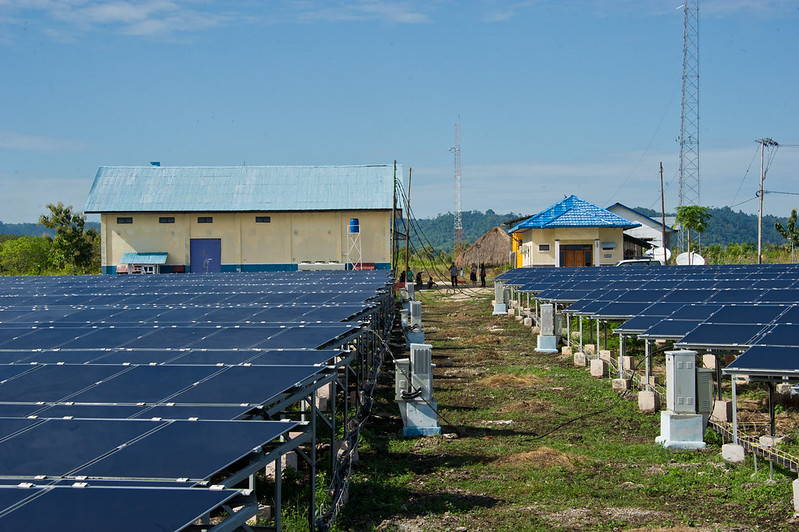
Rows of ground-mounted solar panels and electrical boxes installed in front of facility buildings to provide electricity on Sumba Island, Indonesia.

Credit: Asian Development Bank / Flickr

Share