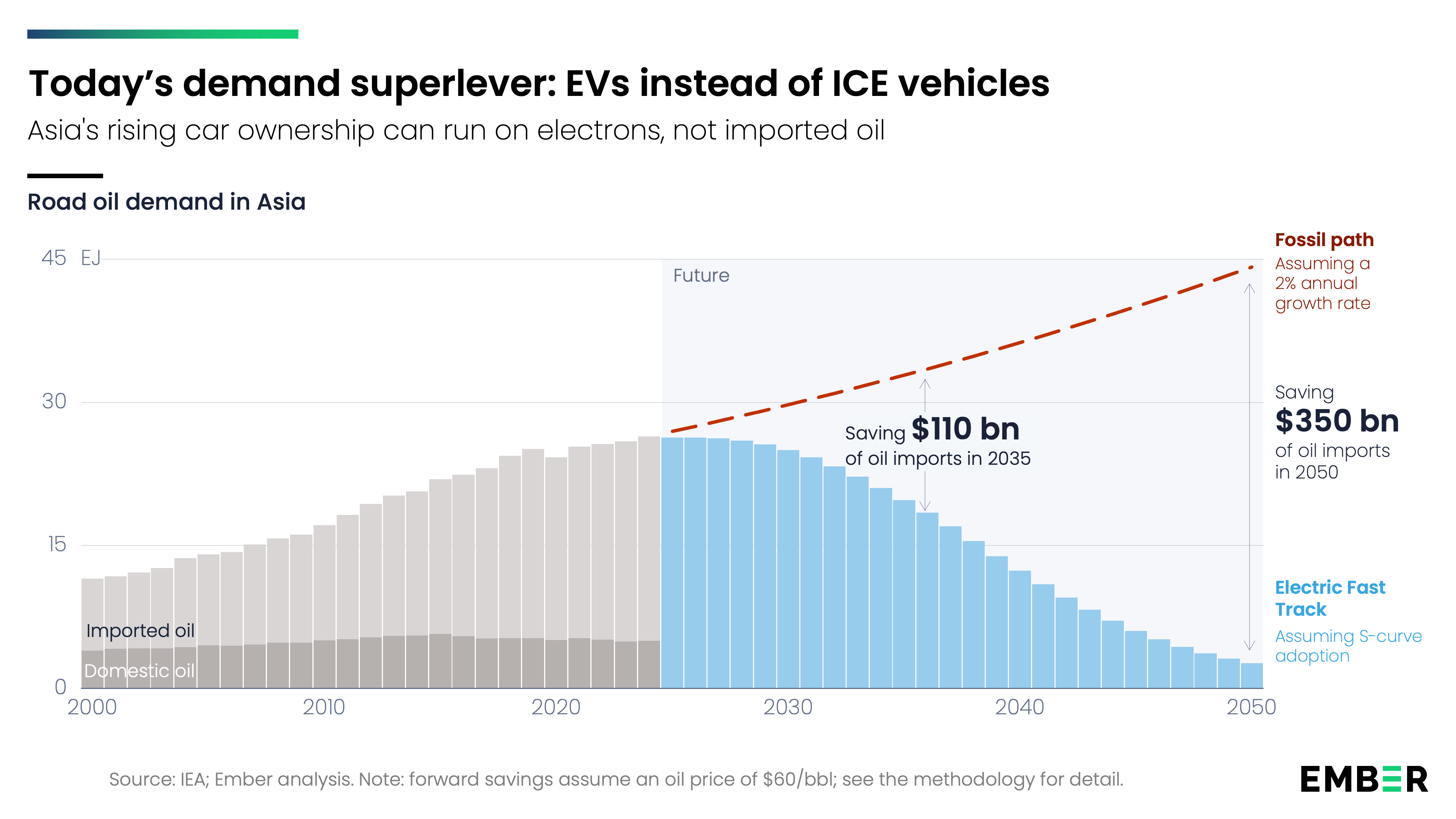
“Electric vehicles are a strategic necessity,” says Daan Walter, Principal at Ember and the lead author of the report. “Road transport is the single largest source of Asia’s fossil imports, costing over $300 billion a year. Asia could electrify its fleet within twenty years and halve its oil imports. No single lever does more for the region’s balance of payments and energy security.”
The new era of fossil fuel shocks, most recently caused by the closure of the Strait of Hormuz is increasing the urgency for Asian countries reduce oil & gas imports and switch to a path of homegrown electrotech. The region sourced 45% of its oil and roughly 30% of its LNG from the Middle East in 2024, and around 80% of all the oil and gas passing through the Strait of Hormuz is destined for Asian markets. Even in the optimistic scenario of an early reopening of Hormuz, the report cites forecasts showing oil prices remaining above 2025 levels for at least two more years. LNG has also proven no refuge, as seen when Europe turned to LNG after Russia’s 2022 invasion of Ukraine; surging prices effectively priced large parts of South and Southeast Asia out of the market.
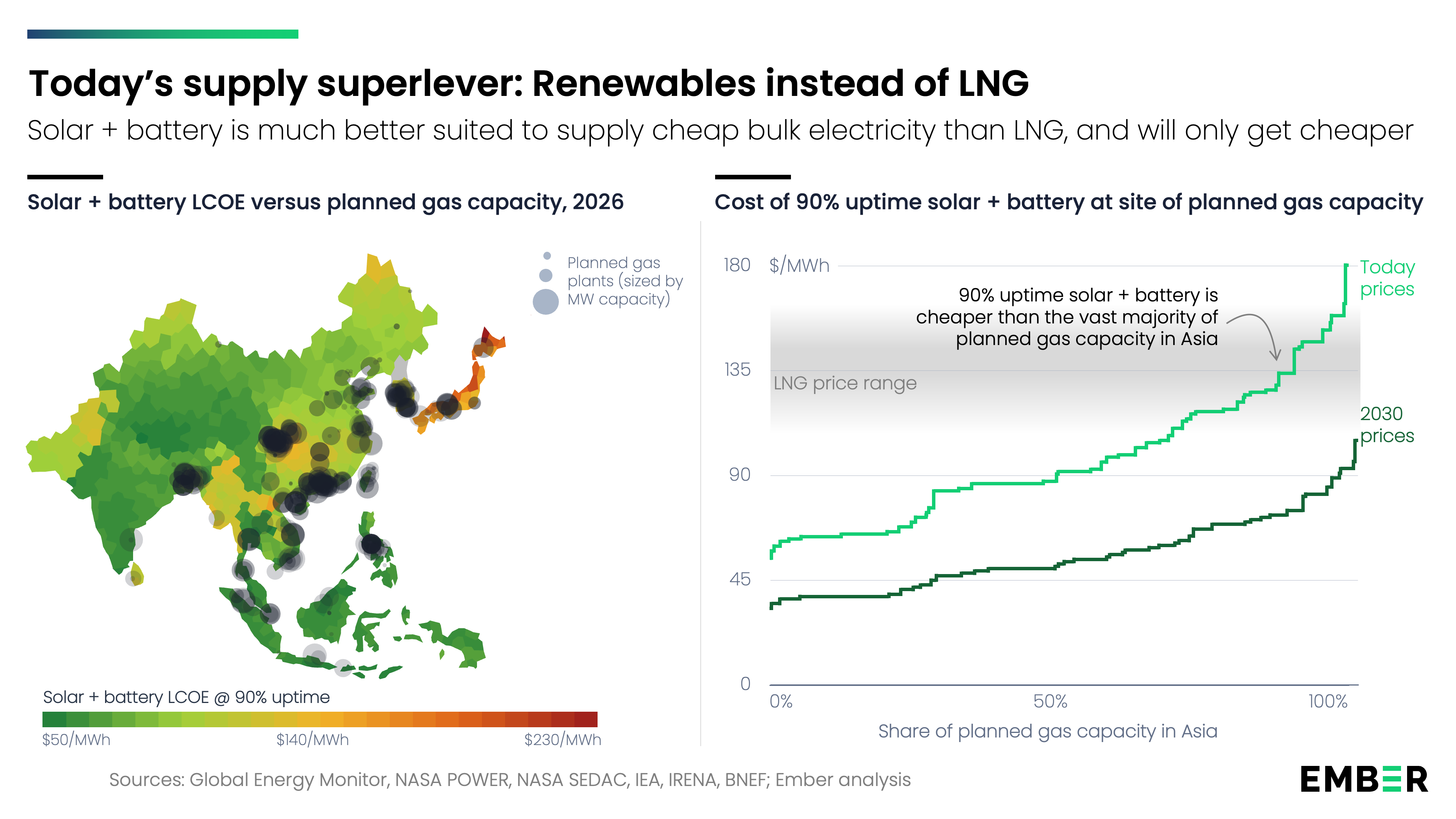
“Asia has been highly dependent on the old stability of the Pax Americana, which is being challenged by one oil shock after another, and the closing of Hormuz is a major catalyst for a change,” says Kingsmill Bond, Director at Ember and a co-author of the report. “The economics of electrotech have been transformed in the last five years. The cost of firm electricity from solar backed up by batteries has fallen below that of fossil fuels for almost all of Asia. What was competitive before is irresistible now.”
The report states that both levers, supply and demand, can be deployed at a speed that fossil infrastructure cannot match. Solar and batteries can be rolled out in days, in increments as small as a few kilowatts, costing a few thousand dollars, whereas a new LNG import chain can take around six years and several billion dollars before delivering its first power. The prices of everyday electric technologies, from cookstoves and air conditioners to two-wheelers and LED lighting, have fallen by between 35% and 90% over the past decade.
“Electrotech is fast, modular and consumer-led,” says Walter. “Faced with a crisis, policymakers can deploy electrotech rapidly, and households can climb the energy ladder one step at a time at low incremental cost. Witness what happened in Pakistan. Households and businesses have installed distributed solar at a pace that has outrun centralised planning entirely. Governments need to keep up.”
The report states that becoming an electrostate is an imperative for Asian countries. Asia spends around $1.1 trillion a year importing fossil fuels, money that a pivot to electrotech will increasingly redirect into domestic supply chains, manufacturing and infrastructure. Crucially, this could lead to stronger Asian currencies as the fossil import burden on the trade balance and forex exposure could come down to ~10-15% or lower for every Asian economy.
The shift would also begin to clean the air for the roughly nine in ten Asians who breathe pollution above World Health Organization limits, while building a commanding position in the electric industries that the rest of the world will be buying for decades.
“Asia does not have the fossil resources to grow with domestic molecules; the way to grow without deepening energy dependence is through electrotech,” said Lolla. “Asia now has the chance to build its future on electrons. If this is to be the Asian century, the path will be electric.”