The solarisation of Pakistan’s energy economy | Ember

The solarisation of Pakistan’s energy economy

Distributed solar is driving up electricity demand, bringing huge social and economic benefits.

25 Jun 2026
23 Minutes Read
Download PDF
Dave Jones
Chief Analyst
Ember
Nabiya Imran
Associate – Energy Insights
Renewables First
Sohaib Malik
Senior Fellow Energy Transitions
Renewables First
Muhammad Mustafa Amjad
Director Programs
Renewables First

Highlights

+21%
Growth in national electricity demand in just two years, enabled by distributed solar.
22%
Pakistan’s true electrification rate, which now matches the global average
+27
Gigawatts of distributed solar deployed in just two years, the same as all the operating coal, gas and oil plants built in Pakistan ever.

Executive summary

How distributed solar is changing Pakistan’s energy system

In just two years, Pakistan’s energy system has been transformed by distributed solar.

Official statistics have largely missed the scale of this transformation. The rapid adoption of consumer-led solar in the country has had effects far beyond the power sector. Rather than simply replacing grid electricity, distributed solar has enabled a surge in electricity consumption, accelerated electrification across the economy and changed how businesses, farmers and households use energy.

By lowering costs and improving access to electricity, distributed solar is unlocking demand that high prices and unreliable supply had long constrained thereby bringing benefits to Pakistani consumers.

Pakistan’s per capita energy use is less than a quarter of the global average, so its future electrification story is less about the current energy system and more about the growth to come. Electrification will triumph, but only if electricity remains cheap, reliable and accessible.

Pakistan has a thirst for energy, and solar is providing it. Distributed solar is so fast and cheap to build, that it is actually driving up electricity demand. So many other emerging countries also have pent-up energy demand, weighed down by the problems and cost of fossil fuels. Pakistan’s distributed solar boom provides experience to show how fast clean energy growth can happen, and the benefits that this brings.

Dave Jones
Chief Analyst, Ember

Distributed solar is providing millions of Pakistani homes, farms and businesses with affordable, reliable electricity. Empowered by the widespread adoption of solar PV tech, consumers are playing a central role in Pakistan’s electrification and energy transition.

Nabiya Imran
Associate – Energy Insights, Renewables First

Key takeaways

01

Pakistan’s total electricity demand rose by 21% in just two years, met entirely by distributed solar generation.

The rise in electricity demand of 33 TWh between FY23 and FY25 was led entirely by distributed solar generation which more than tripled, rising from 15 TWh to 51 TWh and more than covered all demand growth as grid generation fell by 3%. As a result, distributed solar’s share of the electricity mix almost tripled as well, increasing from 10% to 28%. This growth occurred alongside GDP growth of 5.2%.

02

Distributed solar has accelerated electrification, bringing Pakistan close to the global average.

Electrification – the proportion of final energy demand met by electricity – rose to 21.7% in FY25, just a whisker away from the global average of 22.0%. Pakistan gained almost five percentage points in just two years, while the global average rose by just 0.8 percentage points. Electricity met almost all growth in energy demand. While electricity demand surged by 21%, non-electricity energy use increased by just 2%. As distributed solar supplied nearly all of this additional electricity demand growth, it is also meeting almost all the energy demand growth.

03

Distributed solar has helped to increase electrification in almost every sector

In agriculture, solar has largely displaced diesel and grid electricity, changed irrigation economics and enabled farmers to pump more water than ever before. In industry, it has filled the vacuum left by collapsing captive gas and coal by providing competitive pricing advantages. In residential settings, it has unlocked consumption that high tariffs and loadshedding had long suppressed, driving growth in appliance use, particularly cooling. Commercial solar, meanwhile, has quietly absorbed demand growth without proportionate exposure to grid tariffs. Transportation, which has so far remained largely untouched by the shift, is becoming the next frontier of electrification.

04

No other electricity source could have achieved what distributed solar achieved.

Distributed solar was faster: in just two years, 27 GW of distributed solar was installed, equivalent to the capacity of all operating coal, gas and oil plants ever built in Pakistan. Distributed solar was cheaper – residential solar with a medium battery produces electricity at around PKR 20 per kWh, half the PKR 40 cost of grid electricity. Distributed solar was better – it has eliminated daytime loadshedding, avoided more than $12 billion USD in oil and gas imports by February 2026, reduced CO2 and air pollution and saved transmission and distribution losses.

Chapter 1

The solarisation of Pakistan’s energy system

Something remarkable has happened in Pakistan’s energy landscape and official statistics have largely missed a growing transformation of the whole system beyond just the power sector.

In just two years, Pakistan’s electricity generation has surged by 21%, making a total increase of 33 TWh. This rise was entirely led by distributed solar generation, which increased by 36 TWh. This 21% rise in electricity demand occurred alongside GDP growth of 5.2% over the same period.

Distributed solar generation more than tripled, from 15 TWh in FY23 to 51 TWh in FY25. Grid electricity generation declined slightly, by 3%.

This meant 28% of Pakistan’s electricity generation was distributed solar in FY25, up from 10% in FY23. Taking into consideration transmission losses and theft from grid electricity, distributed solar accounted for 32% of electricity supply.

Pakistan’s solar revolution is an outcome of several factors at play: rising electricity prices (compounded by the 2022 European energy crisis) made solar savings increasingly attractive. Generous net-metering policy that rewarded early adopters, falling panel costs globally, growing unreliability of the grid and a tax regime that kept import costs low supported rapid adoption as well.

Renewables First fills the void on distributed solar data

The most recent analysis by Renewables First (RF) places distributed solar deployment at 38 GW as of June 2025 (end of FY25).

The work of Ember, Transition Zero (TZ) and the Policy Research Institute for Equitable Development (PRIED) contributed to RF’s estimates. Ember’s analysis of Chinese custom data shows 47 GW of solar panels cumulatively exported from China to Pakistan by June 2025.

This represents the upper bound of potential deployment, as Pakistan imported very few panels from other countries, and not all Chinese panels imported will have been installed, assuming some are sitting in storage or in transit.

TZ estimated 27.5 GW of distributed solar by examining a small amount of high-resolution satellite images and scaling the results for the entire country. In the same study, PRIED, interviewed 5,300 households and businesses, producing an estimate of 33 GW of distributed solar when scaled to the national level.

Drawing on these inputs, RF estimated total distributed solar deployment at 38 GW by June 2025 through a triangulated, bottom-up methodology combining field data, market consultations and national statistics.

RF estimated that this capacity generated 51 TWh of electricity in FY25, based on a capacity factor of 16.71%. Well-maintained residential systems can reach capacity factors up to 20% given the country’s high solar irradiation and lack of shaded areas, while heavily soiled or suboptimal systems perform less well.

RF’s estimate combines a 16.71% capacity factor with 10% curtailment for off-grid and behind-the-meter (BTM) systems to reflect this mix. Mapped across sectors, 44% of FY25 deployment was residential, followed by industry (26%), agriculture (21%) and commercial users (9%). This sectoral split reflects different connection models: residential and industrial deployment is mostly behind-the-meter, while agriculture accounts for most off-grid systems. Because off-grid systems are disconnected from the grid, they represent almost entirely new electricity demand. For full details, see Customer-Owned Renewable Electrification (CORE) Finance Mapping, 2026.

Distributed solar is electrifying Pakistan

This huge rise in electricity demand, enabled by distributed solar, has brought Pakistan’s electrification rate close to the global average.

Electrification – the proportion of final energy demand coming from electricity – rose from 17.0% in FY23 to 21.7% in FY25, just a whisker away from the global average of 22.0%. Pakistan gained almost five percentage points in two years, while the global average rose by just 0.8 percentage points.

Electricity propelled almost all growth in energy demand. So, whilst electricity demand surged by 21% between FY23 and FY25, non-electricity energy use rose by just 2% (the combined rise in final energy consumption of oil, gas, coal and LPG reported in Pakistan’s Energy Yearbook).

Since distributed solar supplied almost all new electricity demand, and non-electricity energy was almost unchanged, it was the primary driver of this rise in electrification rate.

Ember calculated the 21.7% electrification using Pakistan Energy Yearbook data, supplemented with distributed solar generation from Renewables First and biomass demand data from the IEA. Biomass is included because the IEA’s global electrification methodology counts biomass in final energy use, whereas Pakistan’s official statistics do not.

The distinction is important because biomass use is significant in Pakistan’s residential sector for heating and cooking. The Energy Yearbook does not include biomass and would suggest a higher electrification rate of around 27%, once distributed solar is accounted for.

Distributed solar has become a significant and accelerating driver of electrification across most sectors. In FY25, it added 7 percentage points to Pakistan’s total electrification rate (excluding biomass). By sector, distributed solar added 8 percentage points to the residential, 9 percentage points to the commercial and 7 percentage points to the industrial demand. Transport remains the sole exception, with electrification effectively at zero throughout.

Chapter 2

How distributed solar impacts energy use by sector

Distributed solar is accelerating electrification in almost every sector of Pakistan’s economy. However, it has reshaped energy use differently across sectors.

2.1 Residential sector: distributed solar is overwhelmingly meeting new electricity demand

Residential electricity demand has risen by a third (32%) in just two years, driven almost entirely by distributed solar. Solar generation increased from 7 TWh to 23 TWh, whereas residential grid electricity demand rose just 6%. This suggests that residential solar is overwhelmingly about meeting new electricity demand, which in turn is being stimulated by solar itself.

Renewable First’s “Customer Owned Renewable Electrification” report gives valuable insights into how households are using electricity given the widespread adoption of solar:

  • Almost a fifth (18%) of Pakistani households now have solar: 7 million of the country’s 40 million households, representing 16.9 GW of capacity. On average, this amounts to 2.4 kW per household, equivalent to around five solar panels – more than enough to power much of an average household’s daytime demand.
  • Solar ownership is concentrated in rural households. While 60% of Pakistan’s population is rural, 73% of solar-owning households are located in rural areas. These consumers faced the least reliable electricity supply, long outages and in some cases, no grid connections altogether. Adoption has also been concentrated primarily among higher-income households with sufficient financial resources to fund upfront installation costs or access financing.
  • What households pay for evening electricity depends on the kind of solar system they have. Those with behind-the-meter systems without batteries pay full grid prices in the evening, losing any daytime solar they do not use. Those on net metering can offset evening consumption against daytime surplus, although the shift to net-billing earlier this year has reduced that advantage. The government’s intent appears to be drawing demand back onto the grid to support improvement in utilities’ financial performance, but this logic may not hold for most residential adopters. Given that the majority of systems are already behind the meter, the more likely behavioural response to reduced export incentives is a push toward building batteries, limiting the expected recovery in grid demand.

The question is, what do they use the electricity for?


A lot more appliances

The rise in distributed solar is enabling more demand for electrical appliances.

Given Pakistan’s climate and cooling needs, solar has helped unlock an increase in the use of cooling appliances. This ranges from fans and evaporative coolers to air-conditioning systems, some of which can connect directly to solar panels without a household inverter. Pakistan’s AC market grew from 5.8% annually in 2021 to 7.4% in 2025, propelled by urbanisation, rising temperatures, and demand for efficient cooling, and is projected to expand at a CAGR of 7.6% through 2032.

For other appliances, the data is sparser. Refrigerators, washing machines and domestic water pumps are all key staples for most Pakistani households. There have been reports of consumers shifting their use to daytime hours to take advantage of effectively free solar electricity.


Less diesel generator use

Many of the same consumers who invested in uninterruptible power supply (UPS) systems and diesel generators during the loadshedding crisis of the early 2010s are also those that have installed solar. Some solar power is therefore likely reducing diesel use. However, official statistics do not report diesel use in generators, making the scale of any reduction difficult to quantify.


Cooking and heating still dominated by gas and biomass

There is very little evidence so far of a significant increase in the use of electricity for household cooking and heating.

Total gas and LPG use is roughly unchanged. Gas use has fallen because of a moratorium on new gas connections, but this has been offset by higher LPG use. LPG is usually available in the form of cylinders, and recent price increases following the Hormuz crisis may create opportunities for cooking electrification.

Much of Pakistan’s cooking and heating demand is still met by biomass. Firewood, animal dung cakes and crop residues are used for both cooking and heating especially in rural areas lacking reliable and affordable alternatives. IEA data shows household biomass consumption is twice that of gas, LPG and electricity combined. Biomass use is not reported in Pakistan’s Energy Yearbook.

Electricity could play a larger role in these uses. Portable induction hobs provide a low-cost option ($20) for cooking, while heat pumps can provide winter heating at a significantly higher upfront cost ($600). There is also a clear pathway for switching household energy use from gas to electricity.

Residential solarisation has been overwhelmingly about enabling more demand, rather than displacing grid electricity or other fossil fuel use.


2.2 Industrial sector: distributed solar fills the gap left by declining gas and coal use

Industrial electricity demand has risen by a fifth (22%) in just two years, driven entirely by distributed solar. Industrial solar deployment is the second largest of any sector, at about 10 GW, dominated by behind-the-meter systems.

Solar generation more than tripled from 4 to 13 TWh, more than meeting the rise in electricity demand (+9 TWh). As a result, grid electricity use fell by 6% (-2 TWh).

Unlike other sectors, however, the industrial story plays out against a backdrop of declining energy demand rather than expansion. Prior to the recent surge in distributed solar, between FY21 and FY23, industrial coal use fell by 62%, oil by 23% and fossil gas by 25% in final energy terms. A portion of this reduction reflects a statistical transition: fuel previously consumed in captive power plants (recorded as final energy) has been displaced by solar, which delivers the same electricity using less primary energy. The true decline in industrial energy consumption is therefore likely smaller than recorded figures suggest.

Gas use fell a further 15% from FY23 to FY25, as fossil gas prices for industrial use saw a sharp rise in October 2023. Coal and oil consumption remained broadly unchanged over these two years.

Much of the fuel decline in industry was from International Monetary Fund (IMF) mandated levies placed specifically on gas used for captive self-generation, aimed at redirecting industries to the national grid. Industries faced a constrained choice: absorb higher grid tariffs, continue running increasingly costly captive plants or invest in solar. Many opted for solar; others reduced operations entirely.

Adoption of solar has not been uniform across subsectors. Textiles, which account for more than half of Pakistan’s exports, have been among the most aggressive adopters, driven not only by domestic cost pressures but also by the need to lower the embedded carbon intensity of exports and maintain global competitiveness. Cement, fertiliser, and other energy-intensive subsectors have adopted solar selectively. Research on Pakistan’s cement plants shows that solar can supply part of their electricity needs, but cement kilns still rely on conventional fuels for the high-temperature heat needed to make clinker.

There is further potential for distributed solar to replace gas use in textiles and food industry. Both sectors use gas largely for low-temperature heat, which can potentially be provided more cheaply with distributed solar electricity, including heat pumps. Coal remains important in cement and brick kilns, which can be electrified, although this is not necessarily economic without subsidies.

Industrial solarisation has therefore followed a different logic from the other sectors: solar has filled the vacuum left by collapsing captive coal and constrained gas.

2.3 Commercial sector: distributed solar helps meet most of a 39% surge in electricity demand

Commercial electricity demand has risen by 39% in the last two years, the fastest growth of any sector. This was mostly driven by distributed solar. Solar generation quadrupled from 1 TWh to 4 TWh, while grid electricity use rose by 8%.

Solar deployment in the commercial sector is relatively small at 3.3 GW, making up around 9% of the national total. Despite its modest absolute size, solar constitutes around 15% of the sector’s final energy consumption, a higher share than both the residential and industrial sectors. BTM systems dominate deployment in this sector.

The daytime load profile of most commercial operations such as offices and shops, aligns naturally with solar generation, making self-consumption highly attractive without requiring net-metering arrangements.

Alongside rising electricity demand, gas use in the commercial sector also grew by 24% between FY23 and FY25.

All in all, for most commercial users, solar functions as a hedge against tariff exposure and reliability risk on incremental load, rather than a wholesale replacement for grid supply.

2.4 Agricultural sector: solar displaces diesel and grid power, as solar tubewells lead to an irrigation boom

Agricultural electricity demand has risen by a third (34%) in just two years, driven entirely by distributed solar. Total agricultural solar deployment stands at 8.1 GW, of which around 80% is estimated to be off-grid.

The agricultural sector offers the clearest example of distributed solar’s transformative impact, driven primarily by displacement of existing diesel use with some additional demand effect. Solar generation more than tripled from 3 TWh to 11 TWh. Of the additional 8 TWh solar generation, 3 TWh displaced grid electricity demand (which fell by 38%), while 5 TWh represents entirely new electricity demand as electric solar-powered tubewells replaced diesel pumps.

Solar tubewells have transformed irrigation economics through a combination of private market forces and government schemes. Savings from these lower operating costs can be reinvested for greater productivity, while solar systems continue generating electricity for decades after installation.

Financing mechanisms have also played an important role in enabling agricultural solar adoption, particularly given the high upfront cost of solar tubewell systems. Agri-solar systems have been financed through a mix of subsidies, microfinance institutions (MFIs), and agri-focused lending products offered by commercial banks, while installers and dealers remain important for distribution and access.

Between 2022 and 2025, solar has surged from near-zero to 61% of all tubewells, while diesel has sharply declined from 79% to 28%. This reflects a structural transition as farmers rapidly move away from costly diesel and unreliable grid supply. Additional demand is also visible. The total number of tubewells grew from 1.52 million in 2022 to 1.76 million in 2025, a 16% increase, suggesting that cheaper solar pumping has enabled irrigation in places or at intensities that were previously uneconomic.

This transition has displaced a substantial volume of diesel. With diesel-powered tubewells falling from 1.20 million in 2022 to 0.48 million in 2025, the shift implies about 1.9 billion litres of diesel avoided annually, almost 1.6 MTOE. High speed diesel use is not reported separately in the agricultural sector; it is grouped under transport. As a result, the reduction in diesel consumption is not explicit in government data and is instead inferred from the number of tubewells.

As solar makes irrigation cheaper for farmers, the risk of groundwater depletion has also increased. Lower pumping costs have increased water extraction, while continued reliance on water-intensive crops and the limited adoption of smart irrigation technologies means improved affordability may simply translate into more groundwater use. The benefits of agricultural solarisation will be greatest if they are accompanied by measures to improve water management and groundwater sustainability.

In short, agricultural solarisation has been both a diesel and electricity displacement story and also a demand growth story. The energy gains are real, but unless paired with water use reform, they risk being undercut by the very groundwater stress they accelerate.

2.5 Transportation sector: solar’s untapped frontier as EVs begin to emerge

No distributed solar can be directly attributed to transport because of a structural accounting problem. Electricity consumed at public EV charging stations is likely recorded under the commercial sector in national energy accounts rather than transport. Personal EVs charged through solar home systems face a similar blind spot: with that electricity recorded as residential consumption. The result is that even where solar is already powering EV charging, it remains invisible in transport sector data.

Due to this gap, transportation sits outside the deployment-displacement-demand framework used in the preceding sections.

This matters because the sector’s trajectory is quietly shifting. Oil demand rose by 7% from FY23 to FY25, recovering some declines seen in previous years while gas demand fell by 15%. As electric two- and three-wheelers gain market share and the broader vehicle fleet begins to electrify, transport is likely to become the next major frontier for solarised demand.

Existing energy accounting systems are poorly equipped to track this transition because they rely heavily on fuel sales data. Without methodological updates to how transport energy consumption is measured, the displacement of oil by solar-charged electricity will continue to go largely uncounted, and the true scale of the opportunity will remain unclear.

Chapter 3

Why the electrification surge could only have happened with distributed solar

Distributed solar has addressed Pakistan’s electricity demand in a way no other electricity source could match. It has helped to stimulate electricity demand. Cheap and reliable electricity is one of the most powerful tools for raising living standards and driving economic growth.

3.1 Faster

Put simply, no other electricity source could have been built and connected quickly enough to meet electricity demand growth and enable new demand except distributed solar.

In just two years, 27 GW of the 38 GW distributed solar was installed. This is equivalent to the total installed capacity of all coal, gas and oil plants ever built in Pakistan.

Large-scale power plants take several years of planning and construction before generating a single unit of electricity. The 525 MW Nandipur gas power plant took eight years from government approval to commercial operation, the 660 MW Jamshoro coal plant took 12 years, and the 969 MW Neelum–Jhelum hydropower project faced delays of 21 years. No grid-scale plant could have enabled new electricity demand or met latent demand in time like distributed solar did.

Grids are built even more slowly. Distributed solar is embedded within the network and needs far less grid reinforcement by comparison to a centralised power plant, especially when there is sufficient battery storage buildout.

3.2 Cheaper

Because distributed solar is so cheap, it is not just meeting existing electricity demand, it is also stimulating growth in new electricity demand.

Residential solar systems with a medium battery provide electricity for around PKR 20 per kWh, according to Institute for Energy Economics and Financial Analysis (IEEFA).

This is roughly half the price of grid electricity. Commercial and domestic retail electricity (beyond low tariff thresholds) costs PKR 40; industrial electricity is 10-20% cheaper than that.

Diesel generation costs around PKR 120 per kWh – six times that of solar electricity, based on the diesel priced at PKR 380 per litre ($1.36 per litre). If a customer needs to use even a small amount of diesel generation during loadshedding, solar is likely to pay off.

Perhaps the most prominent impact of cheaper electricity is on air conditioning. Solar and AC adoption have become co-determining purchases: households install panels partly to run ACs affordably; AC use on grid electricity prices would just be unaffordable for many. Where solar is a quarter of the price, the economics of cooling are transformed.

3.3 Better

There are other ways distributed solar is delivering a better type of electricity. It has eased chronic daytime loadshedding, avoided fossil fuel imports, cut CO2 and air pollution, and reduced transmission and distribution losses.


Eased chronic daytime loadshedding

One of distributed solar’s clearest wins has been restoring reliable daytime power to households and businesses. Consumers who endured up to 12–18 hours without electricity in the early 2010s found relief by installing rooftop systems of their own. Most recently, during the fuel crisis triggered by the closure of the Strait of Hormuz, the government was forced to reintroduce loadshedding in the evenings, while solar largely met electricity demand during the day.

That success, however, has created a new challenge. As solar adoption has grown, it has reshaped the national load curve in ways that shift peak demand to the evening. Load management is now concentrated in evening peak hours that solar cannot serve.

Bridging that gap will require either battery storage to carry surplus solar into the evening, or incentives that shift consumption toward daytime hours.


Avoiding fossil fuel imports

Pakistan’s fossil fuel import vulnerability makes the shift to solar all the more consequential. The country has avoided more than $12 billion USD in oil and gas imports cumulatively up to February 2026, and could save a further $6.3 billion by the end of the year. Given that fossil fuel imports cost PKR 4.3 trillion ($15.5 billion) in FY25 alone, these avoided costs represent a meaningful reprieve from the currency pressures and inflationary cycles that have historically destabilised the economy.

The alternatives to solar are also riddled with externalities. Beyond import bills, coal, oil and gas contribute to climate change and local air pollution – burdens that fall hardest on a country already on the frontlines of climate risk like Pakistan.


Saved transmission and distribution losses

Distributed solar is used onsite, avoiding transmission losses. Pakistan loses roughly 22% of grid electricity between generation and billing. Therefore, at a system efficiency level, 1 unit of distributed solar is equal to around 1.28 units of grid electricity.

3.4 A different way to buy electricity

Compared to grid electricity which you pay for as you use it, solar is more complicated. There is a large upfront payment, which then provides ‘free electricity’ in the daytime.

It raises questions about how household energy behaviour changes. Lower marginal costs could potentially increase air conditioning use through rebound effects, although the extent of this response remains uncertain. Electricity consumption patterns may also become more dynamic, depending on how easily households are able to align appliance use with solar generation. It also raises questions around investment decisions within households. The point at which households choose to add batteries or expand solar capacity is not yet clear, nor is the speed at which earlier investments such as diesel generators are phased out.

Finally, there may be distributional implications within households, including how decisions around energy use and investment are negotiated.

It is not to say this model is better or worse, but rather that more research is needed on how electricity (and energy) behaviour is changing in Pakistan with solar.

Chapter 4

Distributed solar could help Pakistan leapfrog the world on electrification

It’s easy to look at Pakistan’s current energy system and imagine how it can be rapidly electrified. Biomass used for residential heating and cooking causes significant health damage, which electric heating and cooking could help alleviate.

Most of Pakistan’s gas is used for low-temperature heat, which is economically replaceable with heat pumps when the gas price is as high as it is right now. Within industrial gas demand, only 17% is used for harder-to-abate fertiliser manufacturing. Pakistan has no primary steel industry, and aviation makes up only 2% of oil demand, both of which are difficult to electrify. In many ways, electrifying Pakistan’s energy system is perhaps easier than in many other countries.

However, Pakistan’s future electrification story is less about the current energy system and more about the growth to come. Pakistan’s per capita energy use is less than a quarter of the global average – just 20% of global electricity consumption per capita and 24% of non-electricity energy use according to the IEA (without distributed solar adjustment).

Electrification will accelerate, but only if electricity is cheap, reliable and accessible.

4.1 Electricity is the preferred energy source

Ember’s recent report, Electric Asia, outlines how fast electrification has already been happening in Asia, and identifies three structural drivers of further electrification. First, Asia does not have plenty of oil and gas. Asia accounts for just 2% of global oil reserves, 8% of global gas reserves (outside of the Middle East and Central Asia). Second, Asia is the workshop of the world and electrotech products are manufactured goods. Third, technology has come so far that 70% of energy demand can already be electrified.

At the national level in Pakistan, the push factors for electrification are immense. Renewables First has documented physical and economic inefficiencies across Pakistan’s fossil-heavy energy system. Oil and gas imports impose substantial costs through import dependence, foreign exchange exposure, and vulnerability to global price shocks. 10% of Pakistan’s GDP is being spent on fossil fuel import bills over the past few years as a result of depreciating rupee and global energy shocks.

Fossil gas, for example, is expensive and increasingly scarce in Pakistan. Household gas connections are on a moratorium, while industry pays hefty, imported gas prices for a fuel whose physical efficiency is inferior to electrified alternatives. Solar electricity is proving to be a more effective option in industrial use cases requiring low-temperature heat, lighting, and air conditioning.

The pull factors are also overwhelming. Once imported, solar PV has no recurring fuel cost and can generate electricity for decades. Electric vehicles are approaching cost-parity with petrol vehicles, giving them a huge lifetime cost advantage due to the cheaper cost of electricity compared to petrol. Although Pakistan’s personal mobility stock comprises mainly ICE vehicles, demand for EVs is getting traction. A shift to electrified personal mobility is estimated to avoid annual oil imports of 10 MTOE, without the costs associated with environmental and health damages caused by ICE in the country’s densely populated urban centres.

4.2 Distributed solar needs to be cheap, reliable and accessible

Distributed solar has its limitations.

Batteries are needed to help make it reliable round the clock – cheap daytime availability is not enough. Battery prices have fallen significantly and in2025, the cost of storing an hour of electricity was just $65 per MWh. However, upfront costs are still an issue – converting solar into 24-hour electricity requires more capital expenditure in batteries than solar panels – which will make it hard for many Pakistani households to afford. Perhaps batteries built into the local grid, rather than at homes and industries, might be a cheaper way to implement batteries at scale.

Rooftop space is also inherently limited, even though land is not. Rooftop potential is estimated at 310 TWh, and with generation at 51 TWh, 17% of the potential is already used. For a home, an office, or even a light manufacturing unit, rooftop solar may be able to power the majority of the electricity needs. But for heavy industry, future demand, and other larger users, it isn’t enough. At the other end of Pakistan’s distributed solar revolution is Saudi Arabia’s utility solar revolution, where it’s aiming to go from zero renewables in 2020 to half of its electricity generation by 2030, powered largely by large solar and battery sites. These are able to achieve some of the cheapest electricity prices in the world of any type – in Saudi Arabia, solar-plus-storage systems can approach near-continuous supply at a firm LCOE of around USD 70/MWh, competitive with combined-cycle gas generation even where fossil fuels are domestically.

Finally, grid investment is needed to make electricity accessible. For example, it is still unclear whether new large industrial customers can get electricity connections as quickly as they need it. Although distributed solar necessitates less grid investment than large power plants, some grid investment is still needed.

Solar has revolutionised Pakistan’s energy landscape and has the potential to play an even greater role in meeting the country’s growing demand needs in the coming years.

Supporting materials

Downloads

Acknowledgements

In addition to the authors, we thank all those within Ember and Renewables First that have contributed to this report, including Muhammad Mustafa Amjad, Rini Sucahyo, Chelsea Bruce-Lockhart, Kingsmill Bond, Kostantsa Rangelova, Sachin Sreejith, Sana Shahid and Ardhi Arsala Rahmani.

Cover image

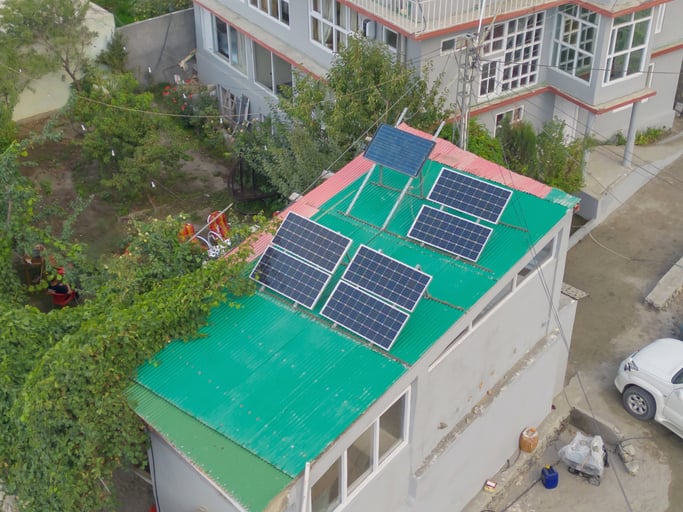
An overhead perspective showing multiple solar panels mounted on a green and red corrugated rooftop of a home in Pakistan, with a garden and a parked vehicle visible nearby.

Credit: tampatra / Getty Images Plus

Share