

The sunny side of electrification
Ember Current – July 2025 Newsletter

When I first joined Ember in 2019, I helped build our electricity generation dataset. Solar power was growing rapidly back then, but it was still tiny compared to what it is today. In the last six years, solar has continued its mind-blowing journey of declining cost and rapid deployment, and has become the engine of our global power system. It still surprises me just how pivotal the technology has become to meeting our electricity needs.
This year, I had the opportunity to work on the Energy Institute’s Statistical Review of World Energy, for which Ember is now a partner. Once again, it feels like solar is the showstopper reshaping our global energy system, but this time on a much bigger stage. For the first time outside of a recession, renewables were the largest source of new energy supply, with 71% of the increase coming from solar power. Keep reading to find out more, alongside other highlights from a busy month at Ember!
Insights, analyses and commentaries
My top picks
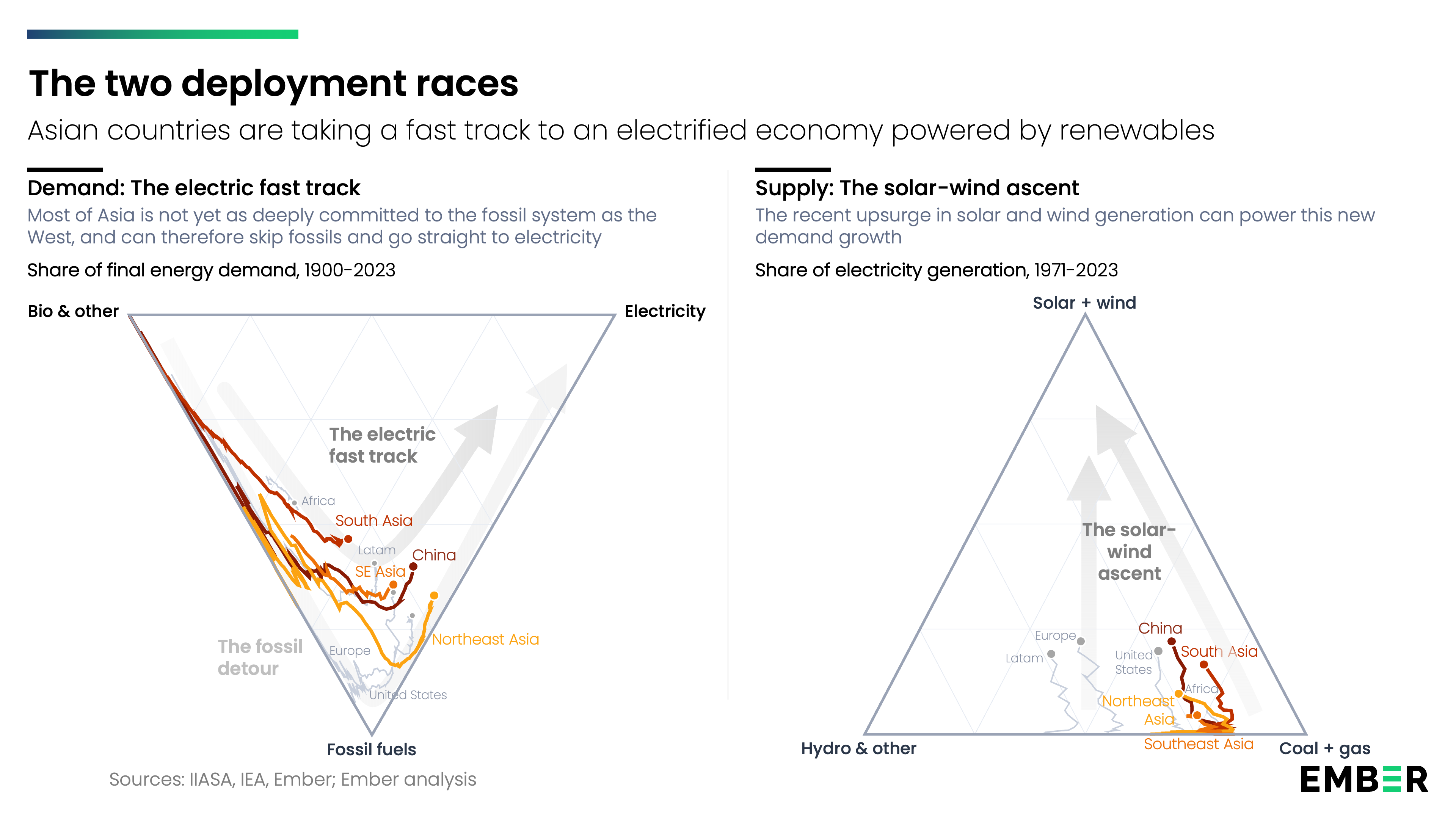
The way the world meets global energy demand is changing, with renewable sources and electrification both driving a shift away from fossil-based growth. If there is one region that is driving this change faster than any other, it is Asia. We’ve recently released several big reports that take a look at this, as well as analysis of how other economies can catch up.
EI Statistical Review of World Energy
One way electrification is changing the energy game in Asia is through the transportation sector. Electrified transport has meant that China’s diesel and gasoline demand has fallen in each of the last two years. Notably, on a per capita basis, China’s road fuel demand is a third of the level of the EU’s consumption, and six times lower than the US
Electric Asia
Asia is leading the electric age, powered by clean technology like renewable energy, heat pumps and batteries. The region manufactures three quarters of the world’s electrotech machinery and is electrifying rapidly.
A clean break: leaving fossil volatility for clean tech security
Elsewhere, in Europe, there’s an opportunity to shift from the vulnerability of fossil fuel dependency towards home-grown manufacturing and more resilient clean tech imports. Electrification can pave the way for greater energy security and self-sufficiency for the continent.
There’s more!
- Batteries and demand flexibility are ready to scale across the EU
- The solarisation of Pakistan’s energy economy
- UK solar homes power equivalent of five hours of daily air con use during heatwave
- Renewables save $750 million in electricity subsidies in Türkiye
- Gas share in global power mix has declined for a fifth consecutive year
- Renewables shield Spanish consumers from elevated gas prices
Ember in the news
- Renewables To Squeeze Oil And Gas Imports In New Electric Age For Asia – Forbes | Read more
- Wartime jolt pushes buttons on renewable power – The Financial Times | Read More
- Solar power outpaces coal as US emerges as world’s top oil exporter – Fox News | Watch the video here
What I’m reading
Visual storytelling corner
Chart of the month
Clean technologies are not just another form of energy import: they are the building blocks of an electrified, more secure energy system. Fossil fuels must be continuously shipped, burned and replaced, leaving economies exposed to volatile prices and supply disruptions. By contrast, clean technologies such as solar panels, wind turbines, batteries, heat pumps and electric vehicles are imported as durable assets that generate, store or use electricity for years. As electrification expands, each clean tech import adds lasting capacity to the system, while recycling and material recovery can further reduce future import needs. This makes electrification a pathway away from recurring fuel dependency and towards a more resilient energy system built on domestic renewable power.
Turning data into action
Data highlights

We recently published a summary of the world’s latest electrification targets. At the time, there were only two commitments for raising electrification rates. Ember will be tracking future announcements to ensure this page is up-to-date.

Electric vehicle exports reached a record $9.2 billion, up 49% year-on-year, in May 2026. Explore the trends via our China Cleantech Export Tracker
As another heatwave hits Europe, see how wholesale electricity prices are responding via our European electricity prices and costs data tool
Country spotlight
The US is massively stepping up its solar game. US solar generated more electricity than coal in May for the first month on record. In May 2016, solar generation was less than 2% of mix, with coal making up 26%. A decade later, solar made up 12.8% of generation in the month of May. Meanwhile, coal fell to 12.2%, its fourth-lowest monthly share ever.
Event highlights
Launch of the Energy Institute Statistical Review of World Energy
On the 30th of June 2026, Ember’s Interim Managing Director, Aditya Lolla joins the launch of the Energy Institute Statistical Review of World Energy. Marking three quarters of a century of this landmark report, the 75th edition provides the first comprehensive analysis of global energy production, consumption, trade and emissions for 2025. Now in its fourth year under the Energy Institute’s stewardship, and for the first time co-authored with Ember, this publication continues to serve as an essential resource for understanding the evolving energy landscape.

Event highlights
Launch of the Electric Asia Slidedeck
Asia’s rise is usually told as the defining economic story of the century – and separately, the rise of electricity is a defining energy story. However, instead of two separate stories, Ember’s new report ‘Electric Asia’ argues that Asia’s rise is electric, and the electric age is accelerating Asia’s rise.

Event highlights
Launch of Ember & Renewables First: “The Solarisation of Pakistan’s Economy”
“The Solarization of Pakistan’s Economy” examines Pakistan’s consumer-driven distributed solar transition, which official statistics have largely failed to capture. It maps approximately 38 GW of installed capacity across four sectors, residential, industrial, agricultural, and commercial, tracing the distinct role solar has played in each: unlocking suppressed demand, displacing fossil fuels, and absorbing demand growth outside the grid. This study also looks ahead at the next frontiers of solarization across these sectors and transportation, where electrification has yet to meaningfully take hold.