

£1bn but falling: Record subsidy for UK biomass burning enters final year
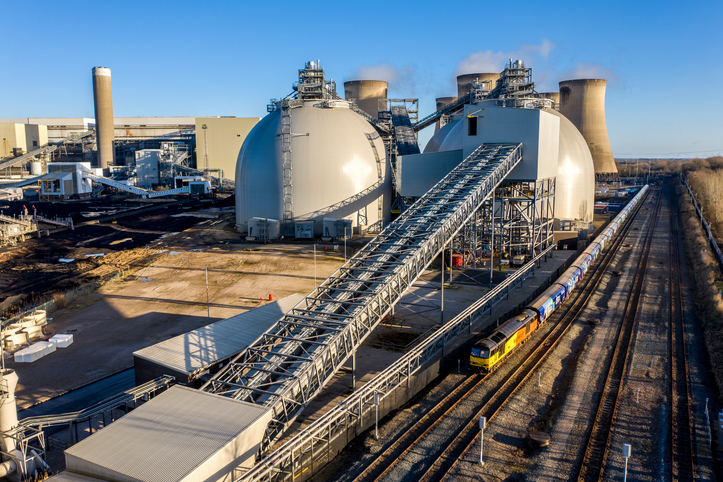
Drax biomass power station, Britain’s largest carbon emitter, received record public subsidies in 2025. From 2027, the subsidy available will be roughly halved to around £460 million per year, beginning its phase-out.
16 Apr 2026
4 Minutes Read


High public payments are due to be cut, but Drax biomass power station earned record subsidies in the last year.
- Drax subsidies reached a record £999 million in 2025, paid for through consumer bills. That’s roughly £2.7 million per day. It means that subsidies to this single power station rose to cost UK households £13 each per year.
- In 2027, public subsidy for Drax power station is expected to drop by about half – to £460 million per year, or roughly £1.25 million per day. 2026 is the final year of high payments for unabated biomass burning at Drax, which began on 1 April.
- Drax is likely to remain UK’s largest emitter in 2027 when subsidies are reduced. Despite lower generation, the scale of remaining emissions all but guarantees this position until at least 2030.
Nearly £1 billion for woody biomass burning is an astonishing high-water mark for public subsidies – and a problematic one as prices soar. While it’s a relief these overly generous payments will halve from 2027, British taxpayers should never have been in this position in the first place.
The long-term outlook for power generation at the UK’s largest emitter remains highly uncertain, as Drax’s long-term idea to install carbon capture technology falters. Without this, its argument for continued subsidies is undermined.
Drax subsidies hit record £999 million in 2025
Ember analysis of Drax’s 2025 financial reporting shows that public subsidies reached £999 million in 2025. This marks a record level for payments to Drax, attributable to high-emitting power generation at the Drax biomass power station.
Drax power station is the UK’s largest emitter. However, because it burns woody biomass, Drax’s emissions are ‘zero-rated’ in carbon accounting, making the company eligible for public payments. Subsidies are distributed through two schemes: the Renewables Obligation (RO), which covers three of the four generating units at Drax power station (£728 million in 2025), and Contracts for Difference (CfD) payments for the remaining units (£271 million).
Public subsidies in 2025 were £130 million higher compared with 2024 (+15%). This was partly due to a 2% increase in generation, but largely due to the rising value of payments under the Renewables Obligation subsidy scheme, which have increased by 10% for two consecutive years.
Building on this upward trend, the daily value of Drax’s subsidy payments climbed in 2025 to £2.7 million per day – costing every British household over £13 per year. This value is set to fall by around half as some subsidies are planned to be phased out, but will still cost households around £6 per year from early 2027.
Highly lucrative RO payment scheme is set to end in early 2027
Despite record-breaking payments in 2025, the beginning of the phase-out of public subsidies for Drax is in sight.
Drax power station houses four generating units, subsidised either through the CfD (unit 1) or the RO (units 2, 3 and 4). Total RO and CfD payments to Drax reached £8.72 billion since 2012 – the majority through the lucrative RO programme, which is coming to an end in early 2027. The CfD programme has provided an average top-up of £54 for every MWh generated by unit 1, whereas the RO scheme was worth £70 for every equivalent unit of energy generated by units 2, 3 and 4.
Fortunately for energy bill payers, the financial burden of the RO scheme for large-scale biomass burning is coming to a close in Q1 2027. A new CfD scheme, at around half the current subsidy total, will then run for up to four years before ending in Q1 2031.
Drax is likely to remain UK’s largest emitter
In April 2026, Drax power station entered the final twelve months of high subsidy payments. From Q2 2027, a new ‘capped’ CfD will cover all four generating units at Drax, at a higher strike price of £157/MWh (2024 prices) – a 10% increase. Despite this, subsidised generation is capped at a capacity factor of 27%, roughly half the historic average for the biomass power station.
While a 50% cut in subsidised biomass burning at Drax power station will deliver cost savings for consumers, emissions will likely remain higher than any other industrial site or power station in the country, cementing Drax’s status as the UK’s largest producer of carbon emissions.
Long term prospect for Drax subsidy falters as carbon capture is in doubt
In the longer-term, the rationale for continued subsidies for Drax is faltering as plans for emissions reduction are undermined. In its latest financial reporting, Drax once again distanced itself from investment in carbon capture technology, already long-delayed, despite the technology being a key driver for its continued subsidies. This follows the reported closure of a carbon capture trial and cuts to hundreds of jobs, as Drax moves investment to more proven energy technologies. However, any transition to bioenergy power generation with carbon capture would require around £30 billion in new subsidies, more than the entire carbon capture and storage budget. Without the motivation for subsidies to keep carbon capture at Drax in development, the wind-down in subsidies is a further step towards a phase-out.
Supporting information
Methodology
RO payments are taken directly from Drax’s financial reporting for 2025. The exact value of RO certificates is not publicly available, however the total value to Drax of RO payments (£728 million) has been divided by the electricity generation from the three RO units (10.4 TWh) to indicate a value to Drax of £70/MWh. The equivalent value in 2023 and 2024 was £57/MWh and £63/MWh respectively.
CfD payments are instead taken from LCCC publications. Tables of CfD actual payments, emissions and generation are published at a daily level per CfD unit. The value of the CfD payment per unit is the difference between the agreed strike price (fixed per contract, indexed with inflation) and the Baseload Market Reference Price, which is set for six-month periods twice yearly. Daily earnings from the CfD unit are a sum of the fixed CfD strike-price top-up and the generation-weighted Intermittent Market Reference Price for that day. As hourly generation data hasn’t been used, this is an estimate at the daily level.
Subsidy payments per household are estimated. According to most recent DESNZ sub-national statistics, domestic users consume 39% of power generation, with the remainder used by non-domestic consumers. Assuming that these payments are attributeable evenly between consumers, 39% of Drax payments divided by 28.6 million households (ONS) gives a figure of £13.66/MWh.
Acknowledgements
Contributors
Izabela Urbańska, Alison Candlin
Featured image
Teamjackson – iStock Editorial / Getty Images Plus
Related Content
Analysis
How the Philippines' rooftop solar surge can flip the energy emergency script
28 May 2026
Analysis
Rewiring Resilience: AI for Climate-Adaptive Power Grids in Asia-Pacific
21 May 2026
Analysis
Transmission gaps are beginning to constrain India's rapid renewables integration
19 May 2026
Analysis
British power prices are increasingly independent from gas
13 May 2026