Batteries have unlocked the era of anytime solar | Ember

Batteries have unlocked the era of anytime solar

Solar hit a record 10% of global electricity in the first half 2026, a quarter at midday and near zero at night. Now, battery storage is unlocking the next stage of solar growth in the non-sunny hours.

12 Aug 2026
15 Minutes Read
Download PDF

Highlights

10%
Solar supplied a record 10% of global electricity generation in H1 2026.
25%
On the average day in H1 2026, solar met over a quarter of global electricity demand at midday, only to fall to near zero in non-sunny hours.
34%
New batteries installed in 2026 could shift 34% of new daily solar to the evening, based on solar growth in H1 2026.

Executive summary

Batteries are turning record daytime solar into anytime electricity, unlocking the next stage of solar growth

Solar has been meeting an ever-growing share of global electricity, but delivering almost all of it at midday, leaving non-sunny hours a stronghold for fossil generation. Batteries are now scaling fast enough to change that – the era of anytime solar has begun.

Solar has become the dominant force transforming global power systems, meeting a record 10% of global electricity in H1 2026. As the fastest-growing source of electricity, it now supplies a growing share of global demand and displaces fossil fuels, but primarily during sunny hours.

Even in markets with the highest solar shares globally, fossil generation continues to dominate non-sunny hours, from India’s growing evening coal generation to the EU’s barely-moving evening fossil fleet. While there is a significant room for cheap daytime solar to expand, fully unlocking the next phase of growth needs extending solar into the non-sunny hours.

Batteries are doing exactly that. Their economics improved dramatically in 2025, making them a powerful clean flexibility tool that is already deploying at scale. Leading markets show what comes next: solar plus batteries already meet around a quarter of evening electricity demand in California and Bulgaria. Batteries will not solve every seasonal challenge, but they remove solar’s daily limit, allowing cheap daytime solar to power the non-sunny hours and unlocking its next phase of growth.

Cheap daytime solar has become the most powerful transformative force reshaping power grids globally, growing faster than any other source of electricity. Now batteries have become cheap and good enough to unlock the next stage of solar growth with anytime solar. Delivering solar in non-sunny hours, the current stronghold of fossil power, changes everything: solar’s role in global power systems can be far bigger than previously thought possible.

Kostantsa Rangelova
‍
Global Electricity Analyst, Ember

Key takeaways

01

Solar met a record 10% of global electricity in H1 2026.

Solar’s share in global power generation rose from 8.9% in H1 2025 to just over 10% in H1 2026, nearly doubling its market share from 5.6% in H1 2023. Solar generation grew seven times faster than total power generation over the last three years, making it the dominant driver transforming global power systems.

02

Over a quarter of global electricity demand at midday becomes near-zero at night.

On the average day in H1 2026, solar met over 25% of global electricity demand between 11am and 2pm, before dropping to near zero between 8pm and 5am. In more mature markets, solar met over half of midday demand before again dropping to near zero after sunset. Without storage, the non-sunny hours remain a stronghold for fossil power.

03

Batteries deployed in 2026 could shift over a third of new daily solar generation.

Expected battery additions of 459 GWh in 2026 (+50% year-on-year) could shift 34% of new daily solar generation to non-sunny hours, nearly doubling from 18% in 2025. This is a theoretical ceiling: in practice, not all batteries are used to shift solar, and many remain underutilised. Better market design and optimisation are needed to ensure batteries are used to their full potential.

04

Leading markets added enough batteries to shift over three-quarters of their new solar.

Bulgaria (77%) and Chile (76%) installed enough new battery storage in 2025 to shift over three quarters of their new daily solar generation, making them global leaders, followed by Australia (60%). Bulgaria jumped from almost no batteries in 2023 to 3 GWh in 2025, then more than doubled again to 8.6 GWh by May 2026, showing how quickly markets can move.

05

Batteries are already moving solar into non-sunny hours in leading markets.

In California, solar plus batteries met over a quarter of electricity demand during the evening peak (7–9pm) on the average day in H1 2026. In Chile and Bulgaria, solar was effectively absent from the evening in H1 2023 but on the average day in H1 2026, batteries delivered over 10% of evening electricity demand (7–9pm) in Chile and nearly a quarter (24%) in Bulgaria.

Chapter 1: The rise of daytime solar

Solar met a record 10% of global electricity in H1 2026 – a quarter at midday, near zero at night

Solar’s share of global electricity reached a record high in H1 2026, but almost all of it was delivered within a few daytime hours. However high the midday solar share rises, without storage its contribution still falls to zero in the non-sunny hours.

Solar’s record 10% share was built on ever-higher midday shares. After sunset, however, power systems still return to fossil fuels and the first signs of strain, from negative prices and curtailment to slowing solar growth, are appearing in the markets that pushed daytime solar the farthest. Battery storage can break this daytime-only limit.

1.1 Solar’s share of global electricity nearly doubled in three years, reaching 10% in H1 2026

Solar generated just over 10% of global electricity in H1 2026, a new record for the first six months of the year, up from 8.9% in H1 2025 and nearly double (1.8 times higher) from 5.6% in H1 2023.

Solar remains the domina nt force transforming global power grids. Its share has risen by an average of 1.5 percentage points a year over the last three years, as solar generation grew seven times faster than total power generation. So far this decade, H1 solar has been growing at an average of 27% a year, compared with 3.7% for global power generation. As a result of this fast growth pace, global solar generation has doubled, from 769 TWh in H1 2023 to 1,564 TWh in H1 2026, while total power generation grew by 12% over the same period.

1.2 A quarter solar share at midday becomes near zero at night

Ember estimates that, on the average day in H1 2026, solar met over a quarter (25%) of global electricity demand between 11 am and 2 pm. Just six hours later, its share had fallen to near zero between 8pm and 5am.

In more mature solar markets, where solar supplied over 20% of electricity in H1 2026, it met more than half (50%) of midday demand on the average day before disappearing just a few hours later. In Chile, where solar met 26% of all electricity demand in H1 2026, it was able to meet 71% of demand at noon and near zero by 9 pm. Even larger markets like the Netherlands (58% at 1 pm) and Germany (55% at noon) met over 50% of their midday demand with solar on the average day in H1 2026 to also reach zero by 9 pm.

These shares reflect solar generation as delivered, before any shifting by storage. At the global level, even after accounting for battery discharge, solar’s contribution after dark stays near zero. Only a handful of leading markets are already reshaping the evening hours with batteries – Chile among them, as Chapter 2 shows.

1.3 As daytime solar rises, fossil generation continues to dominate after sunset

Solar is meeting a large share of electricity demand growth globally and displacing fossil generation, but only during daytime hours. Meanwhile, fossil generation continues to reign after sunset even in power systems with strong solar growth like the EU and India.

In India, solar has made a visible dent in midday fossil generation, which is mainly coal. On the average day in H1 2026, fossil generation fell to 125 GW at 1pm – around 10 GW below the 135 GW recorded at the same hour in H1 2023, a drop equivalent to the output of around 15 new coal power units (assuming a standard size of 660 MW for modern coal units).

After sunset, however, India uses more coal than ever. Fossil generation between 5pm and 7am averaged 168 GW in H1 2026, up 22 GW from H1 2023. Coal plants therefore ramp down sharply at midday only to ramp back up a few hours later to meet evening demand. As a result, the average difference between the midday low of 125 GW at 1 pm and the evening peak of 174 GW at 7 pm stood at nearly 50 GW in H1 2026, the equivalent of more than 70 new coal power units. On the sunniest days, coal power in India is already hitting a technical minimum, forcing wind and solar curtailment to keep coal plants online at midday.

The EU shows a similar pattern, with a strong fall in fossil generation at midday but almost no decline in non-sunny hours. Between H1 2023 and H1 2026, average midday fossil output (11am to 2pm) fell by 16 GW, from 86 GW to 69 GW, the equivalent of around 24 new coal power units. Meanwhile the evening peak (7-9pm) declined by just 5 GW, from 106 GW to 101 GW. Unlike India, limited demand growth means the EU’s night-time fossil generation has remained flat rather than rising.

Fossil fuels are not alone in the non-sunny hours: wind, hydro and nuclear already carry a large share of overnight demand, and wind is often strongest when solar fades. However, none is growing anywhere near as fast as solar. Solar has been the dominant driver of change in global power systems, but without storage it cannot reach the hours where fossil generation is most entrenched.

Despite very different power systems, India and the EU face the same underlying challenge: insufficient storage to carry solar past sunset, leaving the non-sunny hours a stronghold for fossil power.


1.4 With batteries, the clean flexibility toolbox can now break the daytime-only limit to solar growth

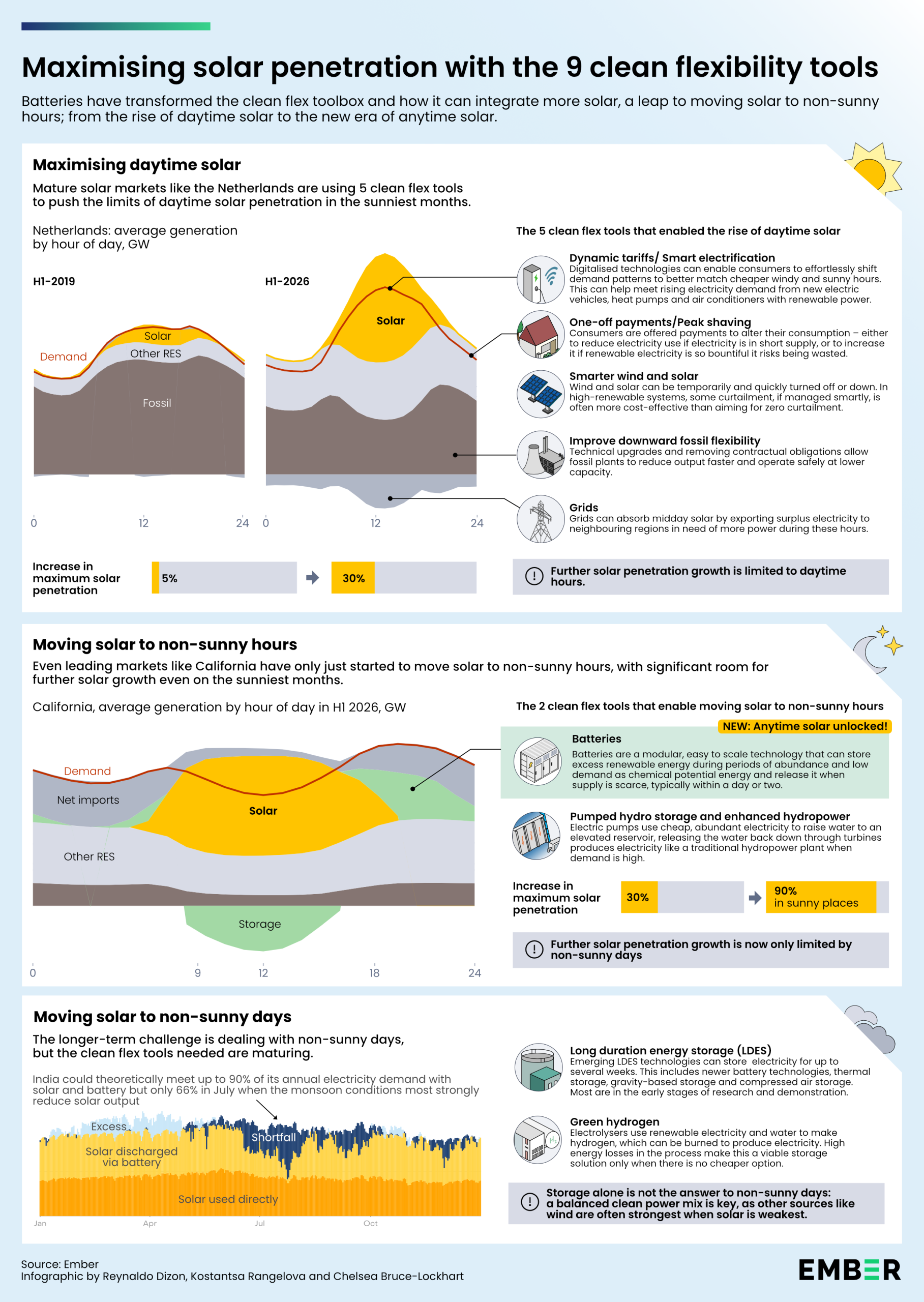
Solar’s rise to 10% of global electricity has so far been driven by markets maximising daytime solar. The mature markets leading this push are running into the limits of how much more their systems can absorb at midday as rising negative prices, curtailment and falling solar capture rates become more common. The impact is already showing in deployment. In 2025, EU solar installations fell 0.7% to 65.1 GW, the first decline in a decade.

There is still room for midday solar to grow. Markets where solar supplied more than 20% of electricity, such as the Netherlands, accounted for just 6% of global power in H1 2026, and even there, clean flexibility tools like dynamic tariffs are far from maximised. For instance, Ember estimates that smart EV charging alone could absorb around 8% of peak hourly wind and utility solar generation in the Netherlands by 2030.

The emergence of lithium iron phosphate (LFP) has transformed the economics of storage. Global average installed costs fell by 95% from $2,634/kWh in 2010 to just $140/kWh in 2025, while performance, safety and cycle life all improved. Battery storage is now an economically viable tool that can scale globally and move cheap daytime solar into non-sunny hours. In doing so, it removes solar’s daily limit and expands its role in the power system.

With batteries, sunny places like India or Mexico could theoretically meet up to 90% of their electricity demand with solar and batteries efficiently. Closing the gap to 100% remains challenging due to cloudy days and in less sunny places – seasonal lulls such as Europe’s winter Dunkelflaute, when low wind and sun for days on end leave batteries with little surplus to charge on.

Currently batteries are only economical for daily cycling, but as they become cheaper, longer durations are becoming increasingly viable. Meanwhile, other long-duration storage technologies are emerging, and a balanced clean power mix remains essential: wind is often strongest when solar is weakest. In practice, most power systems will rely on a balanced mix of complementary resources, with wind, hydro, nuclear and long-duration storage all playing an important role alongside solar.

Chapter 2: The new era of anytime solar

Batteries have unlocked the era of anytime solar

Battery deployment is catching up with solar growth faster than expected, and leading markets are already meeting a large share of their evening demand with solar and batteries.

In less than five years, batteries have evolved from a niche technology into a mainstream solution. Around a quarter of new utility-scale solar capacity deployed globally in 2025 was co-located with batteries. Markets with almost no storage just three years ago, like Chile and Bulgaria, have become global leaders relative to the size of their power systems. But deployment is not enough, batteries transform power systems only where market design allows them to work to their full potential.

2.1 Batteries deployed in 2026 could shift over a third of new daily solar generation

Global battery deployment is surging and quickly catching up with solar growth. Ember estimates that battery additions expected in 2026 could shift over a third (34%) of new daily solar generation (based on H1 2026 solar growth), up from 18% in 2025 and just 4% five years ago in 2021. This means that up to 34% of the new solar generation so far this year could be shifted to the evening, if all batteries were used to shift solar.

Battery additions are expected to reach 459 GWh in 2026, up 50% from 307 GWh in 2025. Slowing solar growth has helped batteries catch up faster. Global solar generation grew 18% in H1 2026, below 20% for the first time this decade. New solar installations in China have eased after a record rush in 2025, while EU solar deployment contracted for the first time in a decade as increasingly saturated middays slowed growth. Solar remains the cheapest source of new power across most of the world, but mature markets are increasingly constrained by how much additional generation they can absorb during the middle of the day.

By shifting cheap daytime solar into the non-sunny hours, batteries remove that constraint, creating the conditions for solar growth to accelerate again.

In practice, many batteries remain underutilised

The estimate that batteries could shift 34% of new daily solar generation represents a theoretical ceiling. In practice, not every battery is used to shift solar to non-sunny hours and many remain underutilised.

Even batteries built for energy shifting are often prevented from operating at their full potential. BNEF classifies batteries by their primary application, and on this basis 74% of all batteries installed in 2025 were used for energy shifting, up from 47% in 2020. In practice, batteries are a powerful multitool and if fully utilised to their potential, they can stack revenues across energy arbitrage, ancillary services and capacity payments. Realising this value depends on market design. Where batteries can access multiple revenue streams and co-optimise across markets, they are used more efficiently.

China illustrates the challenge. Despite being the world’s largest battery market, much of its battery fleet remains underused as regulatory reforms continue to open additional revenue streams. Standalone batteries cycled an average of 299 times in 2025, up from 146 cycles in 2022 but still well below international best practice of around 350 cycles a year. Meanwhile, co-located batteries cycled even less, averaging just 199 times in 2025.

2.2 Leading battery markets could shift over half of new daily solar generation

While batteries deployed globally in 2025 could shift just 18% of new daily solar generation, several countries are much further ahead. Bulgaria (77%) and Chile (76%) added enough battery capacity to shift more than three-quarters of their new daily solar generation into non-sunny hours, followed by Australia (60%).

Bulgaria illustrates how quickly battery deployment can scale. It added around 3 GWh of new battery capacity in 2025, up from virtually none the previous year, supported by government financial support and fast permitting. By May 2026, installed battery capacity in Bulgaria more than doubled to reach 8.6 GWh, with further growth expected through 2030.

Chile followed a similar trajectory, adding 4 GWh of batteries in 2025, more than doubling its installed capacity to 7.6 GWh in 2025. Most of this new storage was co-located with solar plants, helping reduce curtailment and shift solar generation into evening.

The US added 58 GWh of battery additions in 2025, enough to shift around a quarter of new solar generation. Within the US, however, California stands out by adding more battery capacity than solar since 2021.

The EU remains behind the global leaders. Its 27 GWh of battery additions in 2025 were enough to shift just 16% of new solar generation, below the global average. The latest EU grid operators’ scenarios, however, expect EU-installed battery capacity to grow fourfold between 2025 and 2030, with growth across all EU countries.

2.3 Batteries are already moving solar to non-sunny hours in leading markets

The strong battery build-out in leading markets is already transforming power systems. Compared with H1 2023, solar plus batteries supplied a much larger share of electricity during the non-sunny hours in H1 2026, visibly extending solar in the non-sunny hours.

California, a leading battery market globally, illustrates the scale of this shift. On the average day in H1 2026, solar plus batteries met more than a quarter of electricity demand in the evening (7-9pm), up from just 6.8% in H1 2023.

Chile and Bulgaria have seen an even more dramatic transformation. In H1 2023, solar contributed virtually nothing during the evening in both these countries. By H1-2026, batteries were helping solar meet over 10% of Chile’s electricity demand through the evening and well into midnight. Bulgaria saw the largest transformation, with very strong solar growth, most of which was delivered in non-sunny hours. As a result, solar plus batteries consistently met nearly a quarter (24%) of Bulgaria’s electricity demand in the evening (7-9pm) and averaged 10% of demand between 7 pm and 7 am.

2.4 The era of anytime solar has begun

Solar’s record 10% share of global electricity was built almost entirely in the daytime hours. As midday solar has expanded, the first signs of strain have emerged in more mature markets, with negative prices, curtailment and slowing deployment.

Batteries mean solar is no longer limited by the hours of sunshine alone. As markets adapt and storage scales further, the pace of solar growth will increasingly depend on how effectively power systems can integrate and use that flexibility.

The next phase of solar growth will depend on more than installing additional batteries. Markets also need to ensure batteries can participate fully across electricity markets, so they are used where they deliver the greatest value. Where deployment is matched by effective market design, batteries can increase the use of cheap solar generation, reduce reliance on fossil fuels during the evening and strengthen the business case for continued solar expansion.

The era of anytime solar has begun. The pace at which it spreads will now depend less on the cost of solar itself and more on how quickly batteries are deployed and integrated into power systems.

Supporting materials

Methodology

World solar share by hour of day

The world profile of hourly solar share of demand is built bottom-up from national hourly generation and demand data for 14 countries accounting for 82% of global solar generation. Within this group, China’s hourly shape is estimated from representative profiles, scaled to match its actual solar share of demand in Ember’s monthly data. Countries representing the remaining 18% of global solar enter at their actual monthly solar generation, distributed across the day using regional average profiles: the average of profiled European countries for the rest of Europe, and the average of all profiled countries elsewhere. Profiles are aligned on local time.

Bulgaria: estimating standalone battery output

ENTSO-E’s solar category for Bulgaria includes charging and discharging of batteries co-located with solar plants, visible as reported solar generation does not show a pronounced midday peak and shows a pronounced rebound in 8-9 pm. Standalone battery activity is not reported as a separate category and is therefore estimated based on the difference between reported hourly load and the implied load (total generation plus net imports). A negative residual indicates unreported storage charging, including from batteries and from pumped hydro, a positive residual indicates battery discharging (pumped hydro discharge is reported and included in total generation, so only pumped hydro charging remains “hidden” in the residual). The raw residual also contains structural reporting bias. This was removed by subtracting the residual’s monthly average, which preserves intraday cycling.

Reported pumped-hydro generation was used to separate pumped storage from batteries. The resulting solar-plus-batteries total captures both co-located and standalone batteries.

Acknowledgements

Contributors

Ember: Dave Jones, Beatrice Petrovich, Duttatreya Das, Nicolas Fulghum, Rashmi Mishra, Reynaldo Dizon, Chelsea Bruce-Lockhart, Ardhi Arsala Rahmani

Cover image

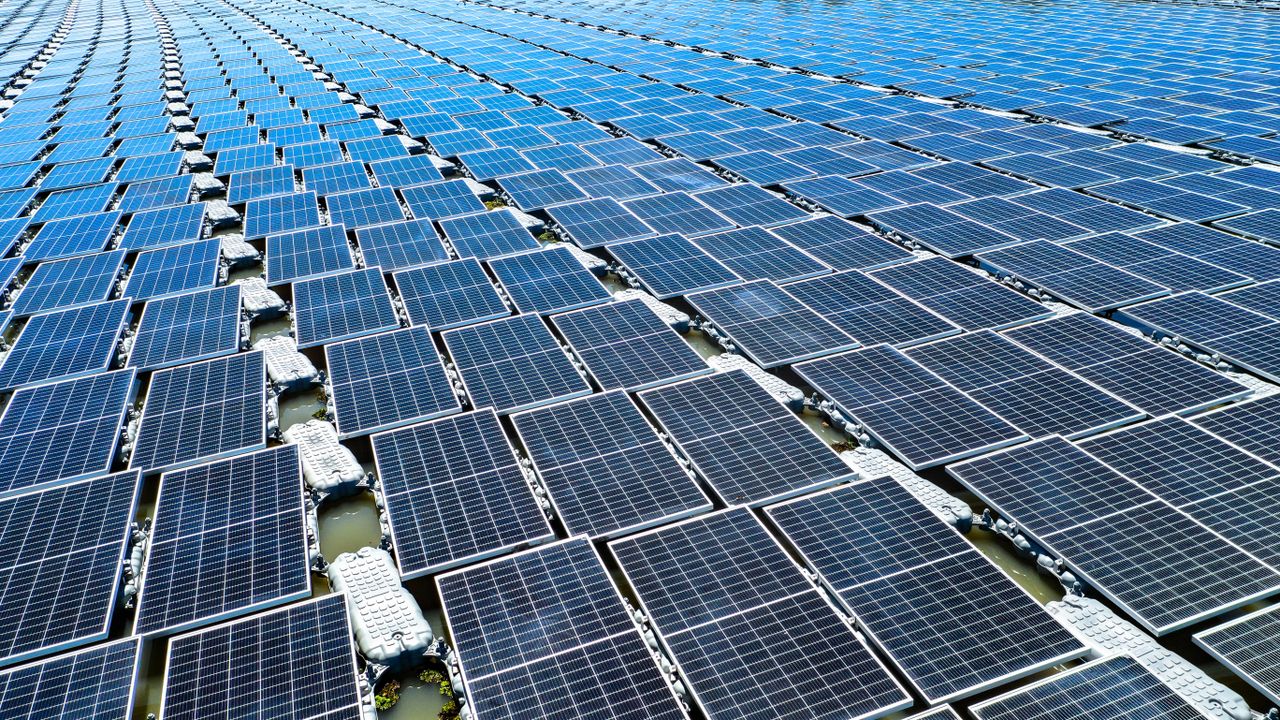
An elevated aerial shot showing a solar panel installation and mini battery facility in a rural island village in Malaysia. The site features ground-mounted solar panels, utility buildings, a communications tower, tropical tree cover, and views of neighboring islands across the water.

Credit: Cn0ra / Getty Images

Share