

China’s central role in the cleantech revolution
Ember Current – October 2025 Newsletter

In June I travelled to Beijing to sit down with industry experts, who shared invaluable insights on China’s energy transition. The message was clear, and reinforced by Ember analysis: China’s fossil fuel use is plateauing while clean technologies are surging, signalling a deeper shift in the country’s growth model. The transition they described is no longer abstract. Clean tech is becoming accessible, affordable and visible in daily life. Even my parents in Tianjin recently swapped their old car for an EV!
After joining Ember in April, one of my first projects was coauthoring our inaugural China Energy Transition Review – a new, annual report which debuted last month. The report fills a gap in understanding on the drivers of China’s energy transition and what this means for the rest of the world. It was an ambitious task for the team to take on such a complex topic, and I couldn’t have asked for a better way to kick off my time here.
With that, let’s dive into the rest of this month’s updates.
Seeing this newsletter for the first time? Scroll to the bottom of this page to subscribe and get Ember Current monthly – directly to your inbox!
Insights, analyses and commentaries
My Top Picks for September
China’s energy transition and the rapid growth of its clean energy technology industry have far-reaching global implications. Notably, the increasing accessibility of these technologies is accelerating clean energy adoption in emerging economies. Exports of Chinese solar panels to Africa illustrate a significant solar uptake across the continent. And around the world, electrification is reshaping energy economics and geopolitical dynamics.
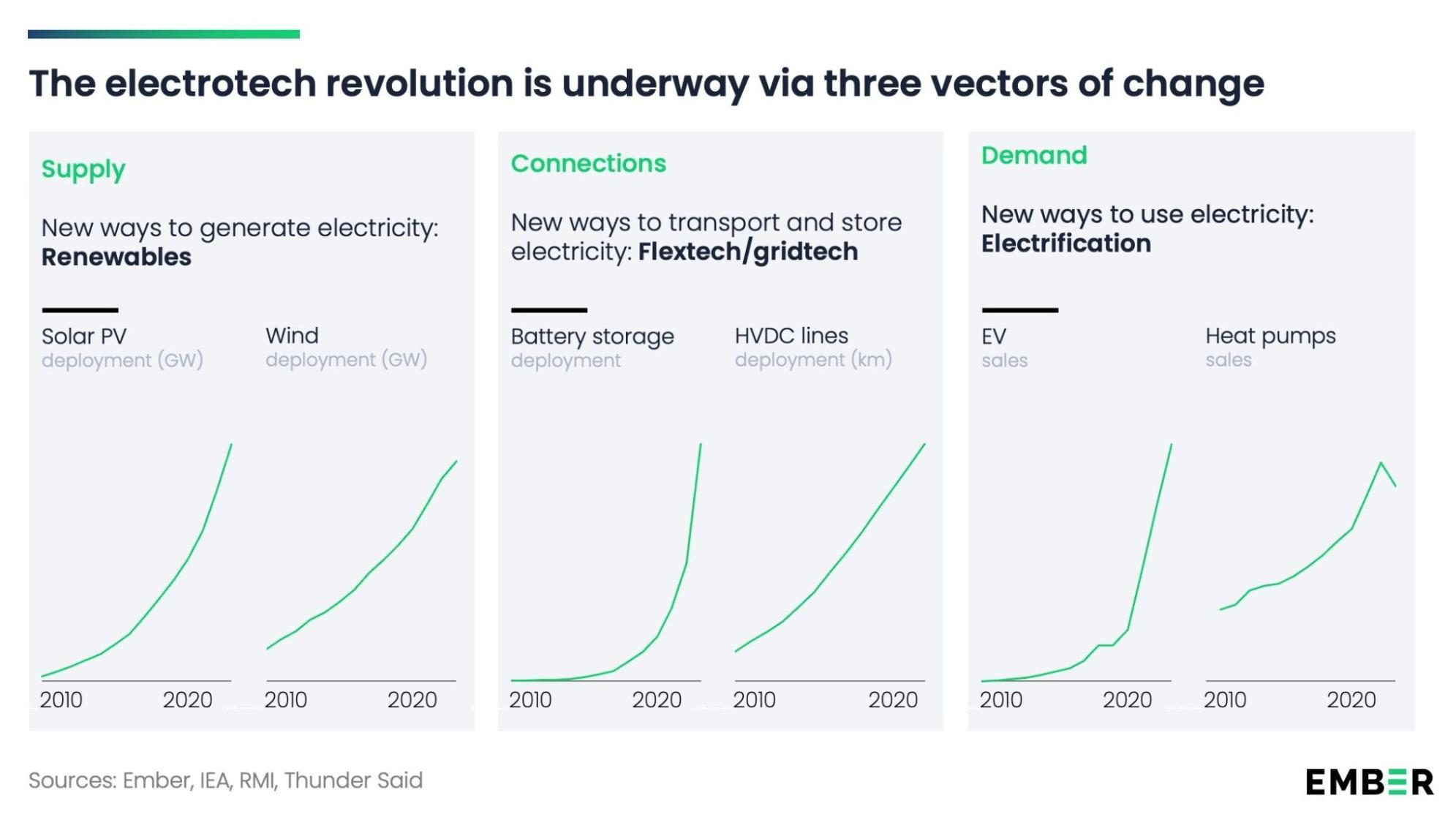
The Electrotech Revolution
The electrotech revolution is the most profound transformation of the energy system since the shift from biomass to fossil fuels in the 18th century. As electrotech becomes increasingly affordable with exponential growth, a century of evolution is converging into a decade of revolution.
Turning to the sun: Solar rise in Central Europe
Solar power in Central Europe has grown at twice the EU average pace for the last five years. The region historically dependent on coal is becoming Europe’s solar powerhouse and hub for battery technology.

The first evidence of a take-off in solar in Africa
We have seen a major pick-up in solar panel imports into Africa over the last 12 months – a shift that is likely to impact almost every country across the continent.

There’s more! Here’s what else we published last month
- Thailand’s cost-optimal pathway to a sustainable economy | Read the Report
- Reducing curtailment in Chile: key to unlocking the full potential of renewable energy | Read the Report
- New lines of defence: how interconnectors keep the lights on | Read the Report
- Falling battery costs can unleash Mexico’s full solar potential and boost energy security | Read the Report
- Wind and solar generate over a third of Brazil’s electricity for the first month on record | Read the Report
- Hidden impact of Australian coking coal in steelmaking | Read the Report
Ember in the news
- China Is the Engine’ Driving Nations Away From Fossil Fuels, Report Says | The New York Times
- Why our clean-energy future depends on emerging economies | Reuters
- Wind and solar power fuel over one-third of Brazil’s electricity for first time | AP
- Power Up: How Clean Energy Is Putting Fossil Fuel Demand in Doubt | Read More
What I’m reading
- The electrification of everything | Financial Times
- Green and intelligent: the role of AI in the climate transition | Nature
- Humans Are Altering the Seas. Here’s What the Future Ocean Might Look Like | The New York Times
Visual storytelling corner
Chart of the month
This chart captures a turning point in China’s power transition: wind and solar are no longer peripheral, but central to provincial electricity systems. In 2024, seven provinces generated over a quarter of their electricity from these sources—with Qinghai at 46%, Gansu at 36% and Jilin at 33% leading the way—surpassing the EU average (29%) in most cases. What makes this important is not just the scale of deployment, but the system integration behind it. The focus has shifted from adding capacity to building a “new electricity system” able to balance high shares of renewables. Fittingly, this very graphic inspired the cover of Ember’s China Energy Transition Review 2025.
Turning data into action
Data highlights

Data on China’s cleantech exports provide early insight into the progress of the energy transition around the world. Launched today, this tool allows you to explore detailed data by technology type, country and region.
Compare the continent’s plans for expanding its interconnection capacity by country for 2024, 2030 and 2040.

Together these sources accounted for 2.77 TWh, which is more than half of Greece’s electricity generation in August 2025.

In the last 12 months solar panel imports from China increased by 60% to 15,032 MW. Check it out yourself in our China Solar PV Export Explorer.
Country spotlight
Brazil’s electricity mix is shifting as solar and wind continue to grow rapidly. Solar’s share grew sixfold between August 2020 and August 2025 to 13%, while wind rose from 15% to 21%. Together, they supplied 24% of power in 2024, up from 9.9% in 2019. While hydro remains Brazil’s largest electricity source at 48%, it increasingly functions less as base load and more as a provider of dispatchable generation to complement variable renewable output.

Ember Current is a revamp of an existing monthly newsletter delivered to our subscribers. Ember Current is written by a different one of our analysts each month, bringing you their own top picks of Ember’s insights and a little window into what has felt important to them over the course of the last few weeks. If you want to receive these updates each month, scroll to the bottom of this page and sign up! For queries and feedback, please reach out to [email protected].
Featured image credits
Xinhua / Alamy Stock Photo
Acknowledgements
Claire Kaelin, Biqing Yang, Tito Das, Leonard Heberer, Reynaldo Dizon, Sachin Sreejith, Chelsea Bruce-Lockhart