Türkiye generated $500 million in exports through interconnections in 20 months
Türkiye has an opportunity to become a key hub in the regional clean electricity transition. Record power export revenue in 2025, new regional interconnection projects and electricity shortages in neighbouring countries provide a strong foundation, while Türkiye’s renewable energy ambitions offer potential to scale up clean electricity trade.
Available in: Türkçe
10 Nov 2026
9 Minutes Read

Türkiye is establishing itself as a regional power exporter, but its exports remain well below their potential. Deeper regional cooperation in electricity trade can strengthen energy security, diversify supply and generate additional revenue, positioning Türkiye as a strategic hub in the region’s clean energy transition.
With targeted interconnection plans and stronger regional cooperation, Türkiye can build on its growing electricity exports and renewable energy ambitions to become a key hub in clean energy. As the host of COP31, it has a unique opportunity to bring neighbouring countries together to strengthen cross-border electricity trade, enhance energy security, diversify supply and accelerate the shift towards a cleaner, more affordable energy future.
Key takeaways
01
Türkiye generated more than half a billion US dollar revenue from power exports since the beginning of 2025.
More than half of this came from rising exports to its southern neighbours, Iraq and Syria. In particular, 4 TWh of total power exports in 2025 generated a record level of annual revenue.
02
Türkiye has interconnections with all of its neighbours, but much of this cross-border links remains underutilised.
Türkiye has 2 GW of import capacity and 3.2 GW of export capacity, of which 1.35 GW and 2.6 GW respectively are operational in 2025. Total interconnection capacity could theoretically have supported 28 TWh of electricity exports, equivalent to seven times actual exports.
03
With 43% of its electricity from renewables in 2025 and plans to triple wind and solar capacity by 2035, Türkiye could become a regional clean power hub.
Its southeastern neighbours still rely on fossil fuels for 89–98% of their electricity generation. Regional electricity trade can strengthen energy security by diversifying energy sources. To realise this, Türkiye’s interconnection plans need to be translated into country-specific targets.
Power exports have generated $0.5 billion USD since January 2025
Türkiye’s primary electricity trade partners in the 2010s were Bulgaria and Greece. Bulgaria was the main source of imports, while Greece was Türkiye’s largest export destination. In recent years, however, the structure of Türkiye’s electricity trade has changed markedly.
Until 2022, Türkiye’s power exports to Greece fluctuated between 2 and 3 TWh annually. This volume declined sharply thereafter, falling to 0.7 TWh in 2024 and just 0.5 TWh in 2025. Supported by a growing share of renewable energy in its generation mix, Greece became a net electricity exporter in 2024, a trend that continued into 2025. Greece’s electricity exports generated nearly $1 billion USD in revenue that year.
Despite the contraction in exports to Greece, Türkiye’s total electricity exports reached nearly 4 TWh in 2025, driven by rising exports to its southern neighbours, Iraq and Syria.
Following the reopening of the 300 MW interconnection with Iraq in July 2024, Türkiye exported electricity at close to full capacity through the end of the year. In 2025, operational interconnection capacity was doubled, further boosting exports and making Iraq Türkiye’s largest electricity export partner that year. However, electricity exports to Iraq were suspended in late August 2025 due to payment arrears, bringing exports to almost a halt. A year after the suspension, electricity exports to Iraq resumed in May 2026 and reached almost the full interconnection capacity by August 2026.
Syria has also become an important new export destination, as infrastructure and political conditions have improved. Türkiye’s exports to Syria have remained steady at around 1 TWh annually in recent years.
Türkiye’s electricity export revenues reached a record $360 million USD in 2025. Including the first eight months of 2026, cumulative revenues reached $500 million USD over 20 months.
On the import side, Türkiye historically imported around 1–2 TWh annually from Bulgaria between 2017 and 2023. Since 2024, however, Türkiye has been a net exporter to Bulgaria. Over the course of the first seven months in 2026, Türkiye exported 1.2 TWh to Bulgaria, while imports were around 0.1 TWh.
Since 2021, Georgia has emerged as a major electricity import partner for Türkiye. Total power imports through the Georgian interconnection slightly exceeded 13 TWh since 2021. However, this line also functions as a transit corridor for electricity from countries without a direct operational connection to Türkiye. This figure therefore includes electricity originating from Azerbaijan, Armenia and Russia. Azerbaijan accounts for the largest share of these flows. Between 2021 and 2025, Türkiye imported around 8 TWh of electricity from Azerbaijan via the Georgia interconnection, with most of the remainder consisting of direct imports from Georgia.
Türkiye’s overall electricity imports remained around 2 TWh annually in recent years, with the notable exceptions of 2022 and 2023. In each of these years, imports reached around 6 TWh. Türkiye eased the impact of the 2022–2023 energy crisis, when fossil fuel prices soared after Russia’s invasion of Ukraine, by importing cheaper electricity through its interconnection with Georgia. While the electricity prices in Türkiye reached as high as $200 per MWh, the average price of power imports was around $100 per MWh.
These developments highlight the importance of interconnection diversity in the electricity trade. Rising exports to Iraq and Syria offset the decline in exports to Greece, while imports through Georgia cushioned the 2022–2023 energy crisis. Since export and import opportunities shift across countries with changing supply and demand conditions, being connected to more markets increases flexibility and resilience.
Türkiye is linked to all neighbours, though connections are not fully utilised
Since April 2015, Türkiye’s power grid has been synchronised with the Continental European network (ENTSO-E), enabling real-time electricity exchange with Greece and Bulgaria. With non-synchronous countries, cross-border trade is conducted either through high-voltage direct current (HVDC) converter stations, as in the cases of Georgia and Iran, or through isolated regional arrangements, as with Iraq and Syria. In such configurations, an interconnection can supply an isolated region even if the rest of the country faces electricity shortages, as has been the case in northwestern Syria, which Türkiye has supplied.
Türkiye’s interconnections span three regions: Europe, the Caucasus and the Middle East.
On the European side, the interconnection with Bulgaria has a net transfer capacity of 434 MW for imports and 334 MW for exports. Türkiye’s interconnection with Greece has a net transfer capacity of 216 MW for imports and 166 MW for exports. In total Türkiye’s net transfer capacity to the European network is set at 650 MW for imports and 500 MW for exports.
In the Caucasus, Türkiye’s only operational interconnection is with Georgia. The 700 MW Georgia interconnector can operate in both directions. Türkiye does not have a direct connection to mainland Azerbaijan’s electricity grid. Its only link with Azerbaijan is through the Nakhchivan region, but this interconnection is not yet operational. In 2025, TEİAŞ and Azerbaijan’s transmission system operator, Azerenerji, signed an agreement to activate this line, which has a capacity of 75 MW for imports and 40 MW for exports.
Türkiye is also physically interconnected with Armenia through the Kars–Gyumri transmission line. However, the line remains inactive, with no transfer capacity currently available. Recently, the two countries have initiated discussions on reactivating the interconnection.
To the south, Türkiye maintains three operational interconnections with Syria, with a combined capacity of 300 MW, all operating from Türkiye to Syria only. A separate 500 MW interconnection between Birecik (Türkiye) and Aleppo (Syria) only returned to operation in September 2026.
In 2024 and 2025, Türkiye also restored its interconnection capacity with Iraq in two phases. The connection is currently capable of operating at up to 600 MW in the Türkiye–to–Iraq direction.
An operational agreement for the Türkiye–Iran interconnection was signed in 2024, although the line has not yet been activated. The Türkiye–Iran interconnection has a capacity of 600 MW in both directions.
Overall, Türkiye possesses substantial interconnection capacity that is technically available but remains underutilised due to financial, regulatory and political constraints. Power exports reached a record 4 TWh in 2025; however, interconnections have the technical potential to support more than 28 TWh of annual exports if fully utilised.
Türkiye’s interconnection plan needs country-specific targets
Türkiye’s operational cross-border capacity totals 1.35 GW for imports and 2.6 GW for exports, including the recently reactivated Aleppo interconnector. Including non-operational links, total interconnection capacity amounts to 2 GW for imports and 3.2 GW for exports. According to TEİAŞ’s latest strategic plan, substantial growth is projected by 2028, with export capacity planned to reach 4.6 GW and import capacity 4 GW. However, the plan does not specify country-level interconnection targets.
Türkiye’s latest long-term climate strategy further outlines a plan to expand export interconnection capacity to 6.75 GW by 2035, while import capacity is planned to reach 6.6 GW over the same period. Yet, similar to TEİAŞ’s strategic plan, the climate strategy also lacks clarity on which specific countries will host these new links.
In spring 2026, high renewable generation driven largely by hydropower contributed to record-low wholesale electricity prices in Türkiye. Stronger interconnection would allow Türkiye to export surplus renewable electricity instead of curtailing generation or selling it at very low prices, increasing its economic value and creating additional export revenue. At the same time, access to Türkiye’s surplus electricity could help alleviate supply shortages in neighbouring countries and displace fossil-fuel-based generation, strengthening energy security across the region.
As a bridge between Europe, Central Asia and the Middle East, Türkiye is uniquely positioned with extensive interconnection opportunities and access to a heterogeneous set of regional power systems, each with distinct electricity mixes, renewable energy potentials and demand profiles. Ongoing regional initiatives aimed at strengthening grid connectivity further enhance Türkiye’s potential role as a central hub in an emerging regional electricity network.
Caucasus: strengthening Türkiye-Azerbaijan ties is strategic
The Caucasus represents the most immediate and strategic option for Türkiye to expand its electricity grid. Türkiye’s close political and cultural ties with Azerbaijan and Central Asia could be translated into deeper regional energy cooperation. In this context, Azerbaijan is already developing a grid connection to the Nakhchivan through the Zangezur region, which would serve as a first step toward directly linking mainland Azerbaijan with Türkiye.
Stronger interconnection with Azerbaijan would also indirectly connect Türkiye to Central Asian power systems. The Caspian Green Energy Corridor, which aims to link Azerbaijan, Uzbekistan and Kazakhstan, has the potential to extend electricity trade from Central Asia to Türkiye. The project is currently under feasibility assessment, with support from the Asian Development Bank and the Asian Infrastructure Investment Bank.
Beyond bilateral projects, the region has broader ambitions to improve internal connectivity. The World Bank is currently supporting initiatives to boost energy integration across Central Asia by expanding total interconnection capacity to 16 GW, up from around 4.5 GW today.
Europe: Türkiye could provide land route to connect with the Caucasus
As Türkiye is synchronised with the Continental European grid, future interconnection developments must be closely aligned with ENTSO-E. ENTSO-E’s latest Ten-Year Network Development Plan envisions expansion on the Türkiye front. Under this plan, a second Türkiye-Greece interconnection is scheduled for commissioning by 2031, while a new Bulgaria-Türkiye interconnection is under consideration for potential operation by 2035.
Türkiye can offer a land-based alternative to the Black Sea Submarine Cable Project, which aims to connect Europe with the Caucasus via undersea links. Such an alternative could reduce costs and project timelines.
In April 2025, Türkiye signed a memorandum of understanding with Azerbaijan, Georgia and Bulgaria under the Green Electricity Transmission and Trade Project, signalling growing interest in multilateral cooperation for clean power trade.
Middle East: Türkiye’s southern neighbours offer major export potential
Türkiye’s southern neighbours represent a significant export opportunity, as the region continues to face chronic electricity shortages. In 2025, Iraq experienced blackouts as early as April, months ahead of the summer demand peak. In summer 2026, Iraq’s peak electricity demand reached a record 60 GW, while available supply fell to just 22 GW, leaving a substantial gap. Rapid demand growth, gas shortages, weak finances and chronic grid losses deepened the shortfall, while reliance on imported Iranian gas left the country vulnerable to supply disruptions.
From early 2025 onward, Iran has also struggled with a prolonged energy crisis, with residential blackouts often exceeding two hours per day. In Syria, most areas continue to receive only two to four hours of electricity per day, reflecting the depth of infrastructure damage and supply constraints.
Electricity from Türkiye’s expanding wind and solar fleet could help alleviate chronic electricity shortages across the region while reducing the region’s reliance on gas- and oil-fired generation.
Türkiye can also explore opportunities to extend its electricity connections further into the south. An ambitious proposal envisages linking its grid to Saudi Arabia through Syria and Jordan. If developed, such a corridor could expand the geographical reach of regional electricity trade and create additional opportunities for cooperation between Türkiye and Gulf electricity markets.
Türkiye can evolve into a regional clean energy hub
Despite evolving regional relationships and ambitious national plans, Türkiye’s current cross-border transmission capacity remains modest relative to its geopolitical potential. The lack of clearly defined, country-specific interconnection strategies risks reducing long-term targets to abstract numbers, rather than actionable infrastructure pathways.
With the right combination of investment, regulatory alignment and regional diplomacy, Türkiye could anchor a new architecture of regional electricity trade. This would not only enhance energy security across neighbouring countries but also facilitate the integration of higher shares of renewable energy.
With 43% renewables in its electricity mix and an ambitious plan to triple wind and solar capacity by 2035, Türkiye is well positioned to act as both a clean power supplier and a regional system integrator. In contrast, many of its southern and eastern neighbours still rely on fossil fuels for 89–98% of power generation, reinforcing Türkiye’s potential role as a regional leader in the clean energy transition.
Supporting materials
Downloads
Download the full analysis.
Methodology
TEİAŞ statistics were used for electricity imports and exports up to 2025, while monthly EPDK reports were used for 2026. Export revenues were based on the “Elektrik Enerjisi” item in TURKSTAT’s Foreign Trade Statistics database. Capacity data for interconnections were compiled from publicly available sources.
Acknowledgements
Contributors
Burcu Ünal Kurban, Reynaldo Dizon, Izabela Urbańska Medina, Sachin Sreejith.
Cover image
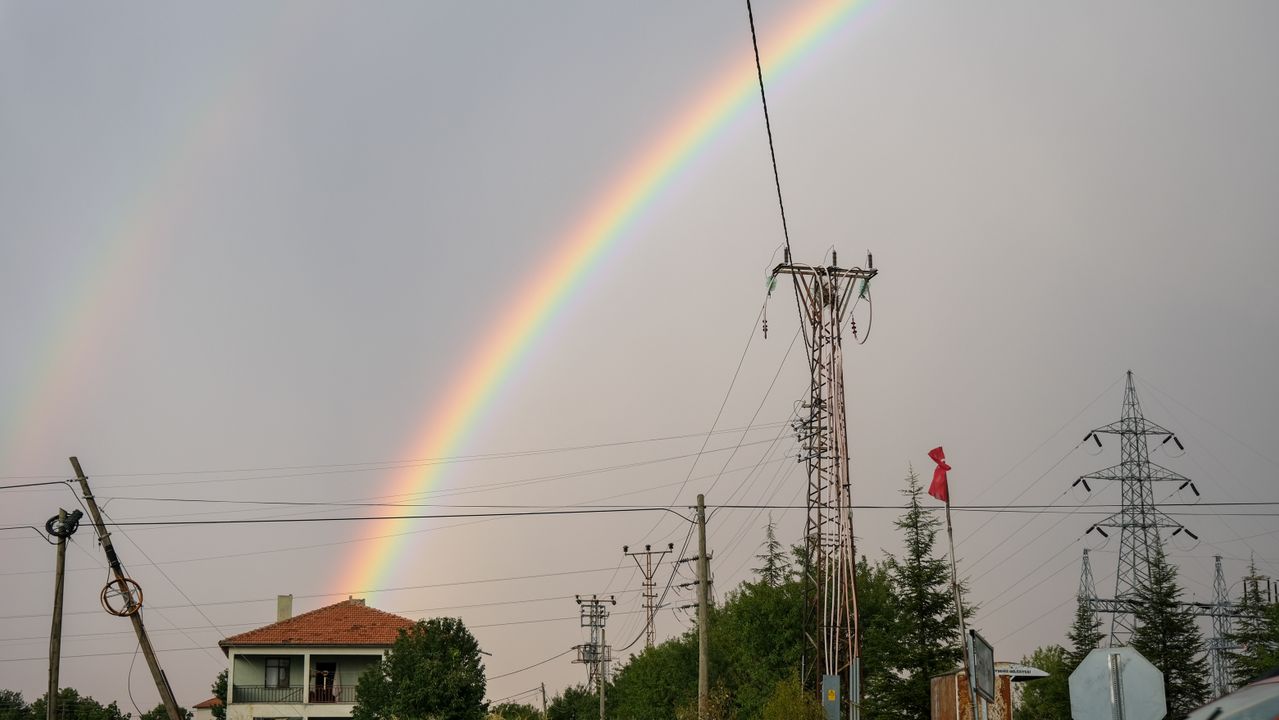
A rainbow arches across an overcast sky behind electricity transmission towers, utility poles, and a residential house in rural Türkiye.
Credit: Ahmet Çiftçi / Pexels