Manufacturing: strong in electrotech, but exporting more than three times as much fossil fuel equipment
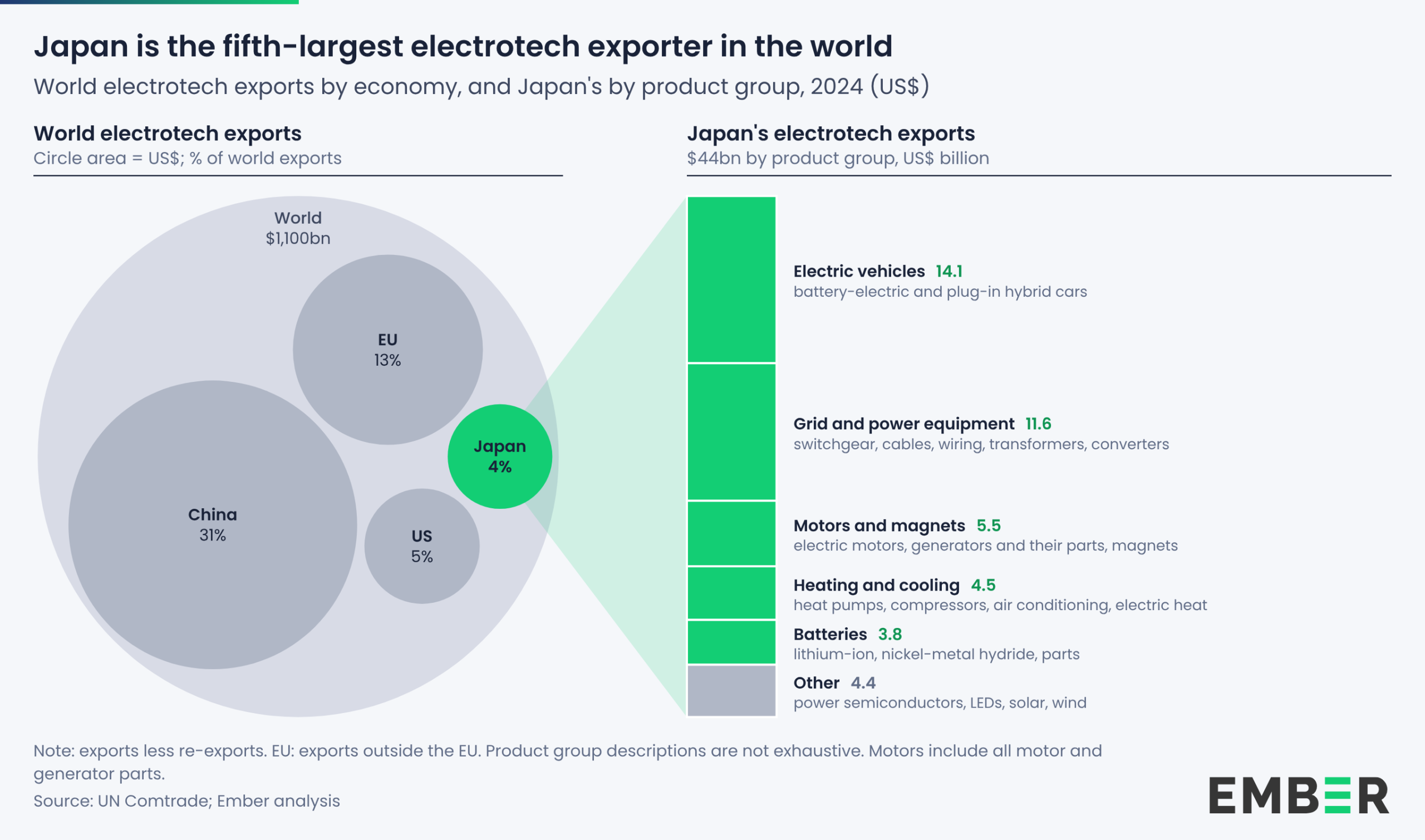
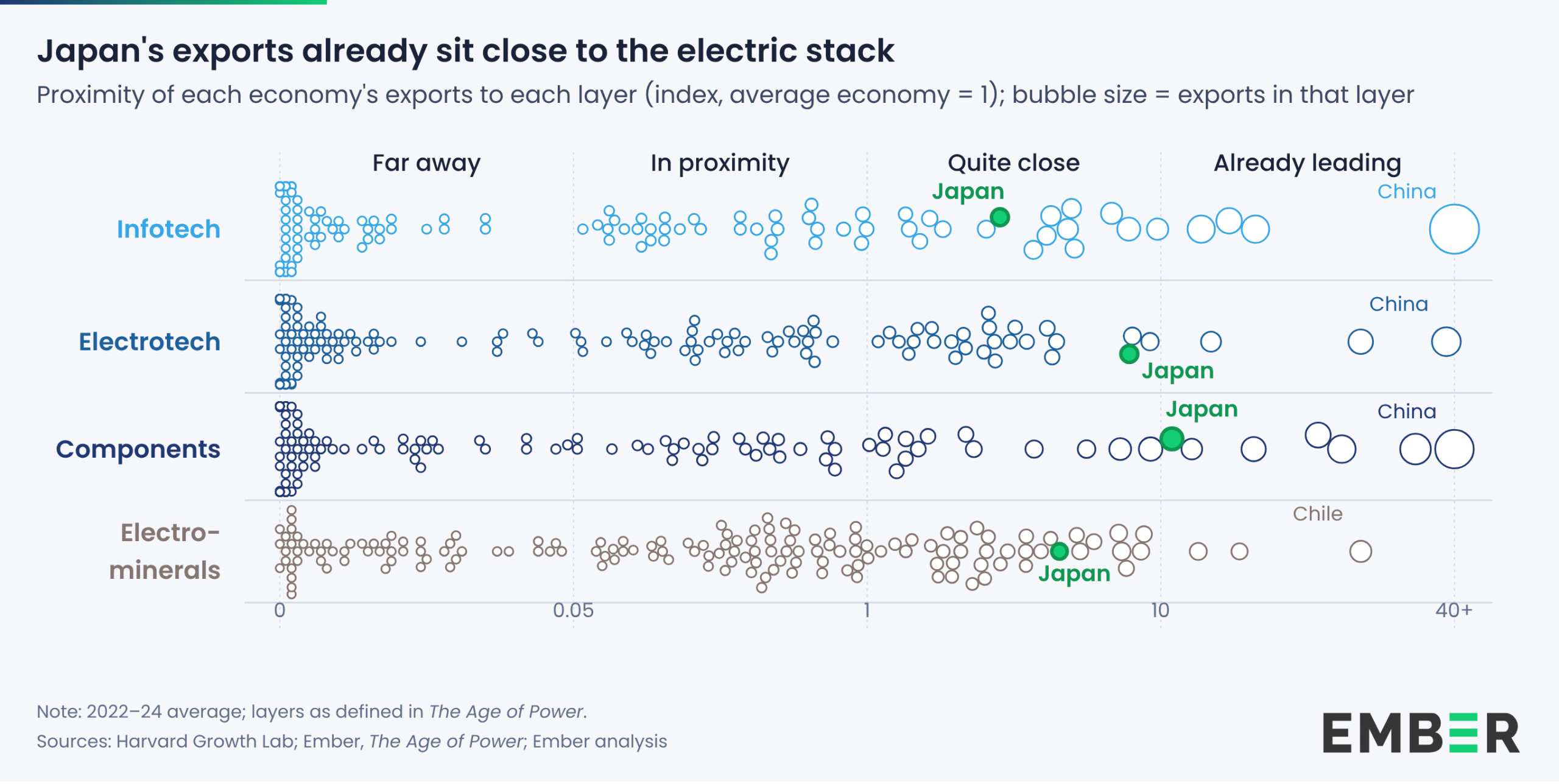
Japan is, of course, a world leader in advanced manufacturing. In 2024, it exported $44 billion of electrotech, led by electric vehicles ($14 billion) and grid equipment ($12 billion) – the fifth-largest total in the world, behind China, Germany, the United States and Mexico. It is also a top-ten exporter of IT and electronics, chips and refined minerals. Measured by how close its exports sit to each layer of the electric stack, it ranks sixth of 157 economies for electrotech and seventh for components.
Its companies lead in many areas. Murata makes about 40% of the tiny capacitors inside every phone and car, Fanuc and Yaskawa are global leaders in industrial robots, Hitachi and Mitsubishi Electric are major grid suppliers, and Daikin sells heat pumps around the world. Japan also pioneered perovskite, a thin, flexible solar cell, and is targeting 20 GW by 2040. But leadership is uneven. Panasonic’s share of EV batteries has slipped to about 4% as Chinese and Korean makers scaled up, and Nidec is pulling out of EV drivetrains after heavy losses. Japan’s carmakers are on the same slide. Since 2019 their share of global car sales has fallen from 31% to 26%, and their sales in China have dropped by a third. Even in Southeast Asia, long their stronghold, they are rapidly losing ground to Chinese EVs.
More widely, Japan’s electrotech strength is still overshadowed by its fossil fuel equipment makers. In 2024, Japan exported $161 billion of fossil fuel kit, including $64 billion of engine cars, $30 billion of hybrids and $24 billion of engines and parts. This is the core business of Japanese carmakers Toyota, Nissan, Honda, Suzuki and their suppliers. Japan sells a quarter of the world’s exported hybrids, but only 7% of its electric cars. On Ember’s rapid-change scenario, in which electrotech keeps winning market share quickly, these exports could fall by about $90 billion by 2035, even if Japan holds its share of world markets. Electrotech is the other side of the ledger. If Japan holds its market share, its electrotech exports could more than double by 2035 – and grow further still if industrial policy helps it win share rather than lose it.